EN
EN  DE
DE  RU
RU  PT
PT  JA
JA  ES
ES  IT
IT 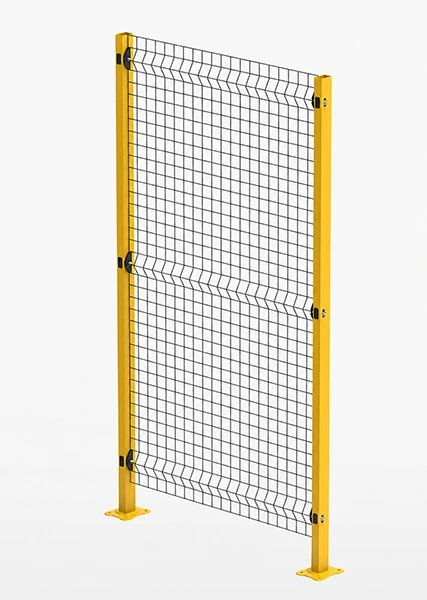
Mefence Clip-Fixed Industrial Safety Fence — Cross-Border Plant Rollout
Multinational Plant Safety Fence Standard: Mefence Clip-Fixed Assembly Replaces Welder Skill Across 25+ Countries
A multinational manufacturer with 100+ plants in 25+ countries cannot let “who welded the perimeter today” decide whether the corporate machine guarding standard survives the audit. Mefence industrial safety fencing swaps site welding for a 3-step clip-fixed assembly using a Q235 frameless 3D welded mesh, so the same installation standard reproduces in Mexico, Vietnam, Czechia and Türkiye without hiring certified welders at every site.

The Cross-Border Installation Problem: When Corporate EHS Depends on Local Welder Skill
Corporate EHS managers write one machine guarding standard, then watch it bend on contact with local reality: in some plants a certified welder is on shift, in others the only available fabricator has been welding for eight months, and in a third the contractor subcontracted the perimeter to a one-person shop. Welded square tube fences, traditional framed guards and chain-link enclosures all share the same weakness — installation quality tracks welder skill, and welder skill is uneven across a 25-country manufacturing footprint. Add a 12-month plant rollout window and the variance becomes an audit finding waiting to happen.
| Specification | Mefence Clip-Fixed Industrial Safety Fence |
|---|---|
| Frame system | Frameless 3D welded mesh — no perimeter frame, no on-site welding required |
| Panel material | Q235 carbon steel, welded wire mesh, powder coated finish |
| Wire diameter | 3 mm or 4 mm options to suit the local impact duty |
| Mesh opening | 20 × 100 mm (default) or 50 × 50 mm (camera/LiDAR-friendly option) |
| Panel size range | 200–1,400 mm width × 200–3,000 mm height — trimmed on site with hand tools |
| Post profile | 40 × 60 mm or 60 × 60 mm yellow powder-coated steel with floor flange |
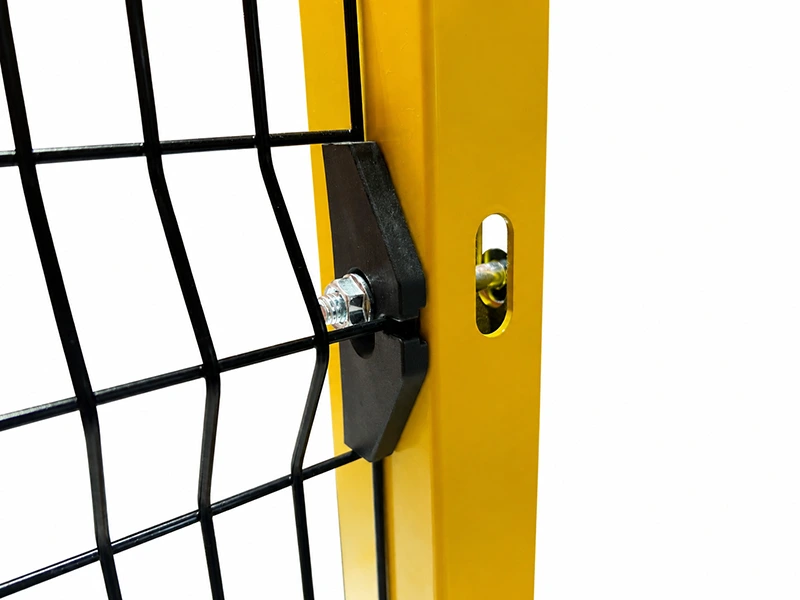
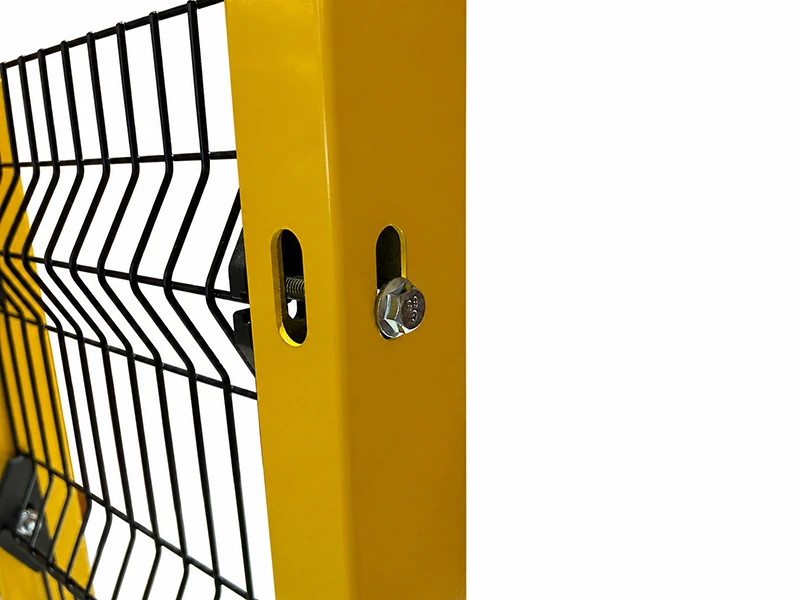
| Fixing method | 3-step clip fixing — panel sits in post slot, plastic clip locks it, no welder, no grinder |
| Installer skill required | Warehouse or facilities maintenance staff — no certified welder license needed at any site |
| Reuse across sites | Modules disassemble and reassemble intact for relocation to the next plant on the rollout plan |
| Compliance anchor | OSHA 1910.212 general industry guarding, ANSI B11.19, ISO 14120 — verified per local audit |
Why Mefence Clip-Fixed Assembly Removes Welder Skill From the Equation
1. Clip-Fix Connection: The Same Three Steps in Every Country
A Mefence connection is a mechanical repeat, not a craft decision. The panel sits inside the slotted yellow steel post, a plastic clip drops into the slot, and the assembly is locked. There is no arc length to set, no preheat to manage, no spatter to grind off, and no weld inspection record to chase. A maintenance technician who has never welded a fence in their life can complete the same three-step clip fix that a contractor in a different time zone will complete next week — and the audit file at both plants will read identically. This is why a Mefence perimeter is the only line item on a cross-border safety spec that does not require a per-country welder qualification matrix.
2. Frameless 3D Welded Mesh: Strength Built at the Factory, Not at the Site
Because every Mefence panel ships from the factory as a folded, factory-welded 3D mesh — the T-shaped ridge pressed into each panel gives it rigidity without a perimeter tube — the only metalwork that ever happens on the customer’s floor is the floor-anchor bolt. There is no site welding step where local skill can drift, no filler metal whose lot certificate has to be re-issued per country, and no hot-work permit that has to be cleared with the plant fire warden before the perimeter can start. The 20 × 100 mm or 50 × 50 mm mesh openings are the same on every continent, and the 3 mm / 4 mm wire diameter is a procurement choice rather than an installation gamble.
3. On-Site Cutting + Modular Reuse: One Spec Travels Across 100+ Plants
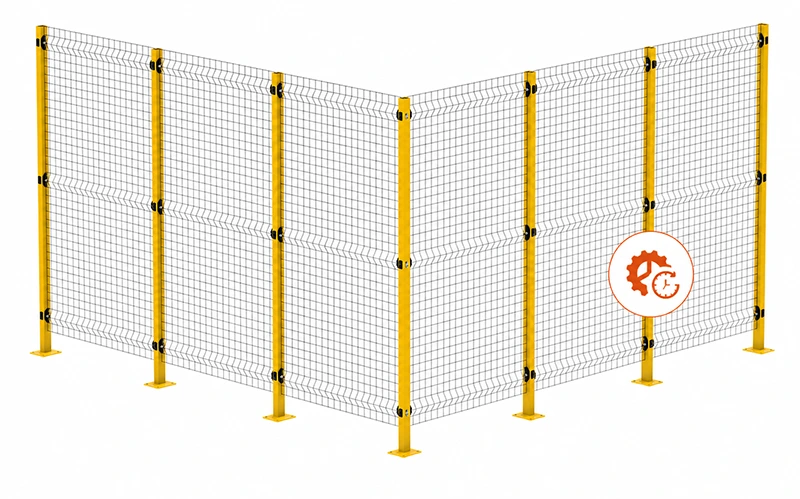
A global rollout rarely has identical floor plans. Mefence panels trim to size with standard hand tools at each site, so the same kit covers the irregular workstation footprints in Querétaro, the conveyor bays in Brno and the robot cell in Pune without a custom fabrication backlog. When the next corporate EHS directive moves a production line, the same Q235 panels and yellow steel posts disassemble and reassemble at the new location — the asset stays on the books as reusable plant equipment instead of being scrapped as sunk-cost welded steel. For a 100-plant network, that modular reuse is what turns a safety capex line into a five-to-ten-year reusable platform.
Where Multinational Plants Use the Same Mefence Standard
- Warehouse zoning and storage area separation across regional distribution hubs
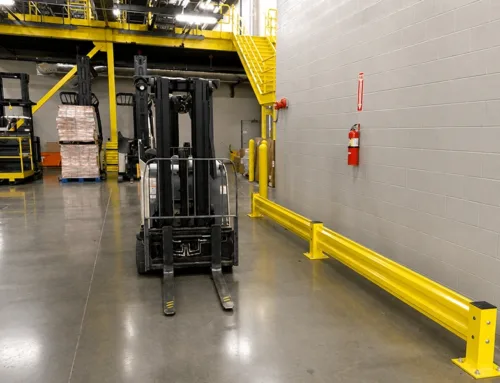
- Pedestrian-vehicle separation between operators, forklifts and tow tractors in shared aisles
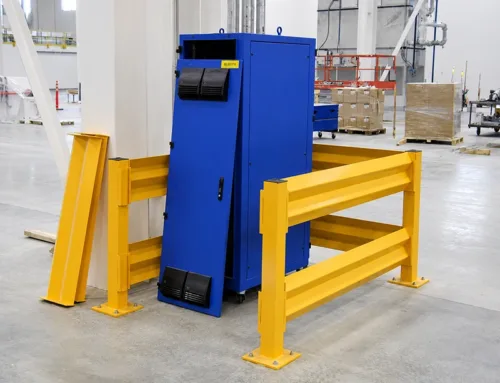
- Robotic workstation enclosure for CNC, welding and pick-and-place cells installed by local maintenance
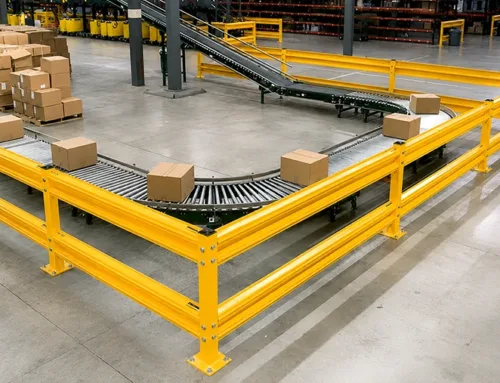
- Automated equipment guarding around conveyors, palletizers and end-of-line packing stations
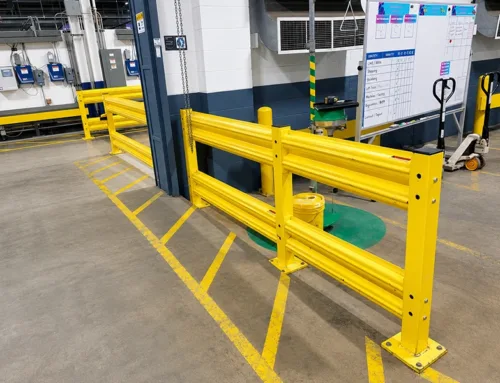
- Tool crib enclosure and material segregation in cross-trained factory support zones
- Temporary construction partitions inside plants during equipment installation or line moves
Every one of these perimeters goes in with the same three-step clip fix, the same yellow Q235 post and the same powder-coated 3D welded mesh — which is the only way to make a single corporate safety spec survive a 25-country manufacturing footprint.
Download the Multinational Plant Clip-Fix Specification
Send the corporate EHS team one specification, not 25: post profile options, mesh opening choices, clip-fix install sequence and a per-site bill of materials template that the local facility team can fill in without welder qualifications. The PDF aligns with OSHA 1910.212, ANSI B11.19 and ISO 14120 review points, while leaving each country to complete its applicable GB, CE, Machinery Directive or local equivalent audit on the same physical installation.
Plan a Multinational Safety Fence Rollout Without Welder Skill Variance
If your group is writing one machine guarding standard for 100+ plants, send the floor plan of the pilot site and the rollout calendar. We will return a clip-fix kit list, a per-site BoM template, and an install sequence that a local maintenance technician can run without certified welders — so the same audit-grade perimeter shows up in every country on the rollout.