EN
EN  DE
DE  RU
RU  PT
PT  JA
JA  ES
ES  IT
IT Mefence Industrial Safety Fence · Human-Robot Collaboration
Humanoid Robot + AMR Cells Need a Visible Boundary, Not a Blind Wall
A human-robot collaboration cell with humanoid robots and AGV/AMR traffic cannot use a solid wall — solid steel blocks LiDAR returns, blocks overhead machine vision, and blocks the operator’s line of sight. Mefence yellow-black frameless safety fence industrial mesh blocks the person, leaves the sensors alone, and uses the T-shaped ridge pressed into every panel as a built-in cable channel for cameras and access control.
Talk to an engineer about your humanoid robot + AMR cell layout
Mefence Specs That Fit a Human-Robot Collaboration Cell
Mefence is a frameless 3D welded wire mesh safety fence industrial mesh panel designed for area demarcation, AGV/AMR lane control, robot workstation perimeters, and modular warehouse zoning. The standard specs below are the ones that matter for a human-machine collaboration layout where LiDAR, machine vision, and operator visibility all have to stay open.
| Item | Mefence specification |
|---|---|
| Material | Q235 carbon steel, electrostatic powder coated |
| Standard color | Yellow + black (custom colors available, including orange) |
| Wire diameter | 3 mm / 4 mm |
| Mesh opening | 20 × 100 mm / 50 × 50 mm |
| Panel width | 200 – 1400 mm |
| Panel height | 200 – 3000 mm |
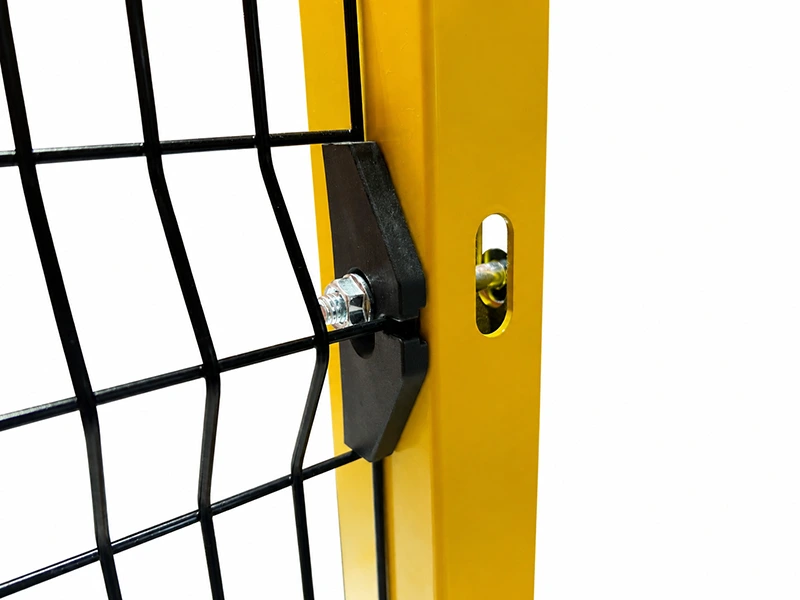
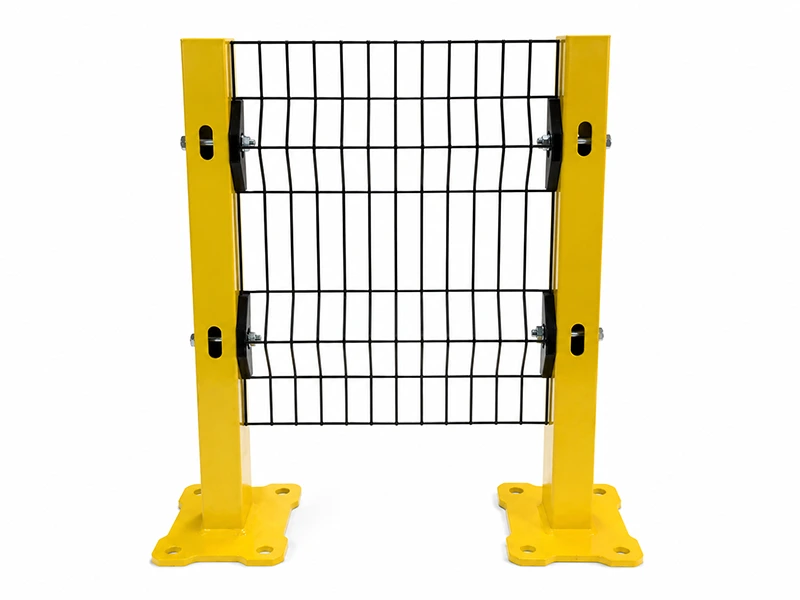
| Post size | 40 × 60 mm / 60 × 60 mm, slotted mounting holes, bolt-down base plate + expansion bolt |
| Panel structure | Frameless 3D welded wire mesh with multiple horizontal T-shaped ridges / bends pressed into the panel |
| Connection | Plastic clip + self-tapping screw (no site welding) |
| Functional slot | T-ridge channel used for cable routing and wood slat inserts |
| Installation | One person, three-step clip assembly; roughly 50% faster than conventional framed fence |
| Positioning | Area demarcation, traffic guidance, modular zone separation, cable management fence — not a certified anti-collision barrier |
| Standards customers reference | OSHA 29 CFR 1910.212, ANSI B11.19, ISO 14120, ISO 14119, ISO 13857, ISO 13855 |
How Mefence Solves the Human-Robot Collaboration Boundary Problem
Yellow-Black Contrast for Personnel Warning in Mixed-Traffic Aisles
In a human-machine collaboration cell, the boundary between a pedestrian aisle and an AGV/AMR corridor has to be readable from across the floor. Mefence pairs a black welded wire mesh panel with a yellow powder-coated steel post (40 × 60 mm or 60 × 60 mm, slotted mounting holes, bolt-down base plate) — the highest-contrast warning palette used in industrial safety fencing. Where a solid divider would disappear into the background, the yellow post and the dark mesh stay visible to a humanoid robot operator, a forklift driver, and an AMR safety scanner alike. For sites that need a different visual cue, the same panel ships in custom colors including high-vis orange for temporary construction fence use during a pilot line install.
Frameless 3D Welded Mesh That LiDAR, Vision and Overhead Cameras Can See Through
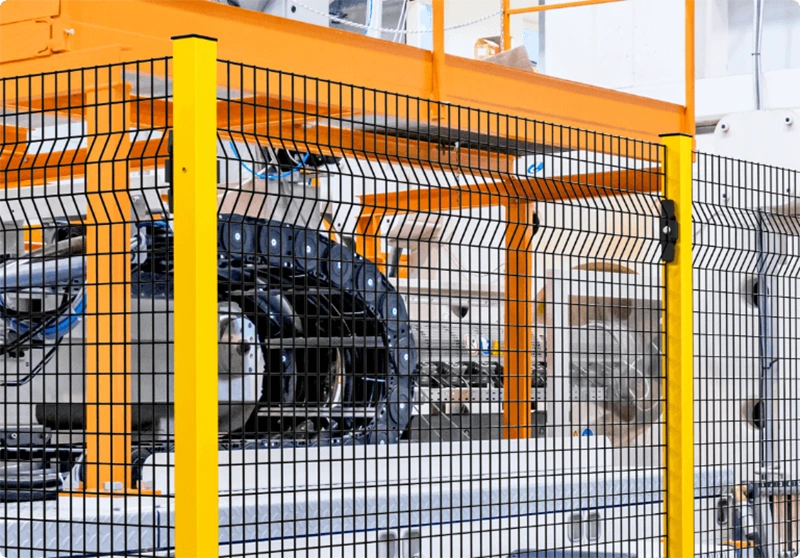
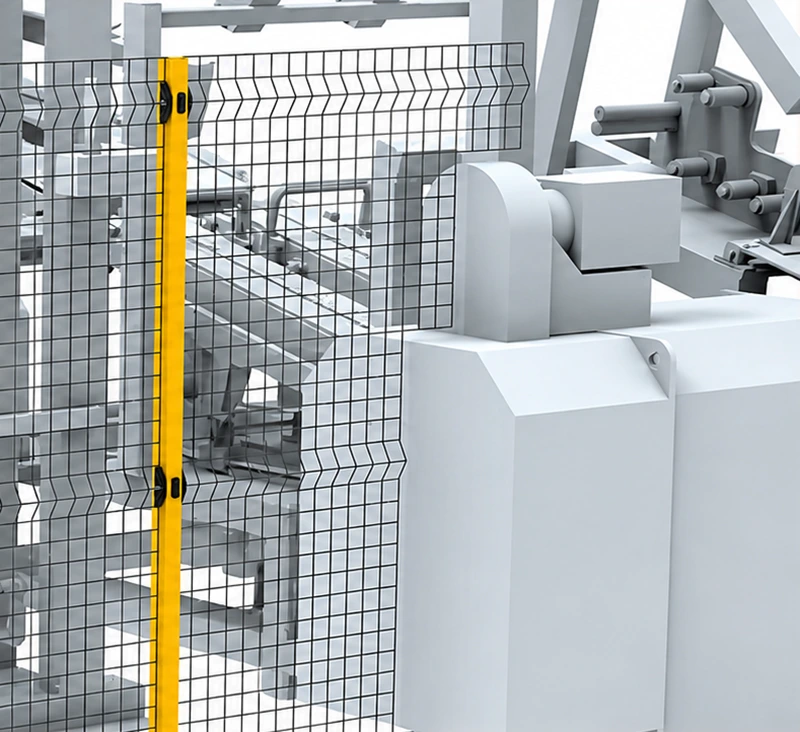
Solid walls hide what an AGV or humanoid robot needs to see. Mefence replaces the blind surface with a frameless 3D welded wire mesh — Q235 carbon steel wire at 3 mm or 4 mm, with 20 × 100 mm or 50 × 50 mm openings — a wire mesh machine guard that stops a person crossing the line without stopping a LiDAR return or an overhead picking camera. Robot safety fence operators in smart factories use the open mesh to keep LiDAR navigation and machine vision intact while the panel still does the pedestrian-vehicle separation that OSHA expects from a safety fence industrial layout. Because the design is frameless, the mesh can be trimmed to the irregular footprint of a robot cell on site without welding, and the clip-fixed plastic clip + self-tapping screw connection lets the layout move when the cell moves.
T-Slot Cable Routing Built Into the Same Panel That Holds the Line
A human-robot collaboration cell is also a network of cameras, door interlocks, and access control readers — and most cable trays have to cross the same boundary that holds the line. The T-shaped ridge pressed into every Mefence panel is not just a structural bend; it leaves a continuous channel along the top of the mesh that acts as a built-in cable management fence route. The same panel that keeps a pedestrian out of an AMR lane can carry the camera PoE line, the safety interlock cable, and the access control reader wiring without a separate tray. For humanoid robot pilot lines, this means one fence does the demarcation, the camera and access control wiring, and the AGV/AMR lane separation — without adding a blind second wall that the LiDAR cannot see through.
Where Mefence Yellow-Black Frameless Fence Fits a Human-Robot Collaboration Layout
- Humanoid robot + AMR shared workspace perimeter — visible separation that does not block LiDAR or machine vision
- AGV lane separation along automated fulfilment corridors, with planned crossing points instead of random incursions
- Pedestrian vehicle separation at the boundary of a robot cell and an operator aisle, using the yellow-black warning palette
- Camera PoE, door interlock, and access control wiring routed along the T-shaped ridge of the same panel
- Pick-and-place station enclosure where overhead cameras and barcode scanners must stay in the loop
- CNC machine guarding periphery where the boundary has to be visible to the operator but not opaque to the lighting
- Temporary retrofit partition during a humanoid robot pilot line install (orange or custom color available)
- Warehouse zoning and tool crib enclosure using the same modular clip assembly
For a humanoid robot + AMR cell, Mefence delivers the visible boundary the layout needs without turning the perimeter into a blind wall. The frameless 3D welded mesh keeps LiDAR and machine vision open, the yellow-black contrast keeps pedestrians warned, and the T-slot cable channel routes the camera and access control lines that a solid wall would force onto a separate tray. For impact-rated strike points inside the same cell, the project team should still pair Mefence with a higher-spec Machine Fence — that split-scope layout is the honest way to keep an automated cell both visible and impact-protected.
Get the Mefence Drawing Pack for a Humanoid Robot + AMR Cell
Send us your cell footprint, the AGV/AMR lane layout, the camera and access control line count, and any irregular column or pipe lines. We return a Mefence panel cut list with mesh opening, post spacing, base plate positions, and T-slot cable routing notes sized to your human-robot collaboration perimeter.
Plan a Humanoid Robot + AMR Cell Boundary With Mefence
If you are laying out a humanoid robot + AMR cell and need a visible boundary that does not block LiDAR or machine vision, send us your perimeter and the camera/access control line count. We will size a Mefence yellow-black frameless safety fence industrial layout — clip-fixed, on-site cut, no welding — and reserve the T-slot cable channel for your camera, interlock, and access control runs.