EN
EN  DE
DE  RU
RU  PT
PT  JA
JA  ES
ES  IT
IT Human-Robot Collaboration Guarding
Mefence See-Through Safety Fence Industrial: Separation That Does Not Blind AGV / AMR Vision
When humanoid robots, AMRs and human operators share one floor, a solid partition hides LiDAR returns, machine vision and supervisor sight lines from each other. A Mefence welded mesh safety fence industrial panel stops a person from walking into a robot cell, keeps the AGV / AMR lane readable to vision-based navigation, and still lets a line leader look across the boundary without climbing a step.
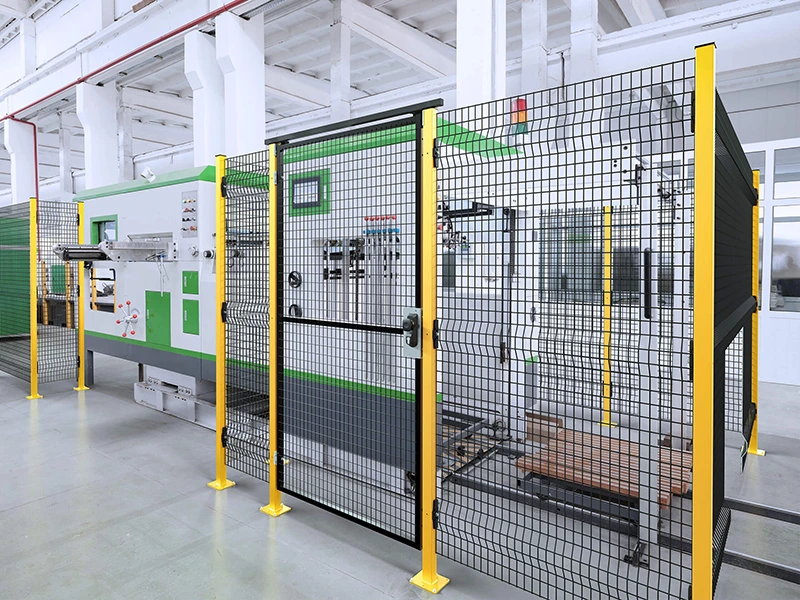
Mefence Specifications: See-Through Mesh, Hard-Floor Ready
The numbers below are the documented Mefence facts that buyers compare against on a smart-factory bid. Mefence is positioned as area demarcation and traffic guidance — not a crash-rated containment system. For direct-impact strike points on robot or conveyor cells, SGF routes the customer to its certified Machine Fence line.
| Parameter | Documented Value |
|---|---|
| Material | Q235 carbon steel wire, electrostatic powder coating |
| Wire diameter | 3 mm / 4 mm |
| Mesh opening | 20 × 100 mm / 50 × 50 mm |
| Panel width | 200 – 1400 mm |
| Panel height | 200 – 3000 mm |
| Ground clearance | 140 mm |
| Post size | 40 × 60 mm / 60 × 60 mm |
| Standard color | Yellow + black (custom colors including orange) |
| Connection | Plastic clip + self-tapping screw, no on-site welding |
| Floor fixing | Base plate + expansion bolt, slotted mounting holes for alignment |
| Functional ridge | T-shaped pressed ridge carries cable bundles and accepts wood-slat inserts |
| Installation | One person, three-step assembly; 50%+ install time reduction vs framed fencing |
| Reconfiguration | Modular, reusable, clip-released — moves with AMR routes and line changes |
| Standards reference | OSHA 29 CFR 1910.212, ANSI B11.19, ISO 14120, ISO 14119, ISO 13857, ISO 13855 |
Why Mefence Mesh Wins the Human-Robot Boundary
Mesh Stops People, Not Light
A 20 × 100 mm or 50 × 50 mm welded wire mesh lets a 905 nm LiDAR pulse from an AMR, a vision-system camera on a humanoid robot, and a supervisor’s eyes all cross the boundary. Painted steel, polycarbonate sheet or block wall — the options a real Safety Officer is given when the AGV map suddenly drops reflectors off a solid partition. Mefence is frameless 3D welded mesh on Q235 carbon steel posts at 40 × 60 mm or 60 × 60 mm, so the laser returns a clean reflection and the camera reads the markers on the next cell without an extra reflector installation job. The boundary still resists a person leaning into it; it does not resist the AGV passing parallel to it.
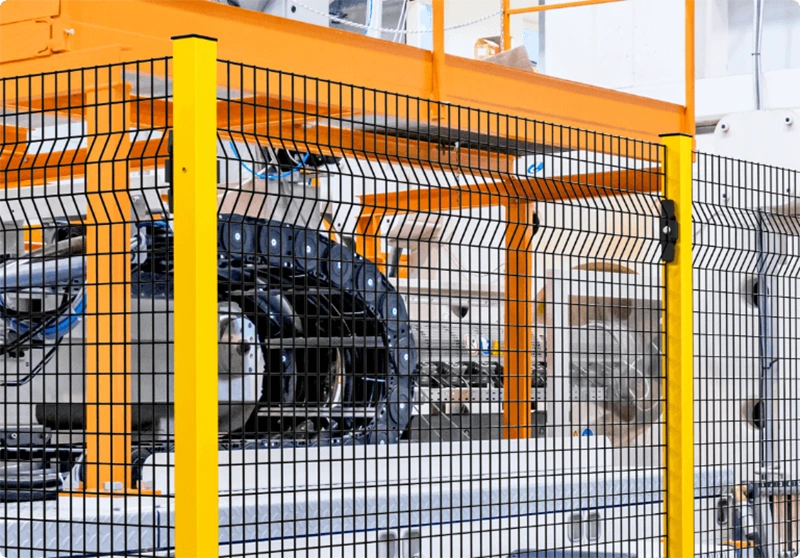
T-Ridge Carries the Cables, Not the Wall
Every human-robot cell needs wiring: a safety light curtain, an interlock tongue, a stack light, a network drop for the robot cell PLC, a door-position switch on the access gate. A solid wall forces a separate cable tray above the partition; a Mefence panel uses the horizontal T-shaped ridges pressed into the frameless 3D mesh as a routing trough, so the cable run stays inside the panel silhouette. Wood-slat inserts can drop into the same channel for visual shielding where the cell needs privacy, but the wiring never sits in front of the mesh where it would block vision.
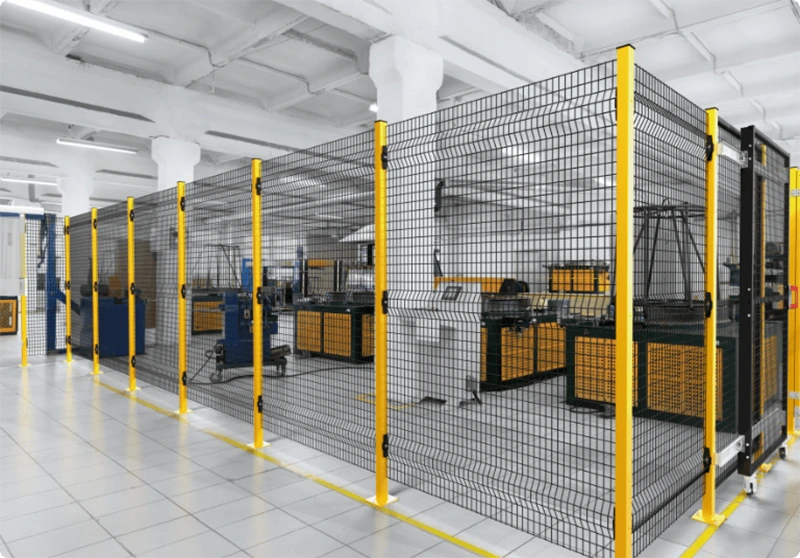
Yellow-Black Boundary Plans the Crossing
AGV / AMR ghost downtime is rarely a software problem; it is a person stepping into a mapped lane because the boundary is invisible from their angle. Yellow powder-coated steel posts plus black welded wire mesh give the highest-contrast warning scheme on a factory floor, and the modular hinged gate with a locking latch converts a random shortcut into a planned access point the WMS can count. In mixed-traffic aisles, forklift path barriers and mezzanine guard zones, that planned crossing is what removes the AGV e-stop and the pedestrian near-miss in the same change.
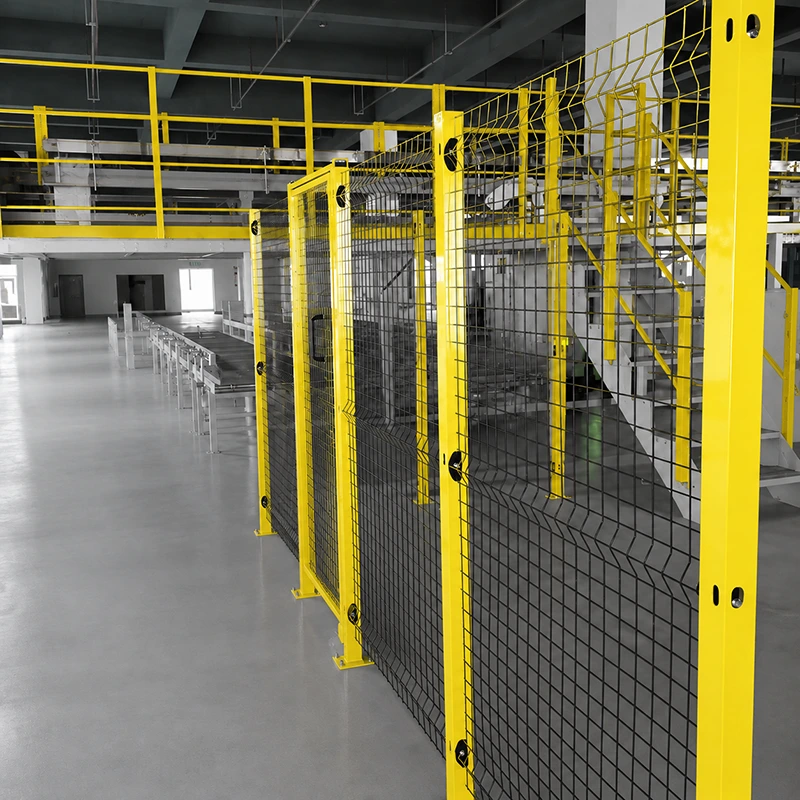
Where Mefence Fits on a Human-Robot Floor
- AGV / AMR corridor separation where LiDAR returns and 2D camera maps must stay readable from both sides of the partition
- Robot workstation perimeter around cobots, CNC cells, and humanoid-robot test stands where supervisors need direct line-of-sight
- Pedestrian vehicle separation in mixed-traffic aisles between forklift path, tow tractor lane and operator walking route
- Warehouse zoning and storage area separation that can be re-released when the AMR route map is re-planned
- Conveyor belt isolation around transfer zones where flying debris must be contained but the cell must stay visible
- Temporary partition during a weekend retrofit, where no on-site welding is permitted beside a live line
- Stairs, mezzanines and elevated platform edge protection that still lets floor supervisors see across the upper level
For direct impact containment at robot or conveyor strike points, route the specifier to SGF’s higher-rated Machine Fence line. Mefence is the right pick for the surrounding zone demarcation, traffic guidance, cable routing and visual shielding around that perimeter — not for replacing a crash-rated barrier.
Bring the Mefence Spec Sheet to Your Layout Meeting
Download the Mefence specification sheet to compare wire diameter, mesh opening, panel width and height, post options, base plate drawings, and color availability against your floor plan. Use it beside the AGV route drawing and the safety light curtain catalog when you mark pedestrian crossings, machine guarding perimeters and AMR corridor edges.
Plan Your Human-Robot Floor With Mefence
Send your floor plan, AMR route map and AGV lane positions. We will mark the Mefence mesh layout, gate positions, T-ridge cable paths and the safe access points — without putting solid walls in front of your robots, your LiDAR, or your line leaders.