EN
EN  DE
DE  RU
RU  PT
PT  JA
JA  ES
ES  IT
IT Paper, Print & Recycling — Hot-Work Permit-Free Install
Mefence Industrial Safety Fence for Paper, Print, and Recycling Plants: Clip-Fixed Install Bypasses the Hot-Work Permit Bottleneck
In a paper mill, a print hall, or a recycling bale bay, paper dust, ink mist, solvent vapour, and stacked bales of used corrugated are all Class A combustibles. A traditional welded perimeter fence means a hot-work permit, a designated fire watch, and a clear-out of every reel, pallet, and solvent drum within the welding radius — which is why the install window slips from one quarter to the next. Mefence’s Q235 frameless 3D industrial safety fence goes up with plastic clips and base-plate bolts: no welder on site, no arc, no spark, no fire watch, no permit. The paper line, the press, and the baler keep running while the perimeter closes around them.
What an install-without-welding perimeter is actually made of
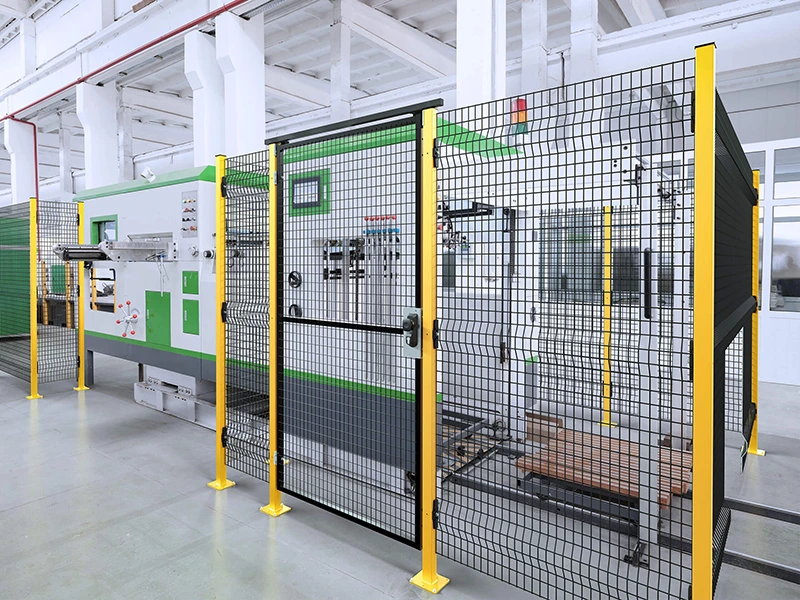
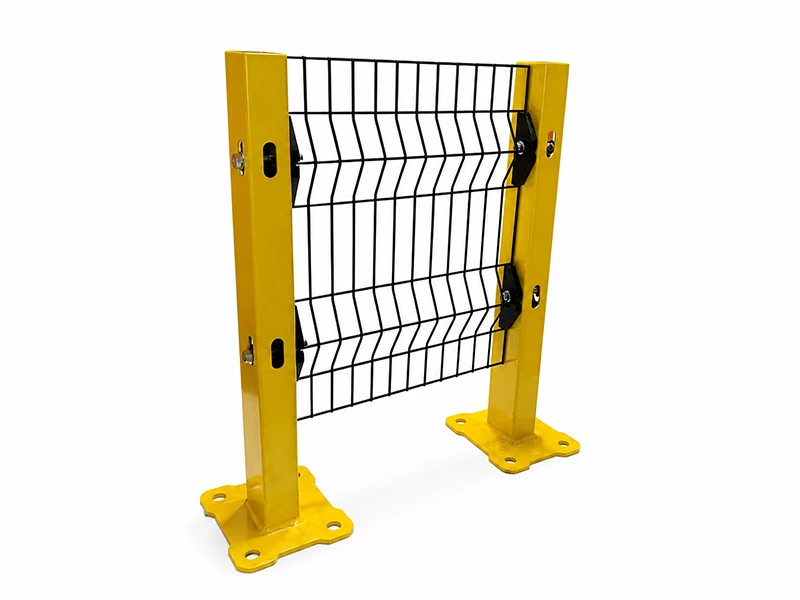
Every Mefence module is built around three facts: a Q235 welded wire mesh panel that ships pre-finished, a yellow powder-coated steel post that bolts to the floor through a slotted base plate, and a plastic clip plus self-tapping screw that locks the panel to the post. No welder touches the site, no hot-work permit is filed, and no fire watch is required to commission the perimeter — the same components also satisfy visual hazard-zone demarcation under OSHA 29 CFR 1910.212 and area guarding under ISO 14120.
| Component | Mefence specification |
|---|---|
| Material | Q235 carbon steel wire mesh and steel post |
| Surface treatment | Electrostatic powder coating — yellow + black standard, custom colours incl. orange |
| Mesh opening | 20 × 100 mm or 50 × 50 mm |
| Wire diameter | 3 mm / 4 mm |
| Panel width | 200 – 1400 mm, cut to length on site |
| Panel height | 200 – 3000 mm |
| Post size | 40 × 60 mm or 60 × 60 mm |
| Post-to-floor fix | Base plate post + expansion bolt, slotted mounting holes for on-site alignment |
| Panel-to-post connection | Plastic clip + self-tapping screw — zero site welding |
| Installation footprint | One person, three-step clip assembly; ~50% install-time cut versus welded framed fence |
| Functional extras | T-shaped ridge carries cable routing and accepts wood-slat visual shielding inserts |
| Standards referenced | OSHA 29 CFR 1910.212, ANSI B11.19, ISO 14120, ISO 14119, ISO 13857 |
Why paper, print, and recycling plants pick Mefence over a welded perimeter
Bolt-down post + clip-fixed panel — the hot-work permit you never have to file
Every post lands on a four-hole base plate that is fixed to the floor with expansion bolts; every panel seats against the post through a plastic clip and one self-tapping screw. There is no welding gun, no arc, no spark, no molten spatter, and no ignition source anywhere in the assembly sequence. For a paper plant that classifies bales, dust, ink mist, and solvent vapour as Class A combustibles, that is the difference between an HSE permit that drags for weeks and a perimeter that goes up between shifts. The same Q235 panel + yellow-black post pair is also accepted as visual hazard-zone demarcation under OSHA 29 CFR 1910.212 and as area guarding under ISO 14120, so the no-welding convenience does not cost the audit trail.
Install on the night shift, audit on the day shift — without stopping the press
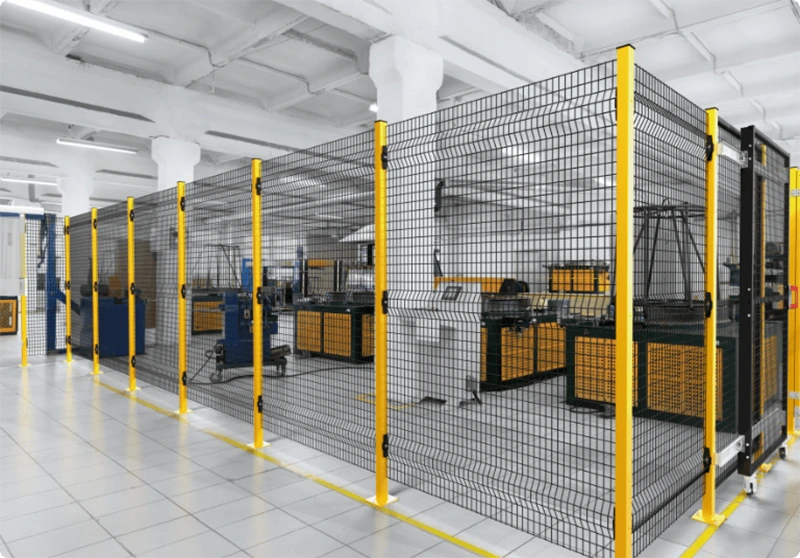
Because every connection is mechanical, the install crew is two people with hex keys and a drill, not a four-person welding team with a permit binder. A typical 60–80 metre paper-mill, print-shop, or MRF perimeter goes up in one night shift; the day shift returns to find the production floor already zoned, the rewind bay already fenced, and the operator aisles already split from the forklift lanes. Where a previous welded install would have meant a 6–10 day production stop and a written hot-work clearance, Mefence trims the install window by roughly half and leaves the line untouched — the same Q235 panels can also be re-trimmed on site to fit a column line, an ink duct, or a press footprint that the original drawing missed.
Modular enough that the next paper SKU reuses the same fence
A paper or print floor rarely stays on the same SKU mix for more than a season. Mefence’s frameless 3D panels are stored flat, re-trimmed to a new length on site, and clipped back into the same base-plate posts when the layout flips. The yellow-black posts and clips stay; the panels change. After two or three rebalancings the same perimeter has been re-cut, re-routed, and re-clipped without a single weld, a single permit, or a single minute of line downtime — the inverse of a welded square-tube fence, which becomes scrap the day the aisle moves. The T-shaped ridge pressed into every panel also doubles as a cable routing channel, so camera, interlock, and access-control cabling rides inside the perimeter instead of across the walkway.
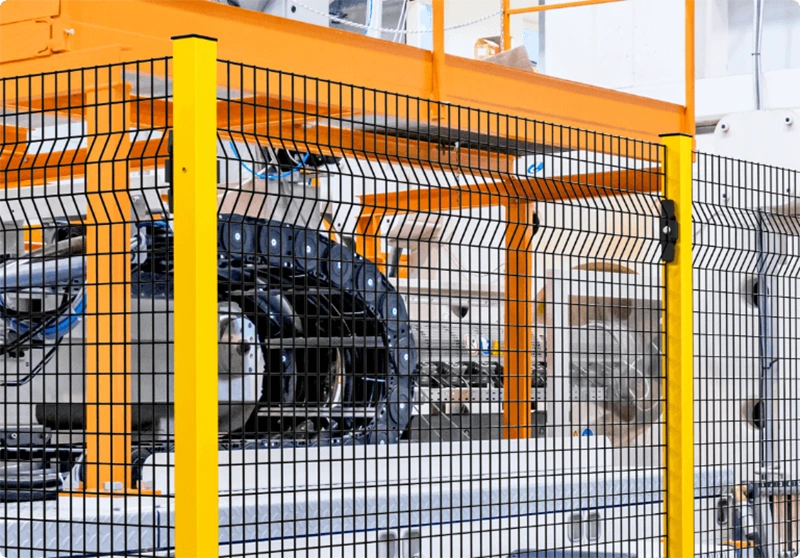
Where the no-welding Mefence perimeter fits in a combustible-floor plant
- Paper-mill bale bay zoning, separating the rewind from the bale feed
- Corrugator and sheeter perimeter for finished-goods pallet staging
- Print-shop press hall zoning between Heidelberg / Komori press islands
- Ink-mixing and solvent-room segregation (visual barrier, not vapour containment)
- Recycling facility MRF floor — splitting tipping, sorting, and baling bays
- Reel warehouse forklift / pedestrian split, including cross-dock lanes
- Converting lines (slitter, die-cutter, flexo) perimeter during product-mix flips
- Temporary partition during a paper-dust fire-system maintenance window
Anywhere the floor counts as a Class A combustible zone and the install window cannot afford a hot-work permit, Mefence’s clip-fixed industrial safety fence is the only modular perimeter that goes up without a spark, an HSE clearance, or a production stop — yellow-black as standard, with orange and other custom colours available where a temporary or visual-shielding variant is needed.
Spec sheet, mesh chart, and base-plate bolt pattern
Send the production floor sketch (PDF / DWG / a phone photo is fine) — including reel columns, ink-duct runs, baler footprints, and any solvent room boundaries — and we return a Mefence perimeter with per-post positions, panel lengths, mesh-opening selection, base-plate bolt pattern, and a hot-work permit checklist that stays empty. No welder on site, no fire watch, no line stop.
Send the floor plan — get a clip-fixed perimeter layout in two working days
Drop the paper, corrugated, print, or recycling floor plan and we come back with a Mefence perimeter priced per running metre, a panel cut list, and a base-plate bolt pattern that drops onto your existing slab — without a hot-work permit, a fire watch, or a single shift of lost production.