EN
EN  DE
DE  RU
RU  PT
PT  JA
JA  ES
ES  IT
IT Multi-powertrain programmes · bolted boundary
Re-Zoning Protection on Multi-Powertrain Assembly Lines: A Bolted, Lift-Out Q235 Warehouse Guard Rail That Travels With BEV/PHEV/ICE Programme Shifts
When a BEV skateboard, a PHEV pack area and an ICE body-in-white line all share one conveyor, the safety perimeter has to move with the programme, not after it. A bolted, lift-out Q235 corrugated steel warehouse guard rail makes that perimeter reusable across every programme shift: no hot-work permit, no slab re-pour, no cell downtime.
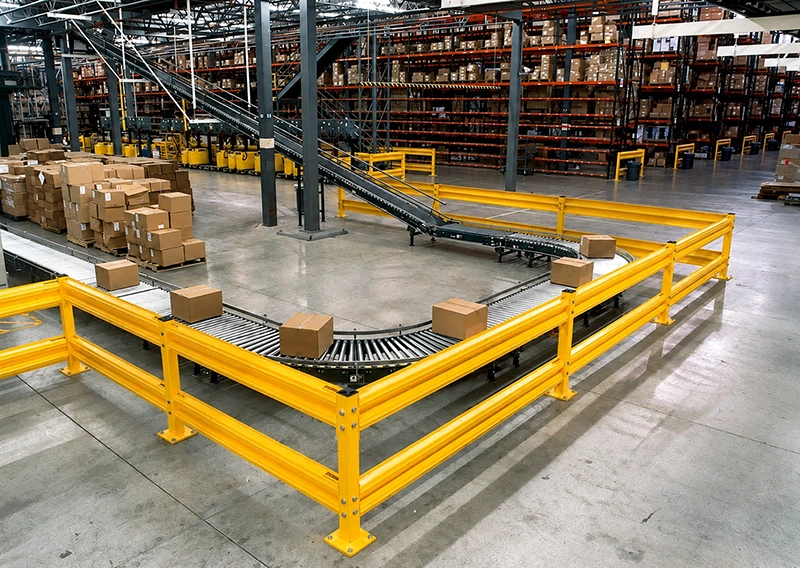
What a Multi-Powertrain Re-Zone Demands From the Steel
Programme shift cycles at multi-powertrain plants no longer run on the year calendar the industry once built steel for. Today a single conveyor can carry a BEV skateboard, a PHEV pack and an ICE body-in-white in the same week, and a programme pull-forward can land four weeks early. The spec table below is what a Q235 modular warehouse guard rail actually delivers across a re-zone — drawn from a documented four-zone layout (17,000 / 12,000 / 17,100 / 11,900 mm) where standard 1,500 mm panels plus 680–1,140 mm custom fillers cover every wall.
| Spec / Parameter | Value / Detail |
|---|---|
| Standard panel length | 1,500 mm (project-cut fillers from 680 mm) |
| Panel height (rail overall) | 1,000 mm |
| Panel configuration | 2-rib W-beam; 3-rib thrie-beam option for higher impact |
| Panel thickness | 3 mm standard; 4 mm for head-on forklift zones |
| Panel width / wave height | 310 mm wide; 85 mm wave height |
| Post | 80 × 80 × 6 mm SHS, 1,500 mm on-centre |
| Base plate | 160 × 160 × 16 mm with four anchor slots |
| Floor / anchoring | Concrete ≥150 mm thick; four M12/M16 expansion anchors per post |
| Re-zone assembly | Bolted, no site welding; lift-out segment for charge-cell hand-offs |
| Surface | Powder coated RAL 1023 yellow; hot-dip galvanised option for BEV pack zones |
How the Bolted, Lift-Out Spec Carries the Re-Zone
Modular Panels That Follow the Programme, Not Just the First Install
A 1,500 mm standard panel plus project-cut 680–1,140 mm fillers is the only way to make a 17,000 mm BEV line and a 12,000 mm PHEV pack zone share one bill of materials. When the programme pulls forward, posts and corrugated rails unbolt and re-bolt into the new layout — the same steel, a different map. The documented four-zone pack on this spec delivered 72 panels (64 × 1,500 mm + 8 specials), 42 posts and roughly 2,243 kg of Q235 across 58 m of perimeter; that exact hardware then redeploys across the next programme shift without the plant buying a second set.
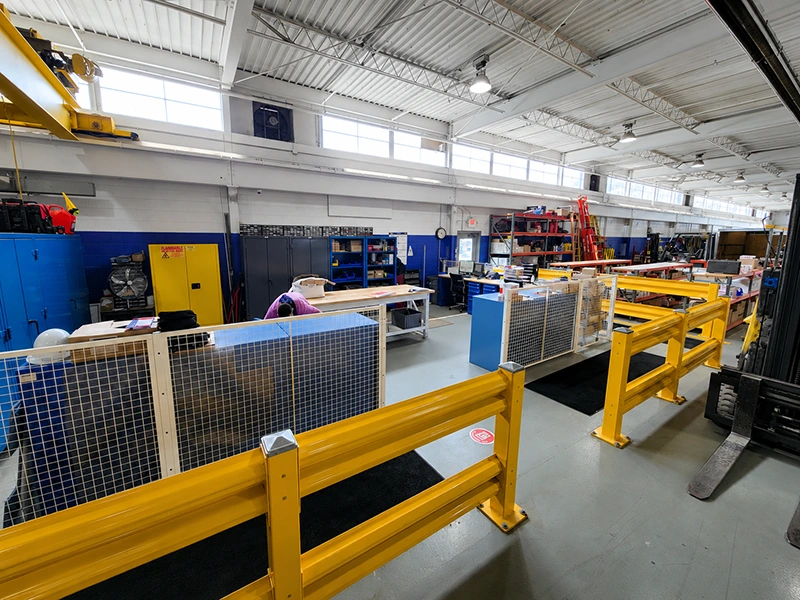
Lift-Out Segment Where the Conveyor Hands the Programme Off
Programme shifts almost always create one fixed crossing — a BEV charge-cell shuttle, a body-on-frame skid for the ICE buffer, or an AGV hand-off between adjacent cells. A lift-out segment sits in that gap; two operators lift it free without tools, the vehicle crosses, and the segment drops back into its brackets. The line opens its perimeter on the SOP schedule without a hot-work permit, a fire watch or a welder booking — which is what keeps a three-day re-zone in a three-day slot instead of sliding into five.
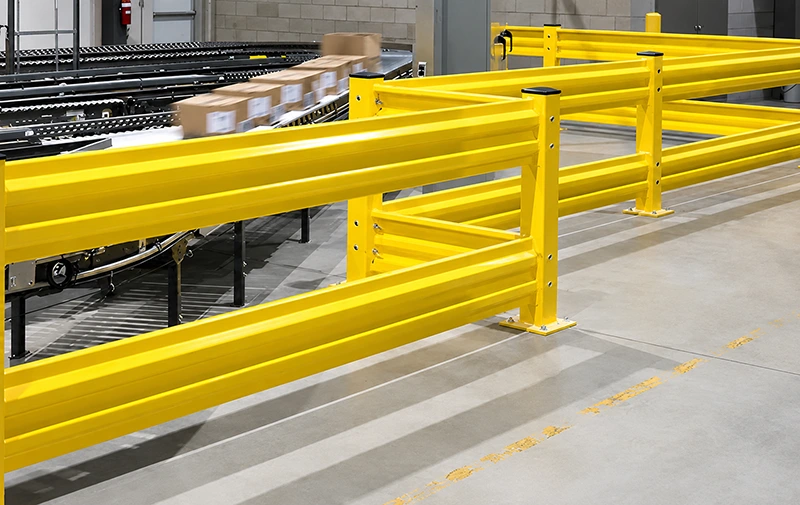
Bolted Base Plates, Not Welded Stubs — So the Next Programme Reuses the Footprint
160 × 160 × 16 mm base plates on 1,500 mm post centres, anchored with four M12 or M16 expansion bolts into a ≥150 mm concrete slab. The bolted detail is what makes the perimeter truly reusable: bolts come out with a socket, not a cutting torch. When the next BEV programme pulls the line 1,200 mm over, the same post-and-plate footprint re-drills (or stays put if the new centreline lands on the existing hole pattern), the rails slide into the new bay, and the cell goes back inside the SOP envelope. Welded pipe railings and concrete bollards cannot do this — they become scrap at every re-zone.
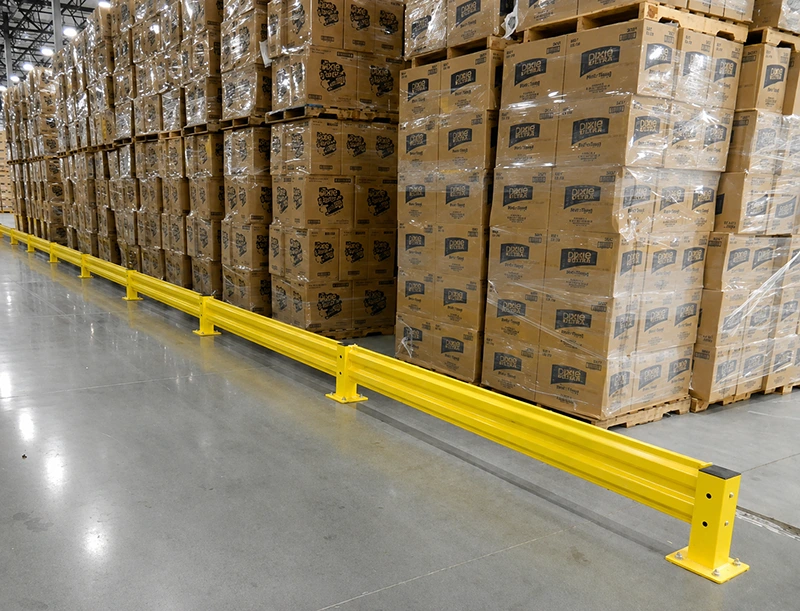
Where Multi-Powertrain Cells Run This Spec
- BEV skateboard cell — battery enclosure lifts, charge cabinets, conveyor entry
- PHEV pack assembly — pack-out buffer, gloves-off inspection zone, age-cycle line
- ICE body-in-white — robotic welding islands, transfer conveyors, paint shuttle
- Multi-OEM contract manufacturer — shared safety spec across Customer A / B / C programme shifts
- Trial build / pilot line — TT cells, prototype PT ramp, SOP perimeter
- Mixed powertrain warehouse buffer — completed-vehicle holding lanes beside the line
Each application stays inside the same Q235 spec — only the rail map and the number of lift-out segments change. Procurement buys one steel, one bolt kit, one install instruction set, and reuses them across every programme.
Reference Note: Re-Zoning a Multi-Powertrain Cell
Download the four-zone layout diagram (17,000 / 12,000 / 17,100 / 11,900 mm) with the bolt-down anchor pattern and the lift-out segment placement rules. Drawings are bound to the actual site measurements; final clearance to the conveyor and to the charge cells must be confirmed against your cell geometry and the relevant EN ISO 13857 / OSHA 1910.212 review.
Map Your Next Programme Shift Before It Lands
Send your cell layout (DWG, PDF or a hand sketch with four wall lengths and the lift-out point) and we will come back with a Q235 corrugated steel warehouse guard rail layout, a 2-rib / 3-rib recommendation and a bill of materials your procurement team can issue.