EN
EN  DE
DE  RU
RU  PT
PT  JA
JA  ES
ES  IT
IT 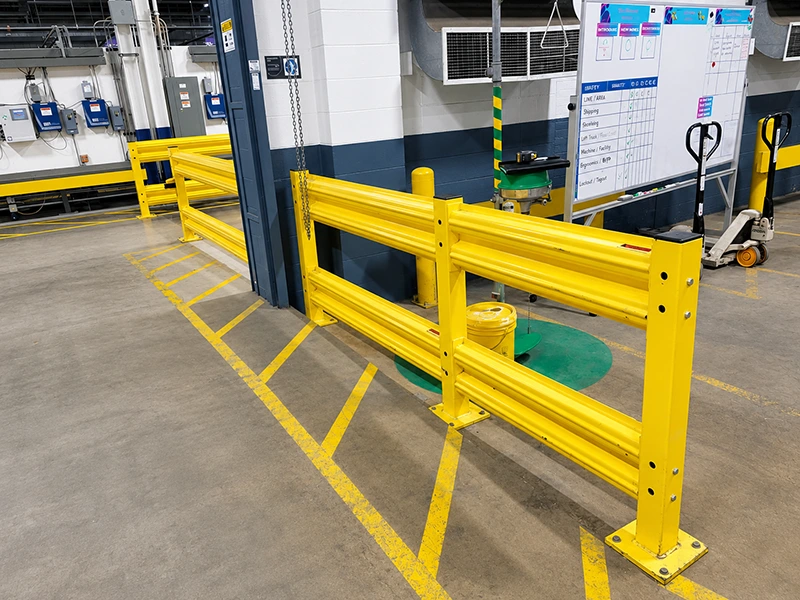
Cold Storage Pedestrian–Vehicle Separation
Cold Storage Forklifts Won’t Yield at -25°C: How a Q235 Warehouse Guard Rail Completes the UWB and Blue-Light Pedestrian–Vehicle Separation Stack
In a freezer, fog, condensation and a glove-thick coat collapse every active warning into a single white noise. A bolted, double-rail Q235 corrugated steel warehouse guard rail with high-visibility yellow coating and optional reflective tape is the passive hard boundary that sits behind UWB tags and blue-light lamps — the layer that doesn’t depend on training, attention or the operator’s mood before a pedestrian strike ends the shift.
Cold-Storage Boundary Specification — What the Hardware Has to Carry
A pedestrian–vehicle boundary inside a freezer has to survive three loads at once: a -25 °C slab, a saturated dock-to-pick cycle and a hand-pallet jack that mis-steers because the operator cannot read the painted line through the fog. The Q235 corrugated steel panel on a bolted base plate is the spec that survives all three without on-going paint touch-up.
| Spec / dimension | Cold-storage Hsafety value |
|---|---|
| Material | Q235 carbon steel; hot-dip galvanized or powder-coated yellow |
| Panel profile | 2-rib W-beam double-rail; 3-rib option for heavier reach-truck zones |
| Panel width | ~300–310 mm; rib spacing ~194 mm; wave height ~85 mm; amplitude ~40 mm |
| Panel thickness | 3 mm standard; 4 mm for higher-energy forklift envelopes |
| Top rail height | ~1,000 mm above slab |
| Lower rail offset | ~100 mm above slab on the 6 mm base plate |
| Post section | 80 × 80 × 6 mm square tube, height 1,000 mm |
| Post spacing | 1,500 mm standard centre-to-centre |
| Base plate | 160 × 160 × 16 mm, four concrete anchor bolts |
| Anchor bolt / floor | Expansion anchor into concrete ≥ 150 mm thick |
| Panel length | ~1,500 mm standard; 680–1,140 mm custom filler for non-modular runs |
| Visibility options | Yellow polyester top-coat, reflective tape strips, optional LED signage |
| End terminations | Bollard end-caps at shared freezer doors; lift-out segment over frost-heaving seams |
| Module | Bolted, no on-site welding, no hot-work permit, lift-out capable |
Why a Passive Boundary Beats Active Warnings in a Freezer
Active Warnings Stop at the Fog Line
UWB proximity tags, blue-light pedestrian lamps, speed limiters and operator-training audits already sit on the active layer of most modern cold-storage facilities. They work — until a winter contract pulls in a temporary picker who has never walked this freezer before, the strip-curtain door stays open for ninety seconds, and the fog bank swallows the blue beam. The Q235 corrugated steel warehouse guard rail doesn’t care. It absorbs the hand-pallet jack that misses the painted line by 200 mm, then stands there ready for the next one. The barrier is the passive layer the OSHA hierarchy-of-controls expects, and it does not ask the operator to be awake, sober or trained on this particular shift.
Double-Rail Geometry Closes the “Walk-Through” Gap
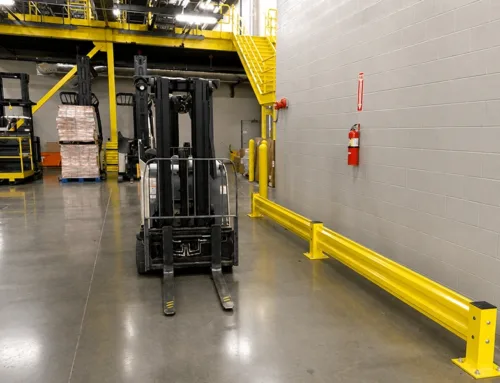
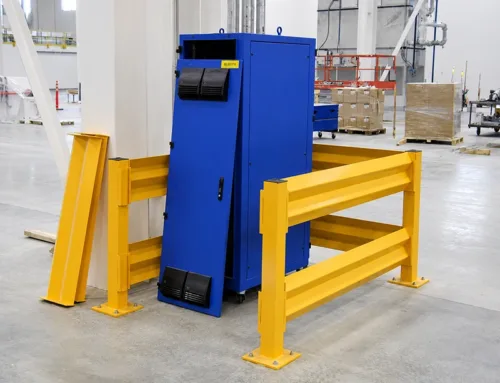
A single rope, a painted yellow stripe or a single low steel rail pipe can be stepped over by a hurried worker or driven through by a reach truck. The double-rail W-beam cross-section shown in the panel view — top rail at ~1,000 mm and lower rail ~100 mm above the slab — closes that gap. The lower rail catches the wheel of a wayward pallet truck; the upper rail catches the chassis. Together they redirect the strike energy into the post and the 160 × 160 × 16 mm base plate instead of into the picker on the other side. For freezer aisles where visibility drops below five metres, the geometry is the safety case, not the colour.
Bollard End-Caps, Reflective Tape and the Shared Freezer Door
Every cold-storage pedestrian–vehicle boundary starts and ends at the shared freezer door. Bollard end-caps at each terminus take the corner-strike load that a simple flat end-cap cannot, and reflective tape strips on the rail face give the oncoming reach-truck driver a visual reference at -25 °C when the headlamp scatters off the fog bank. The barrier forms a continuous corridor that pairs with the active UWB and blue-light stack: the lights warn, the bollard resists, the rail contains, and the expansion anchor holds the slab. None of these layers stand alone; remove one and the next strike finds the gap.
Where to Drop the Passive Boundary Inside a Cold Storage Facility
- Shared freezer door / dock vestibule. Both sides of the entry need a double-rail barrier with bollard end-caps; the corridor opens only for an authorised reach-truck cycle.
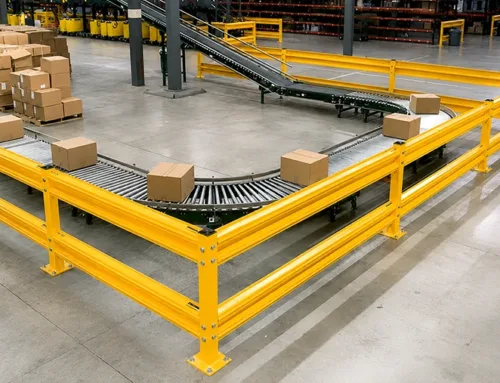
- Pick-face aisle next to a powered pallet-flow lane. A 1,000 mm high double-rail keeps the picker behind the rail while the reach-truck runs the lane at the same time.
- Cold-loading dock apron. A bollard + rail transition from the freezer to the dock leveller protects the seal and the driver from a runaway hand-pallet jack.
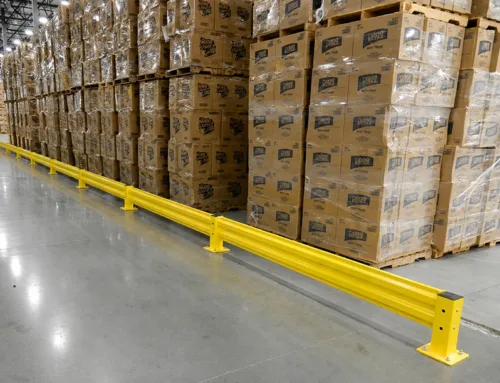
- Pallet-flow rack end in a freezer aisle. The rack-end protection spec is the same — 160 × 160 × 16 mm base plate, four-anchor, double-rail panel, lift-out segment over the slab seam.
- Cold-storage battery / charging room wall. Battery charging walls inside the freezer need the same boundary so a pallet truck cannot push through to the chargers.
- Frost-heaving concrete seam. A lift-out segment over a known frost-heaving seam absorbs slab drift without re-anchoring the entire run.
For shared pedestrian-vehicle supply lines where a hand-pallet jack, reach-truck and picker pass within 1.5 m of each other, the cold-storage Hsafety double-rail corridor is the same bolted spec an automotive plant uses at the JIS drop lane — only the surface treatment is swapped for hot-dip galvanizing or a thicker polyester coat to survive the temperature swing and the daily wash-down.
What to Verify Before You Specify a Cold-Storage Boundary
Before a Hsafety run is signed off for a cold-storage aisle, the spec sheet should lock down six items in writing: (1) hot-dip galvanized versus powder-coated finish, because frost and condensation attack painted welds and bolt pockets first; (2) panel thickness — 3 mm standard, 4 mm for heavier lift-truck envelopes; (3) anchor bolt diameter and concrete slab thickness, with expansion anchors into a slab ≥ 150 mm as the cold-storage starting point; (4) base plate dimension (160 × 160 × 16 mm for typical freezer floor profiles); (5) reflective tape pattern and bollard end-cap detail at every shared freezer door and rack end; and (6) a panel-to-post layout drawing that locks geometry before fabrication, with custom 680–1,140 mm fillers listed for any non-1.5 m run. The Q235 substrate, the bolted connection and the optional reflective / bollard layer are the spec lines that survive the freezer. The third-party impact test for the specific truck-class / zone-class envelope is still an open workstream that should be priced into the project plan rather than assumed.
Send the Cold-Storage Layout — Get a Bolted Spec in 48 Hours
Drop the freezer floorplan, the reach-truck class and the pedestrian-corridor widths. We’ll return a project-cut double-rail layout with 1,500 mm standard panels and 680–1,140 mm custom fillers, hot-dip galvanized finish, reflective tape pattern and bolt-down base plate detail. No on-site welding, no hot-work permit, no shifting painted boundary at -25 °C.