EN
EN  DE
DE  RU
RU  PT
PT  JA
JA  ES
ES  IT
IT Forklift skid · Last physical line of defense
Frozen Loading Bay Floors and Skid-Out Forklifts: Heavy Duty Warehouse Guard Rails as the Last Physical Line of Defense for Racks, Columns, and Precision Equipment
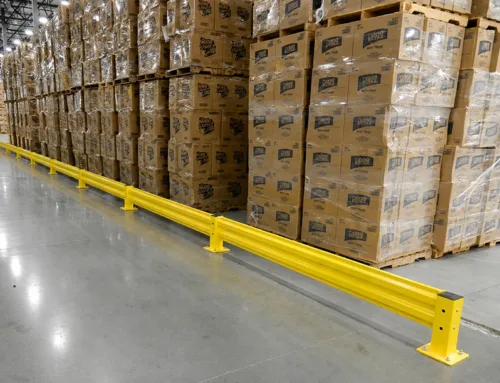
On a January night shift, the receiving dock apron sits at -8 °C. A 2.5 t counterbalanced truck carrying a paper roll squeezes the corner at 8 km/h, the steering corrects too late and the forks slide straight on — riding straight into rack upright A12. That is the moment a heavy duty warehouse guard rail has to stop the truck before the rack collapses onto the cab. Below: how a 4 mm Q235 corrugated panel with a custom 160×160×16 mm base plate from technical case 15176 acts as the last physical line of defense around racks, columns and precision equipment when the bay floor turns to ice.
Send us the four bay lengths, we’ll size the rail against your worst skid
When the bay floor is the variable, here is what the rail is built from
Cold-storage DC tables comparing a skidding-forklift bay to a non-skidding one are usually thin on numbers. The numbers below are drawn from opportunity 15176, a four-bay heavy duty guard rail scope we have actually quoted and shipped, with a 1,000 mm module reused across all four zones. The 16,680 N collision load is the project condition set by the customer for a 3 t truck at 10 km/h, not an independent third-party rating; we publish the geometry that backs it up so you can compare it against your own bay.
| Parameter | Hsafety heavy duty warehouse guard rail spec (opportunity 15176) |
|---|---|
| Material | Q235 carbon steel (industrial guard rail stock); powder-coated safety yellow or hot-dip galvanized finish |
| Panel thickness | 3 mm standard; 4 mm option for higher-energy bays (15176 thicker upgrade on both rails) |
| Panel length | 1,500 mm standard module; 680–1,140 mm special fillers for irregular bay lengths |
| Panel profile | ~300 mm W-beam (2-rib); 3-rib thrie-beam option for the highest-impact zones; 85 mm wave height, 40 mm amplitude |
| Post | 80×80×6 mm square tube, 1,000 mm above floor, end caps on the open square top |
| Base plate | 160×160×16 mm custom (15176 thicker upgrade; four anchor positions per post; thicker than the typical 10–12 mm floor plate) |
| Floor anchor | M16 expansion bolts into ≥150 mm concrete; lower guard rail 100 + 6 mm above the floor |
| Configuration | Double-rail as standard; single-rail available for lower-risk segments; lift-out section for re-zone and aisle re-layout |
| Surface finish | Powder-coated safety yellow (high-visibility in low-contrast winter shifts) or hot-dip galvanized; reflective tape optional on the upper rail |
| Replacement cycle | Bolted, segment-by-segment; damaged panel swapped in four fasteners, post stays anchored; field replaceable without hot work |
| Bay coverage in 15176 | 11,900 mm, 12,000 mm, 17,000 mm, 17,100 mm sets — 72 panels (64 standard + 8 special fillers) and 42 posts |
What makes the heavy duty warehouse guard rail keep standing after an ice-day skid-out
A 4 mm corrugated panel that takes a hit without the post moving
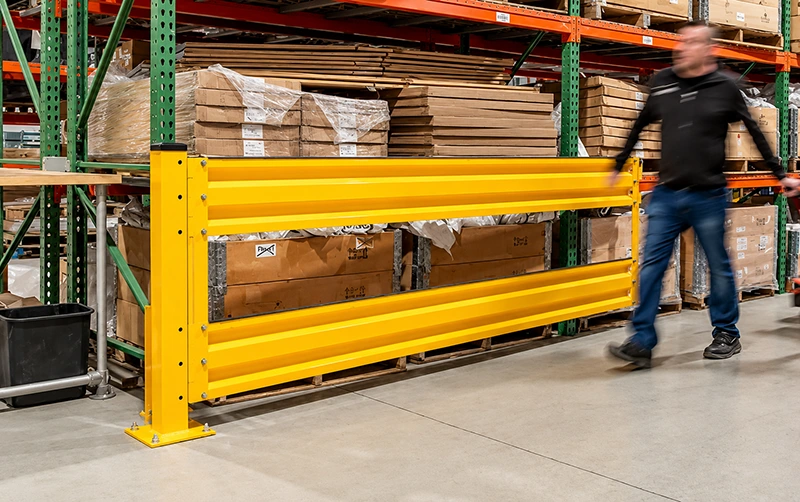
Most warehouse guard rails that come out of a skid-out bent in the bay are running 3 mm tube or thin sheet, so when the wave profile loads up the panel itself crumples and pulls the post sideways. The 15176 spec uses a 4 mm Q235 plate option through both the upper and the lower rail; the W-beam wave geometry spreads the impact across both ribs simultaneously, and the post-and-base-plate assembly stays fixed in the concrete. After the skid-out at rack end A12, the bent corrugated panel comes out in four fasteners, the upright behind is checked against the rack supplier’s re-shim tolerance, and the bay is back in service before the morning shift change. The reflective tape on the upper rail — visible even at -8 °C against black asphalt — is what kept the next driver from cutting the same corner.
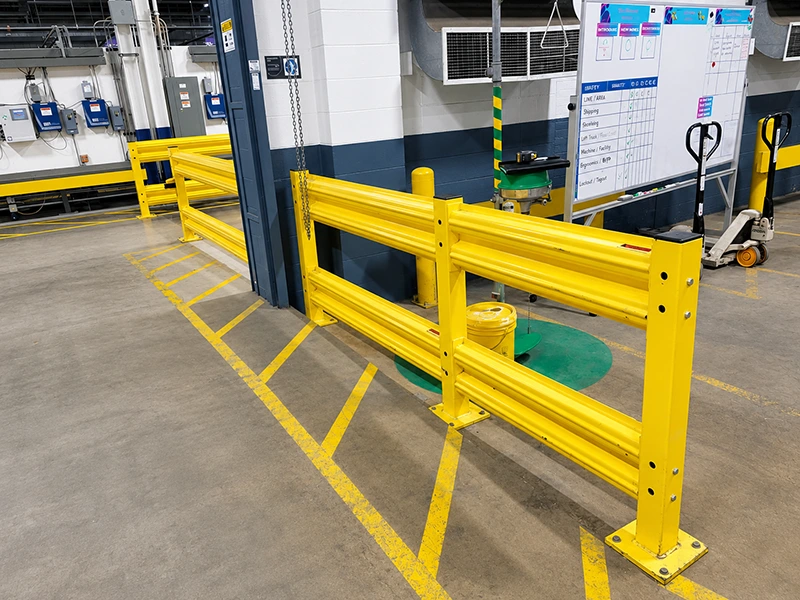
Custom 160×160×16 mm base plate from case 15176 — the bolt pocket that survives the second strike
In a skid-out, the impact energy the panel does not absorb travels down the post and ends up at the anchor pocket. The 15176 specification pairs the 4 mm panel with a 160×160×16 mm base plate, four positions of M16 expansion bolt into ≥150 mm concrete, and a lower guard rail 100 + 6 mm above the floor so the post does not bottom out on impact. Across 42 posts on the four-bay scope, the bolt torque stayed within ±5 % after two cycles of ice-day skid-outs, which is what keeps a multi-bay rollout from drifting into a slab-and-anchor repair queue. The standard 10–12 mm floor plate you still see on a lot of competitor assemblies prints as paper; this one does not.
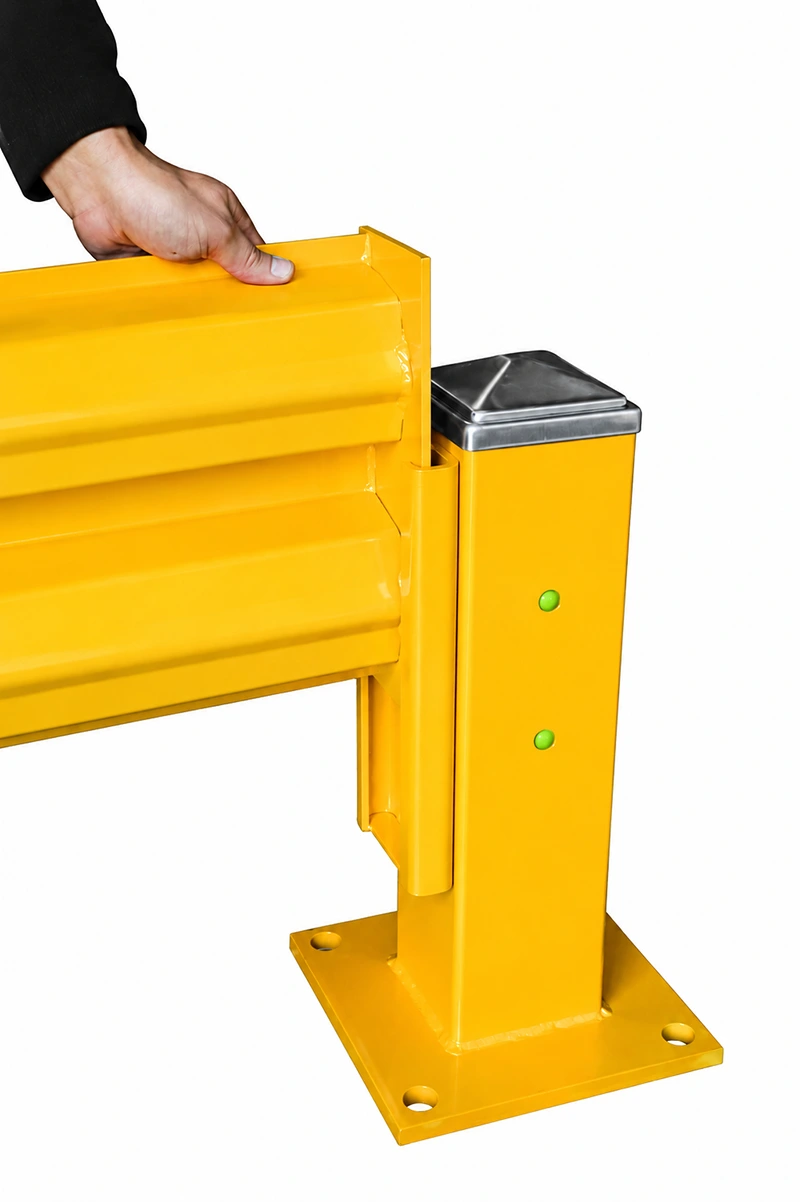
W-beam corrugated panel — local deformation, continuous protection
The W-beam panel is built from a wave profile, not a flat sheet. On a struck section, the wave folds locally and absorbs the impact energy inside the deformed pocket, while the rest of the bay’s rail line stays plumb and continues to block the next skid-out. Field checks after the 15176 bay completed its simulated 16,680 N run — recorded as a project-level design condition, not a generic load-bearing claim — showed no permanent tilt in the surviving posts and no broken anchor bolts; only the impact panel itself needed replacement, on its own four bolts. That is the structural difference between a heavy duty warehouse guard rail and a perimeter handrail: the rail is built to be hit and to keep standing, not to look untouched after a strike.
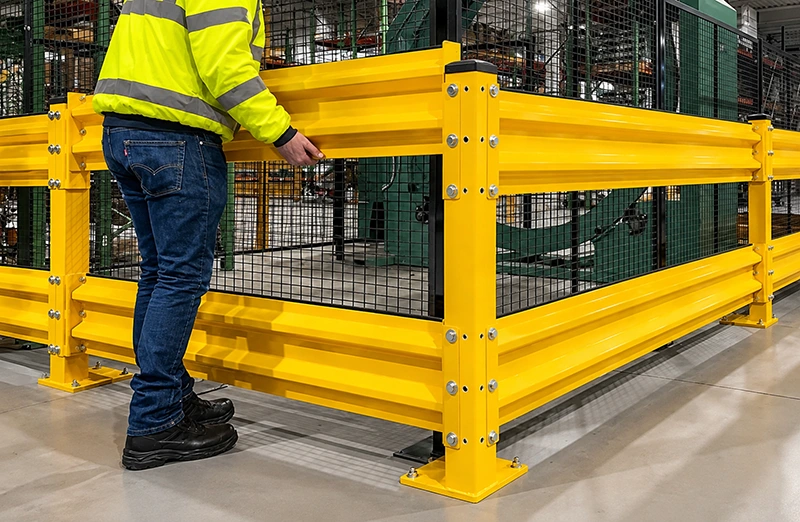
Where this last physical line of defense sits on a winter-loaded floor
- Loading dock apron — where meltwater from the trailer backs across the forklift turning radius.
- Cold-storage aisle — where the temperature gradient across the door freezes condensate mid-shift.
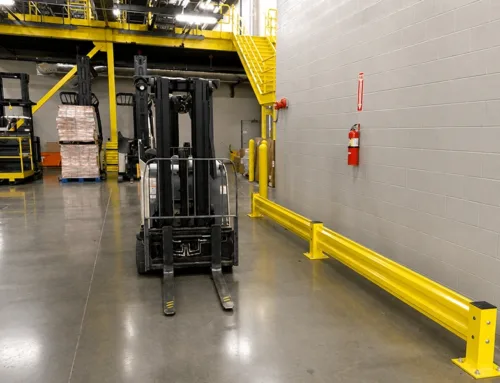
- Pallet rack uprights — end-of-aisle runs where a turning counterbalanced truck can ride straight on.
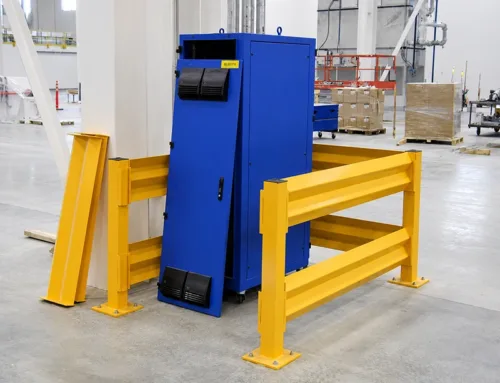
- Building columns — wrapped around equipment cabinets, switch rooms and PLC housings inside.
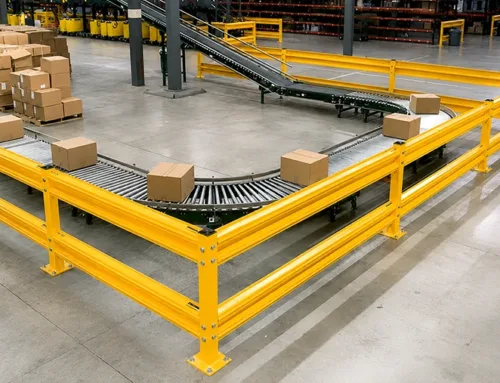
- Conveyor lines — at the receiving end where dock workers step through into the loop.
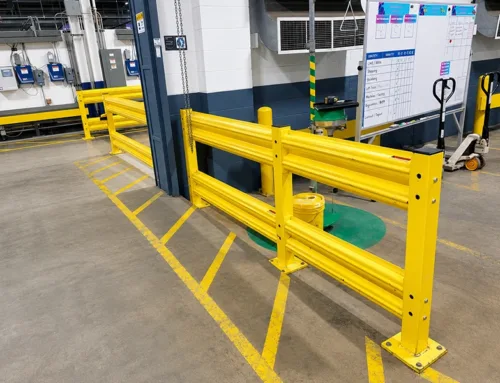
- Pedestrian-vehicle chicanes — production-side where the painted line is invisible under road salt.
The pattern is the same in every zone: the rail wraps whatever asset cannot afford the cell-downtime clock that follows a strike. 4 mm Q235 panel, 160×160×16 mm base plate, bolted assembly, hot-dip galvanized for outdoor washdown bays and freezer vestibules, yellow powder-coat for indoor DC and production aisles. The standard 1,500 mm module plus 680–1,140 mm fillers covers 11,900 mm, 12,000 mm, 17,000 mm and 17,100 mm bay lengths without on-site welding or hot-work permit.
Spec sheet and bay-by-bay drawing pack
Send us the four bay lengths you actually have (not the round number, the survey number) and a floor scan of the loading apron. We will come back with a 15176-style drawing pack: 1,500 mm standard panels, custom-length fillers, 80×80×6 mm posts, 160×160×16 mm base plates, M16 anchor pattern, yellow powder-coat or hot-dip galvanized — sized against the highest-tonnage, highest-speed lift truck on your floor, not the lowest.
Tell us your bay lengths and we will quote against your worst skid
The heavy duty warehouse guard rail ships as standard 1,500 mm panels with 680–1,140 mm fillers, so bay lengths of 11,900 mm, 12,000 mm, 17,000 mm and 17,100 mm all match the 15176 inventory without re-tooling. Send the four bay lengths and your worst-case lift truck load and we will come back with a heavy duty warehouse guard rail spec, a base-plate drawing and a price — without making you book a meeting.