EN
EN  DE
DE  RU
RU  PT
PT  JA
JA  ES
ES  IT
IT Pre-Shift EHS Walk-Around / Black-Ice Loading Bay
Black-Ice Skid Between 23:00 and 05:00 No Operator Reports: Reading a 4 mm Q235 Warehouse Guard Rail with a 160×160×16 mm Base Plate the Next Morning
On a −6 °C ambient dock apron between 23:00 and 05:00, a counter-balanced forklift skids 1.2 m past the floor-mark, finds the rail instead of the rack, and walks away without filing a near-miss entry. A 4 mm Q235 corrugated steel warehouse guard rail with a custom 160×160×16 mm base plate, bolted to a 150 mm concrete slab, is the only forensic read the 5 a.m. EHS walk-around has on what actually happened — and whether the next-shift truck is safe to start.
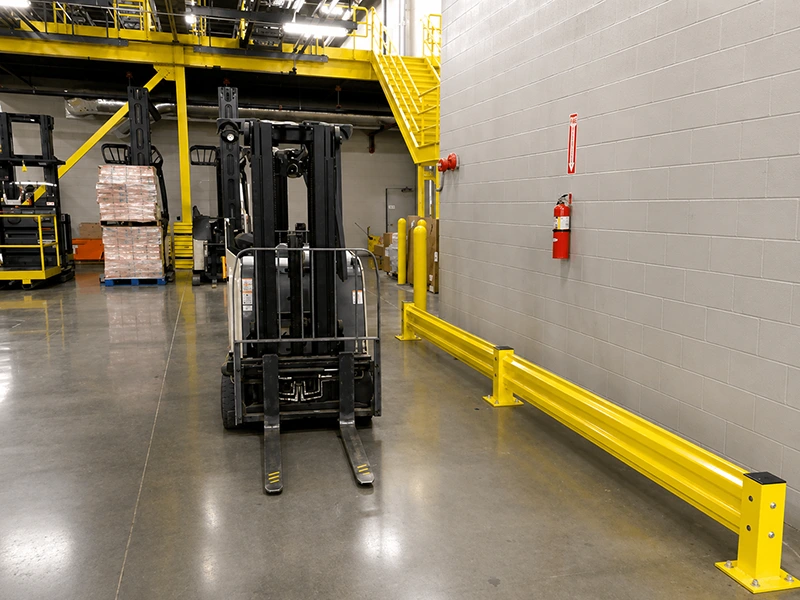
What the 5 a.m. Inspector Actually Looks For on a Q235 Steel Warehouse Guard Rail
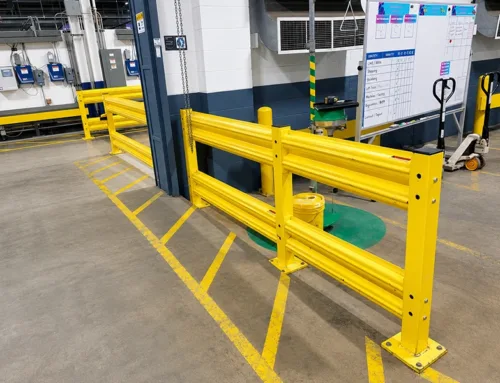
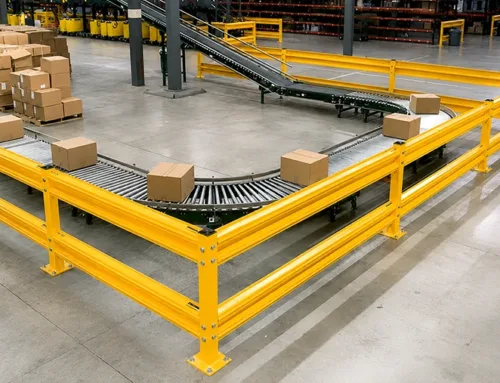
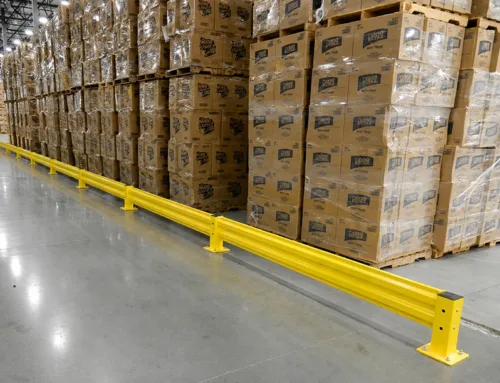
The forensic read is in three places, not one: the corrugated steel panel (wave-peak flatten), the 160×160×16 mm base plate (anchor torque and concrete intactness), and the surface (powder-coat or hot-dip galvanized continuity at the strike chip). The table below maps each of these to a check the pre-shift walk-around can run in under two minutes per rail — without dismantling the post or pulling the anchor bolts.
| Where to look on the rail | What a passing / failing rail tells the 5 a.m. inspector |
|---|---|
| 2-rib or 3-rib Q235 corrugated wave peak (4 mm panel) | Pass: peak flattened under 40 mm, panel still continuous, rail still vertical. Fail: panel torn at the wave or punched through toward the asset. |
| 4 mm Q235 panel vs. the 2–3 mm panels common in same-class rails | Pass: strike energy absorbed in the wave deformation; anchor pocket never loaded. Fail: panel sheared through; full impact transferred into 4-anchor pocket. |
| 160×160×16 mm custom base plate (technical case 15176) vs. 100×100×10 mm typical | Pass: base sits flat on the slab, all four anchor bolts hold torque, no radial crack in the concrete pocket. Fail: anchor pulled, corner spalled, or hairline crack at the pocket edge. |
| Hot-dip galvanized or powder-coated finish at the strike chip | Pass: chip ≤ 25 mm, substrate not exposed over 2 mm, no rust streak below the chip. Fail: continuous rust streak at the weld bead — strike and brine have already started the substrate. |
| Concrete slab ≥150 mm + M16 anchor bolts (engineering pre-condition) | Pass: no radial crack beyond 50 mm from the anchor pocket. Fail: hairline crack runs to slab edge — that pocket, not the asset behind the rail, is the next repair. |
Three Forensic Clues a 5 a.m. Walk-Around Reads Off a 4 mm Q235 Warehouse Guard Rail
1. Wave-peak flatten reads the strike direction and angle
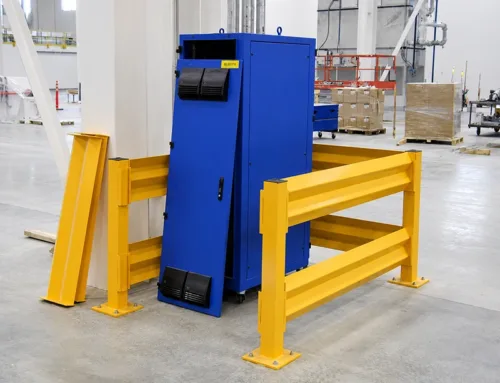
When a counter-balanced forklift rides the wave instead of shearing it, the 4 mm Q235 corrugated steel panel shows it. The wave-peak flatten points back along the strike vector — the front-wheel imprint on the floor plus the wave-pattern flatten on the rail triangulates where the truck came from, at what angle, and whether the truck was loaded or empty at strike. A rail that is still vertical and still continuous has already absorbed the energy the rack upright, the switchgear cabinet, or the precision cell behind it would have taken. The same rail from a 2- or 3- mm panel would have either collapsed into the asset or transferred the impact straight down into the four-anchor pocket, and the next-shift truck would be arriving to a different scene.
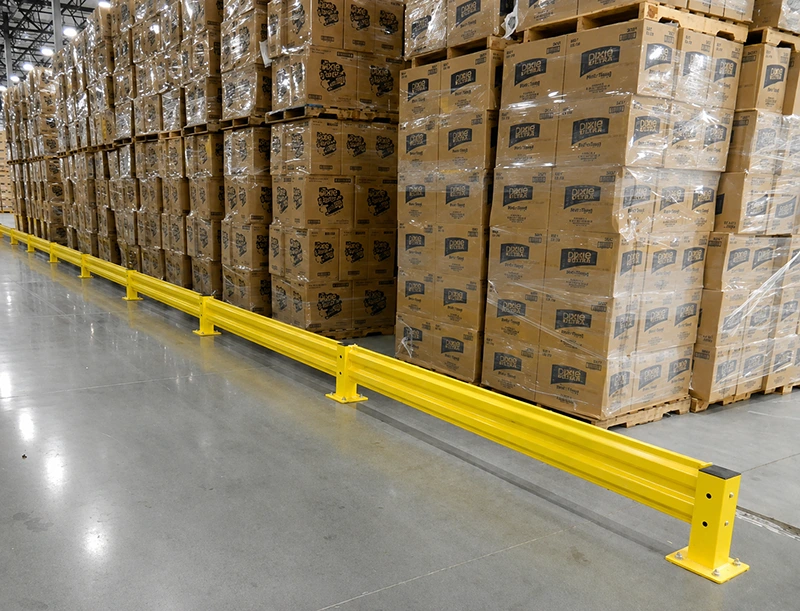
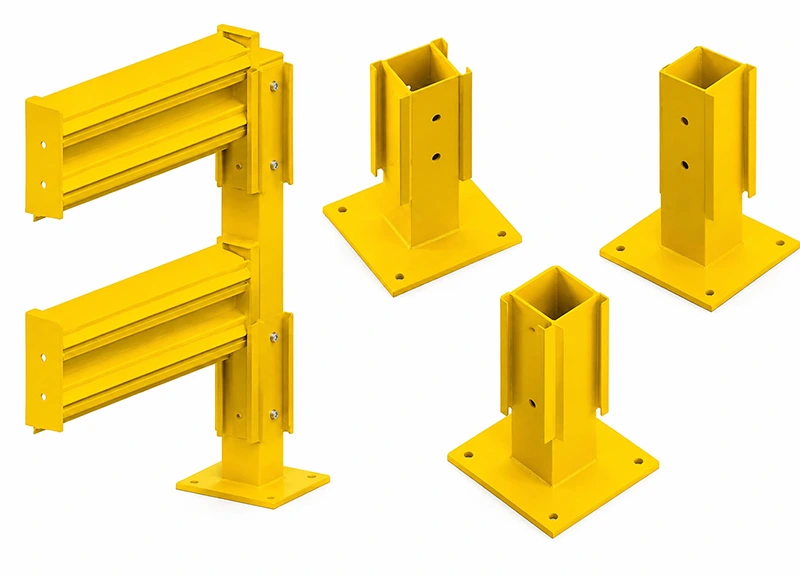
2. 160×160×16 mm base plate keeps the anchor — not the slab — out of the repair queue
What an under-spec base plate does at strike is push the impact energy straight down into the concrete — cracking the slab at the anchor pocket and putting the asset behind the rail on a 3-week concrete-repair hold while the slab cures. The custom 160×160×16 mm Q235 base plate from technical case 15176 spreads the same impact across four anchor points and a 25,600 mm² footprint, so the slab never sees a point load it cannot dissipate. The 5 a.m. inspector checks whether the four M16 anchor bolts still hold torque spec, whether the 16 mm base plate sits flat on the slab with no rocking, and whether the concrete around the pocket shows no radial crack. Pass means the rail is back in service before the 05:30 truck arrives. Fail means that anchor pocket — not the asset — goes into the repair queue, which is the cheaper of the two outcomes.
3. Q235 hot-dip galvanized or powder-coated finish — the coating tells if the strike was fresh
A black-ice bay also runs brine and de-icer, so the rail surface is under two attacks at once: the strike itself and the overnight salt. Hot-dip galvanizing or a 3 mil powder coat puts the protection on the steel substrate, not on top of it — so the 5 a.m. inspector can read the chip at the strike point and tell whether it is fresh (silver substrate, clean break) or stale (substrate already rusted, brown streak below the chip toward the drain). A Q235 substrate with hot-dip galvanized or powder-coated finish keeps that read reliable across the −6 °C ambient-to-ice transition, where condensation and brine would otherwise open a rust path that quietly compromises the steel between strikes. The same read on a thin painted finish is meaningless overnight — the rust signal is not yet visible, even though the strike already happened.
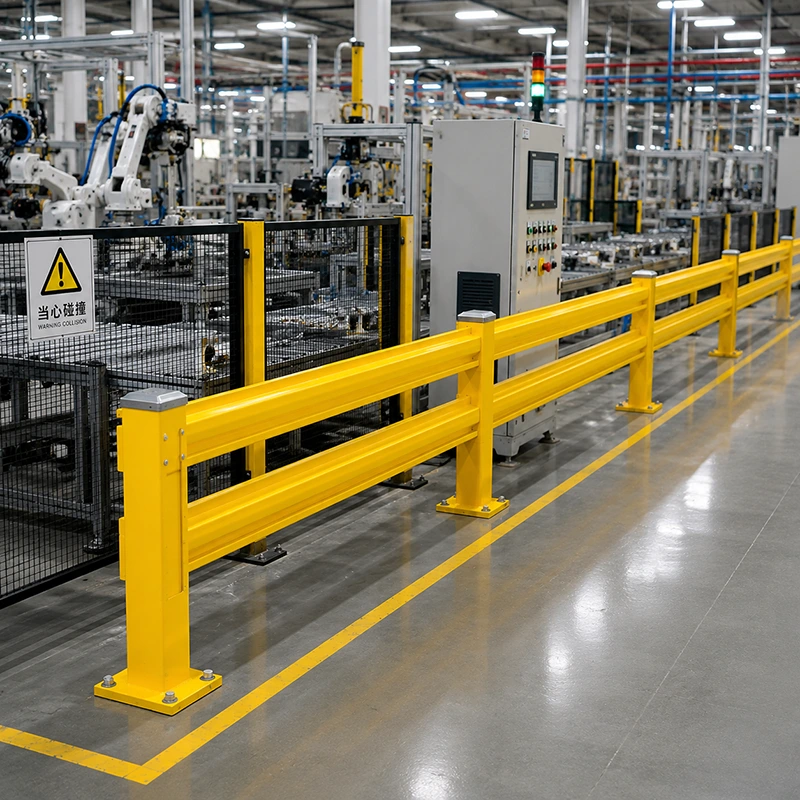
Where the Same Pre-Dawn Read on a 4 mm Q235 Warehouse Guard Rail Applies
- Cold-storage ambient dock aprons where a freezing-rain forecast was logged at 23:00 — bay apron, drive-in lanes, and the 6 m run between the leveler and the staging zone.
- Cross-dock freezer-curtain sills where the cold-air pool sits at tire level (≈10 cm above floor) — the rail at the curtain is the most-skid point on the entire facility, and the rail at 5 a.m. is the operator’s only readout.
- Palletizing-cell perimeters where a 1.2 m skid past floor-mark means a precision-machine repair — the rail protects the robot base, the cobot controller, and the vision-system enclosure in the same arc.
- Rack end-of-aisle where a skid toward upright A12 / B07 / C03 means a pallet-rack replacement — the rail shields the first-frame upright and the floor-anchor from the strike that would otherwise shear the anchor.
- Switchgear and electrical-room corners where frost condensation makes the first skid invisible at the operator’s eye level — the rail carries both the impact evidence and the visible-warning function for low-light shift handover.
- Washdown / brine-treated aprons where the strike-chip on the rail is also a coating-corrode read — the rail tells the inspector both that a strike happened and how the strike is aging.
These six sites share one forensic read: the next-shift walk-around reads the rail first, the asset second, the floor last. Putting that read into the pre-shift checklist — not the post-incident review — is what catches a 04:55 skid-out before the 05:30 truck arrives.
Pre-Shift Black-Ice Loading-Bay Inspection Card (one-page, printable)
A printable one-page card with the five forensic checks (wave-peak, 4 mm Q235 panel integrity, 160×160×16 mm base plate flatness, anchor-bolt torque, slab-intactness) and a tick-box for the 5 a.m. walk-around. Designed to clip onto a high-vis vest and run in under two minutes per rail — including the pass / fail thresholds above. Available on request for distribution across ambient-dock, freezer-curtain and cross-dock sites, and field-tested against the technical case 15176 specification sheet (4 mm Q235 panel, 80×80×6 mm post, 160×160×16 mm base plate, M16 anchor into ≥150 mm slab).
Send Us Your Loading-Bay Geometry — We’ll Map the Inspection Path
Send us the bay length, the bay temperature envelope, the floor-mark dimensions and the asset inventory behind each rail run. We’ll map the 5 a.m. walk-around against the technical case 15176 specification sheet (4 mm Q235 corrugated steel panel, 80×80×6 mm post, 160×160×16 mm base plate, M16 anchor into ≥150 mm slab) so each rail has a named forensic read — wave-peak, base plate, anchor torque, coating chip, slab pocket — before the next freezing-rain shift. No site welding, no slab re-pour, no walk-around guesswork.