EN
EN  DE
DE  RU
RU  PT
PT  JA
JA  ES
ES  IT
IT Industrial Safety Fencing | Cross-Border Automation Projects
Cross-Border Warehouse Rollouts: Why Mefence Frameless Safety Fence Keeps Installation Standards Consistent
For global integrators and authorized installation partners, Mefence industrial safety fencing replaces site welding with a repeatable clip-fixed method. The frameless 3D safety fence supports warehouse zoning, AGV lane separation and automated equipment guarding while reducing dependence on local welding skills.
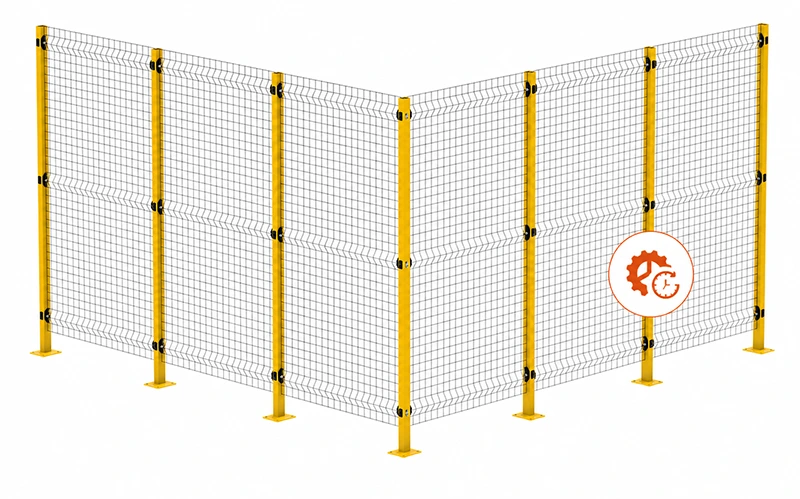
Why Cross-Border Installations Lose Consistency
A multinational warehouse program may use the same layout, drawings and safety boundary at every site. The result can still vary when each local contractor interprets a welded square tube fence differently. Welding qualifications, joint preparation, alignment and rework become the hidden variables. Training a new crew in every country adds cost, while short retrofit windows leave little room for hot work. Barrier tape or rope barriers are faster, but they do not create a durable, visible boundary for pedestrian vehicle separation or hazard zone separation.
| Deployment requirement | Mefence design response |
|---|---|
| Different local installation skills | Plastic clip fixing and self-tapping screws remove the site-welding step; English technical documents and training can standardize the sequence. |
| Irregular or changing layouts | Frameless welded wire mesh panels can be cut on site and rearranged as a modular reconfigurable fence. |
| AGV, AMR and forklift route visibility | Yellow-black safety fence creates a readable boundary without turning a traffic route into a solid blind wall. |
| Retrofit work around live equipment | Cold-work assembly, base plate posts and expansion bolts limit site work compared with a welded framed fence. |
Structure, Parameters and Visual Proof
Clip-fixed assembly makes the standard repeatable
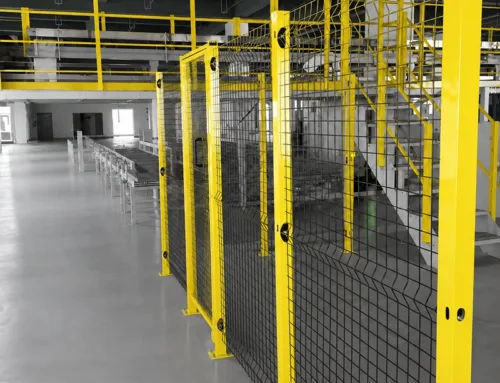
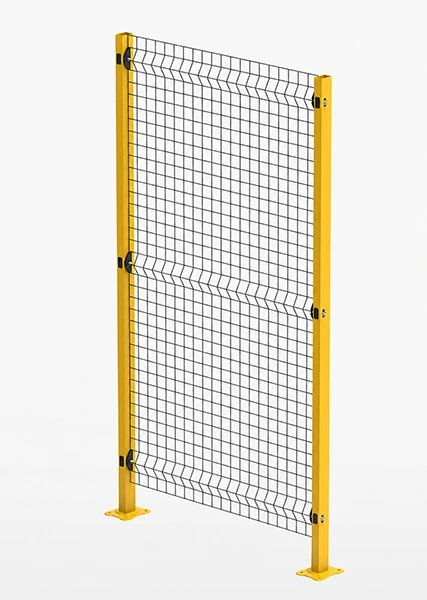
The connection is visible in the close-up: a powder-coated steel post, welded wire mesh panel, slotted mounting holes and mechanical connector. Mefence uses plastic clips with self-tapping screws rather than requiring a qualified welder to fabricate every joint on site. The documented installation method is one-person, three-step assembly, with installation time reduced by 50% or more in the supplied video facts. That changes quality control from “find a good local welder” to “follow the same installation sequence.”
3D welded mesh supports machine guarding and route control
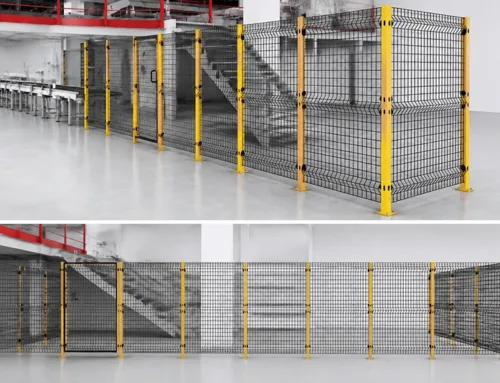
Mefence is built from Q235 carbon steel with electrostatic powder coating. The frameless panel uses multiple horizontal T-shaped ridges or bends, maintaining a slim profile while adding functional space for cable management. Cables can be routed through the raised mesh profile instead of hanging outside the fence. The product range covers 3 mm or 4 mm wire, 20×100 mm or 50×50 mm mesh openings, panel widths from 200–1400 mm and heights from 200–3000 mm. These options let an integrator specify a common system while adapting each station to the local footprint.
Base fixing and modular sizing reduce site variation
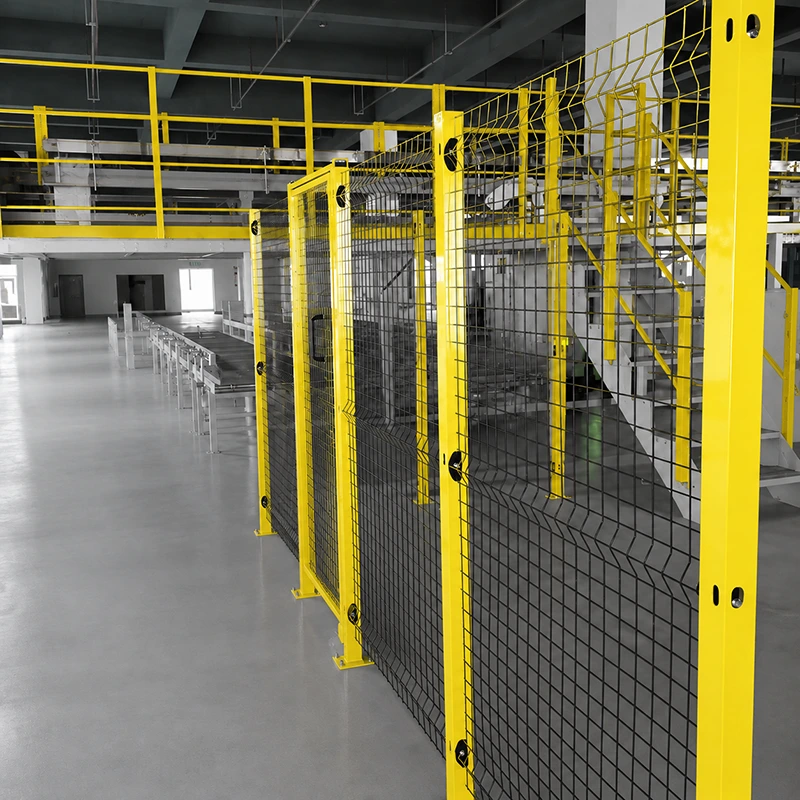
The base-plate post image shows the practical floor interface: a 40×60 mm or 60×60 mm post, a bolted base plate and a welded mesh panel fixed between posts. With 140 mm ground clearance and expansion-bolt installation options, crews can establish a clear floor reference before fixing each module. The same structure can define a robot workstation perimeter, a workshop isolation zone or a warehouse partition, and can be dismantled and reused when equipment moves.
Where This Installation Model Fits
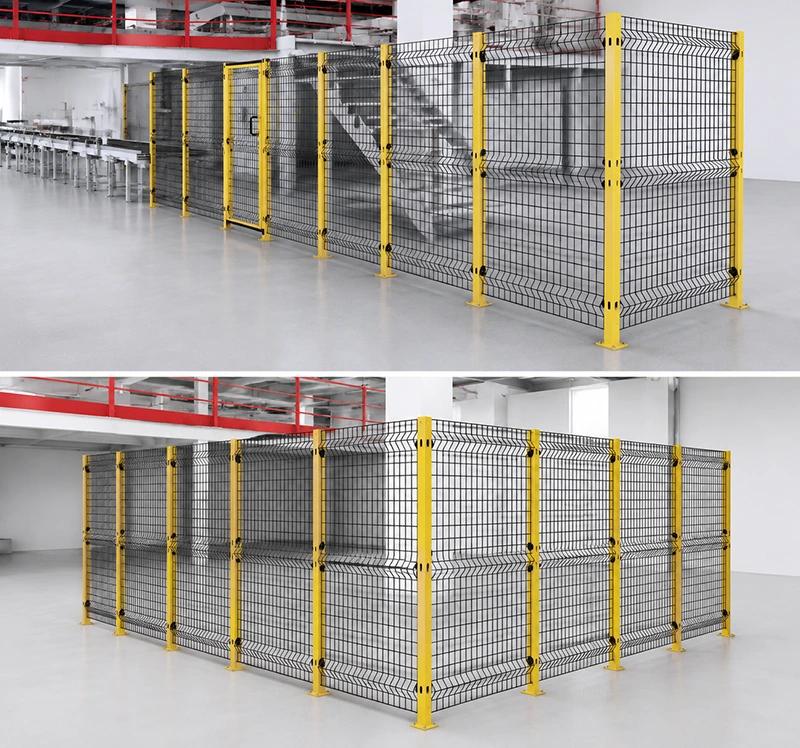
- Warehouse zoning: mark pedestrian routes, forklift path barriers and storage area separation with a visible yellow-black safety fence.
- AGV lane separation: create a readable boundary for automated traffic flow planning without obstructing line-of-sight.
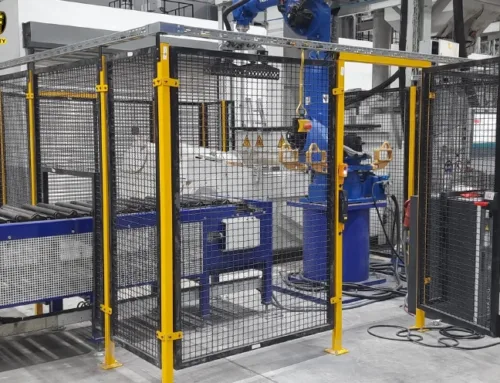
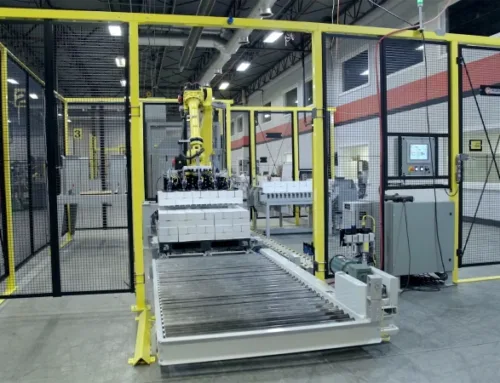
- Robot safety fence: enclose robotic workstations and automated equipment guarding where the requirement is perimeter demarcation rather than certified impact containment.
- Workshop retrofit: use on-site cutting, clip fixing and modular reconfiguration when dimensions change after commissioning.
- Cable management fence: use the T-shaped ridge space for line-side routing; wood slat inserts are available where visual shielding is required.
Mefence is intended for non-high-impact area demarcation, machine-guarding perimeters and traffic control. It is not presented as a certified anti-collision guard. For direct impact containment, integrators should specify SGF’s higher-spec Machine Fence line.
Specify One Standard for Every Local Crew
For a cross-border project, issue the same panel schedule, post sizes, connection details and three-step installation sequence to each site. Mefence supports that process with Q235 carbon steel welded mesh, powder-coated steel components, standard yellow-black finish and documented clip-fixed assembly. Confirm the required mesh opening, wire diameter, panel dimensions, post size, floor condition and access points before release. This turns a variable welding operation into a controlled modular installation package.
Build the Boundary Into the Product
Tell SGF your warehouse zoning, AGV lane separation or robot workstation layout. We can help match panel dimensions, base fixing and connection details to a repeatable installation standard for each country.