EN
 DE
 RU
 PT
 JA
 ES
 IT
Internal shrinkage · warehouse, plant and multi-family storage
Pilferage Rarely Breaks In — It Walks Through on a Valid Badge
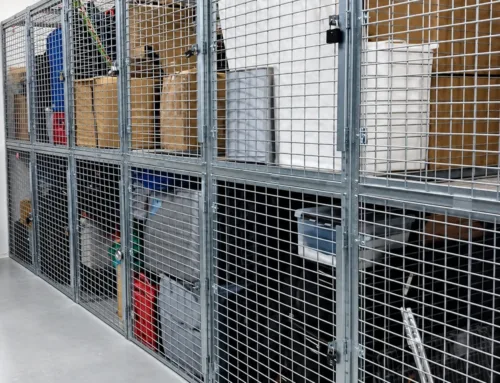
Warehouse-loss guidance is blunt about where stock actually goes: a large share of it leaves with an employee or a contractor who was entitled to be in the building and knew where the cameras were pointed. Their advantage is never strength — it is having a dozen unlocked places to stand next to. A lockable wire mesh storage cage removes that choice. It collects high-value goods into one enclosure with a single hinged mesh door per bay, one marked lock position, and one register that can be pointed at, so a missing item has an owner and a moment attached to it rather than a shrug.
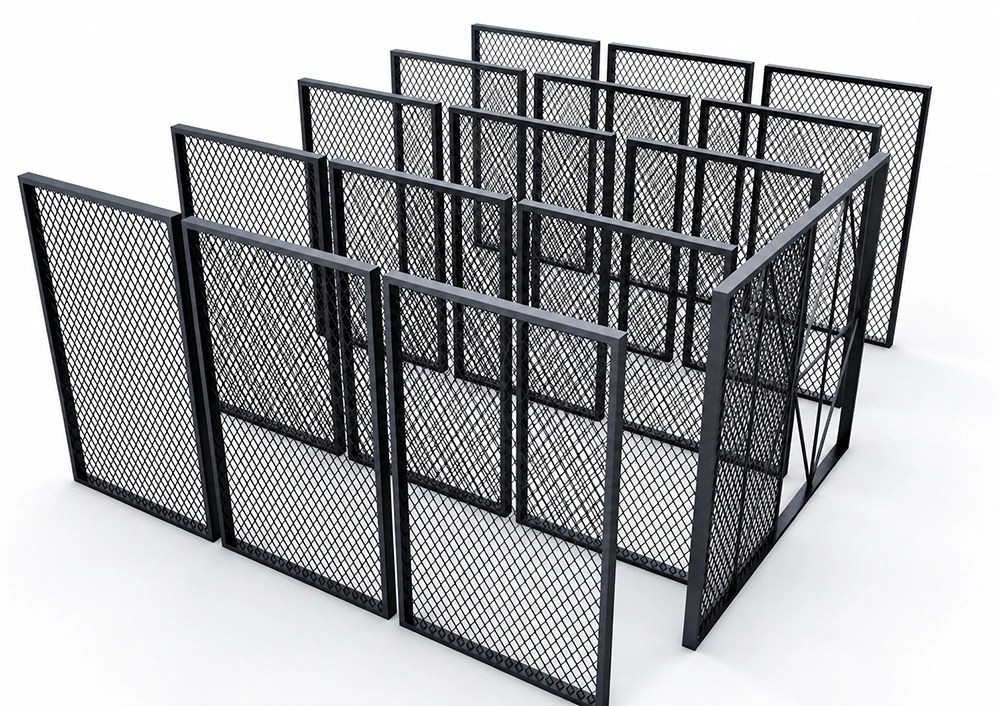
What a Wire Mesh Storage Cage Actually Is, Built Piece by Piece
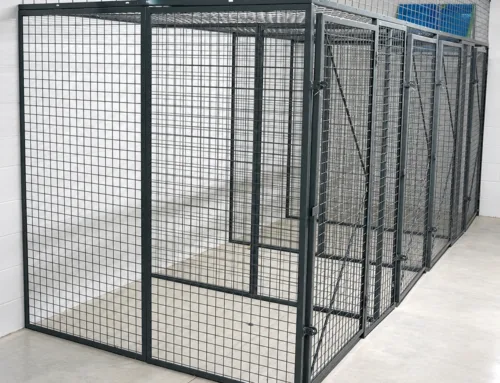
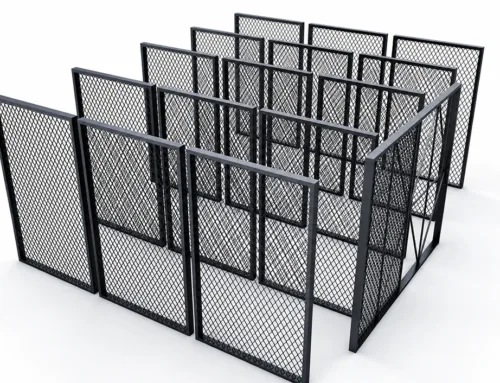
A security cage for warehouse use is not a welded room and it is not a wooden shed. It is a bolt-together boundary: galvanised welded mesh panels clamped to steel posts, drawn back to back between bays with straight bolts and through-nuts on 90-degree angle screws, standing on expansion bolts driven into the slab once the run is squared. It can be run as a walk-in storage cage for a tool crib or as single-tier and double-tier bays for employee storage lockers, with custom heights, widened and deepened bays, base plinths, shelves and mesh fill specified per project.
| Specification item | What the plant or property gets |
|---|---|
| Boundary material | Galvanised steel welded mesh panels on steel posts — a ventilated storage locker face, not a solid panel wall |
| Panel fixing | 90-degree angle screws to the post; adjacent panels drawn back to back with straight bolts and through-nuts |
| Door and lock | One long-strip hinged mesh door per bay, with the lock position scribed on the door bar for a padlock, keyed lock or electronic reader |
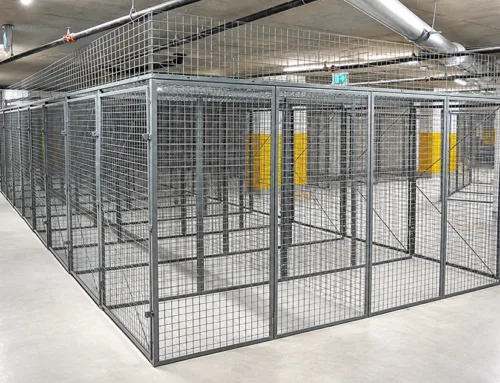
| Ceiling | Top mesh panel on a top rail only where the run stops below the ceiling — so sprinkler spray and air paths stay open |
| Anchoring | Expansion bolts into the slab, driven after the run is squared and levelled |
| Erection | Two people, a hand drill and a wrench — no welder, no hot-work permit, no wet trades |
| Configuration | Custom bay height, widened or deepened bays, base plinth, shelves, mesh fill and door type specified bay by bay |
| Reconfiguration | Modular storage cage: unbolt the run and re-lay it when the stock profile changes |
Why the Single Locked Door Changes the Loss Calculation
One Bay, One Lock, One Name
Pilferage survives on ambiguity. When consumables, fittings and instruments sit on open shelving without lock, every one of them is available to everyone at all times, and no conversation can be had about who touched what. A run of lockable storage cages assigns one hinge line and one padlock position per bay, so a bay can be signed out to a shift, a crew or a tenant. The cage does not police the building; it makes the record possible — a key log, a badge swipe or a sign-out sheet finally has something specific to point at. The same property holds on the residential side, where a basement storage cage with its own lock gives each tenant storage cage an address instead of a corner.
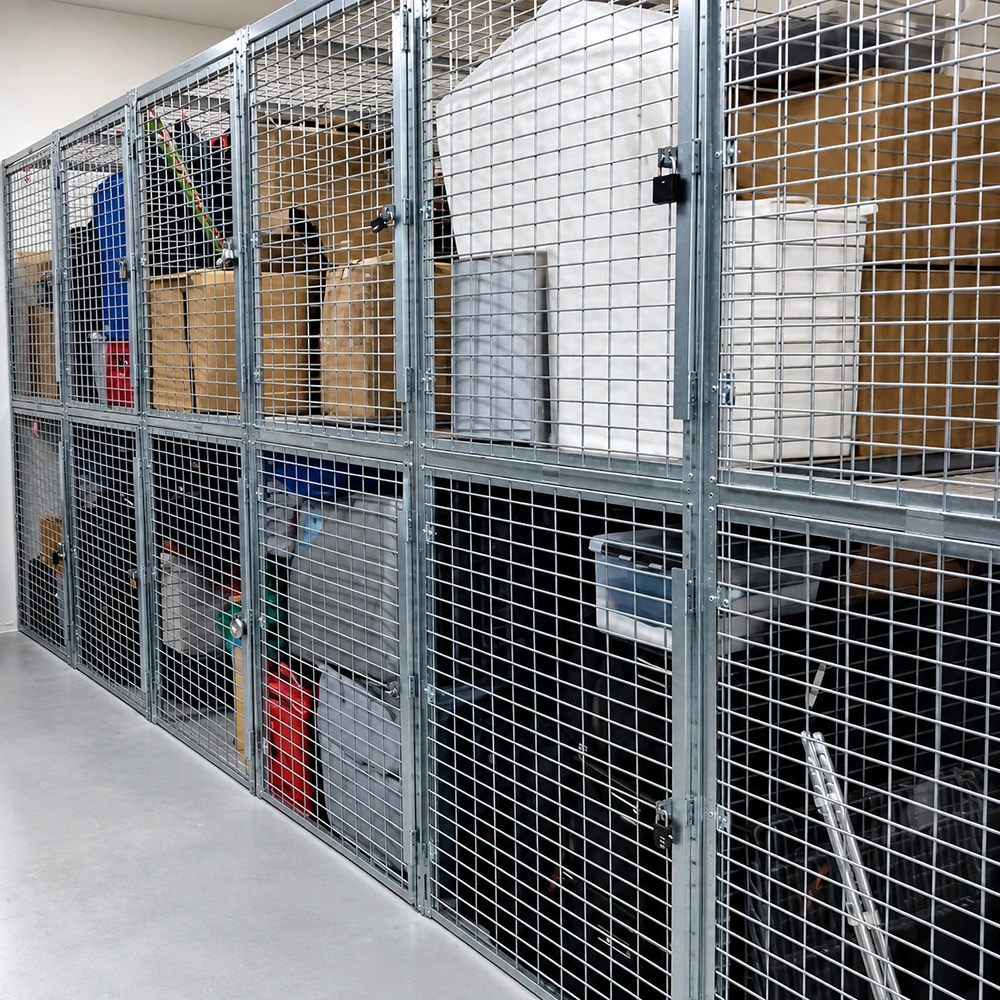
Bolted Frames and Diagonal Bracing, Not a Soft Panel
A cage that bends at the first prying attempt is only a visual boundary. The loaded panels here clamp to steel posts with 90-degree angle screws and lock the neighbouring panels together with through-nuts, and where a bay faces a working aisle an X-shaped diagonal brace carries the racking load and resists the deformation that prying depends on. This is the practical answer to the wire mesh vs solid metal locker argument: the mesh face gives back ventilation and sightlines, while the frame and bracing provide the resistance. The same frame detail — reinforced border, punched oblong mounting slots, welded mesh junctions — is what makes the enclosure an industrial tool storage cage rather than a partition panel leaned into place.
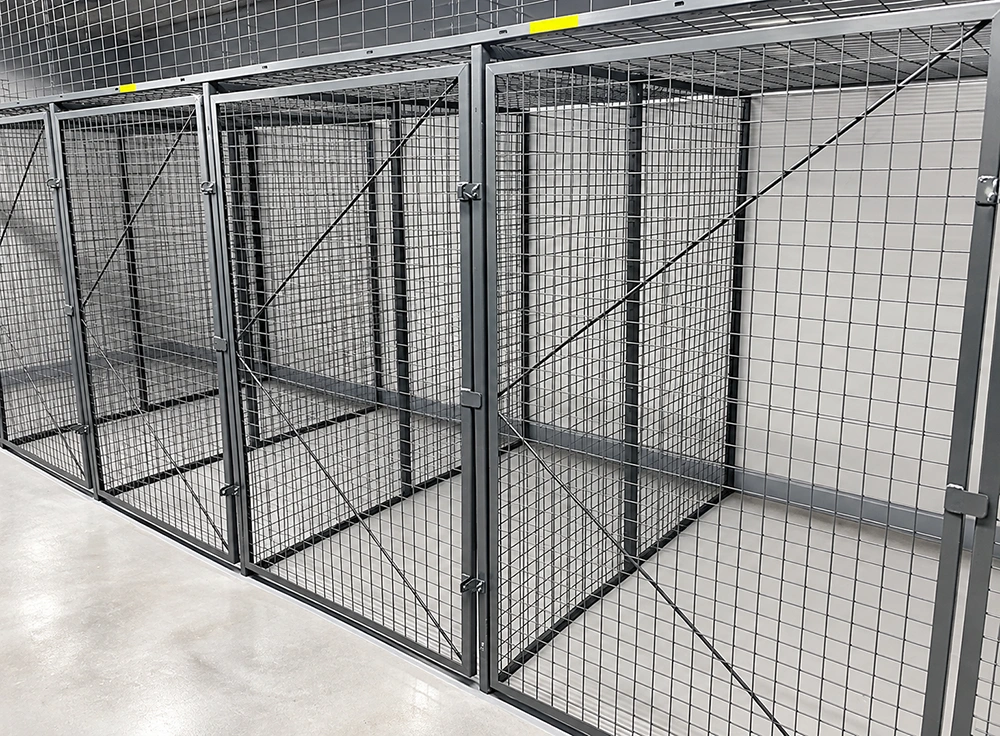
Freestanding Enough to Be Built Around the Stock You Have
The alternative to a storage cage vs storage room decision is usually a masonry store that needs permits, cure time and a production stop. A freestanding cage is assembled against the wall the goods already live beside: expansion bolts into the existing slab, a single-tier full height storage locker run where vertical space is free, a small storage cage for the copper fittings and the instruments that leave in a pocket. The build fits the footprint rather than the other way round, two people complete it with a hand drill and a wrench, and the floor keeps working while it goes up. A space saving storage cage in the corner of a plant and a basement storage cage in a residential building use the same parts.
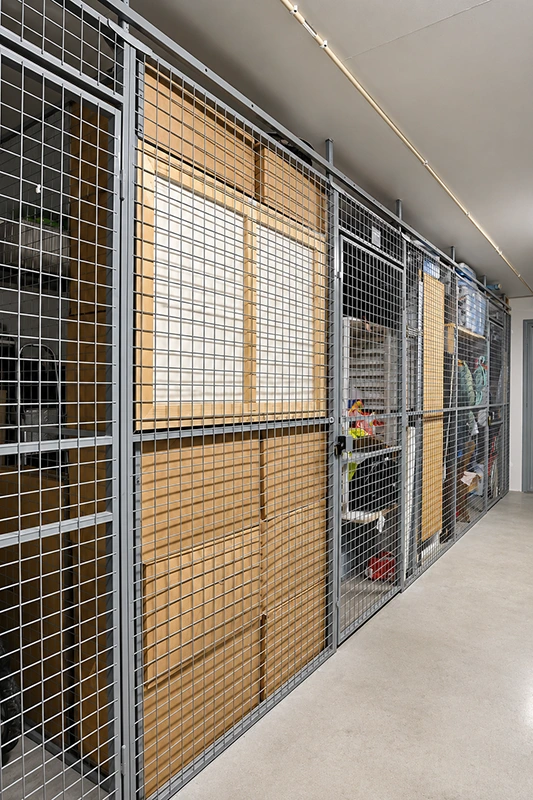
Where an Internal-Loss Cage Earns Its Floor Space
- Warehouse storage cage for high-value pick stock — a locked sub-store inside the building, reached only by the staff who hold the key.
- Industrial tool storage cage and equipment storage cage — one walk-in tool crib cage with a single issue point instead of twelve unlogged drawers.
- Employee storage locker runs — staff belongings or staff-assigned tooling kept in a bay with the lock position marked on the bar.
- Data center security cage and server cage — rack hardware inside a boundary that a badge only opens twice, with mesh keeping the airflow path intact.
- Tenant storage cage in apartments and condominiums — a lockable basement or garage storage cage per unit, readable and countable from the aisle.
- Fire code compliant storage locker zoning — mesh panels keep sprinkler penetration and ventilation where a solid steel partition would close them off.
In every one of these settings the pattern is the same: fewer doors, each of them named. A ventilated storage locker run that a supervisor, a camera and an auditor can read from the aisle costs less to police than a corridor of closed steel doors whose only readable state is locked or unlocked. Physical separation closes the opportunity; the register closes the excuse.
Drawings, Bay Schedule and Lock Plan
Send us the floor you actually have — bay count, clear height, the slab condition and which stock keeps going missing — and we will return a bay-by-bay drawing with the door positions, the marked lock positions and the quantity of mesh panels, posts and expansion bolts. Custom size storage cage runs are quoted from those numbers, not from a catalogue page.
Put the Loose Stock Behind One Door
Tell us what disappears and where it is stored today. We will size the cage, mark the lock positions and hand you an install plan that two of your own people can finish without a welder on site.