EN
EN  DE
DE  RU
RU  PT
PT  JA
JA  ES
ES  IT
IT Fence guarding for metal recycling yards
Fence guarding for dense metal recycling sites that cannot spare safety space
Fence guarding is not only a compliance item in an indoor sorting center. When floor space is expensive and equipment is packed tightly, Mdfence helps keep the line safe with a 20×100 mm precision mesh and a minimum legal separation reduced to 120 mm, so more room stays available for stock, traffic, and turnaround.

Why dense recycling operations choose Mdfence fence guarding
In indoor scrap sorting and metal recovery, traditional guarding often forces a generous safety setback that eats into storage lanes and working aisles. Mdfence is built for the opposite problem: it protects the machine line while compressing the legal isolation distance as far as 120 mm, which is exactly where space pressure is highest.
| Requirement | Mdfence answer |
|---|---|
| Space is expensive | Compact fence guarding layout preserves valuable floor area for stock and movement |
| Dense equipment arrangement | 20×100 mm precision mesh supports tight, compliant isolation around packed lines |
| Legal safety distance | Minimum separation can be reduced to 120 mm where the layout must stay compact |
| Multi-site consistency | Suitable for standardizing one fence guarding logic across a large network of sites |
| Operational result | More area remains available for sorting, staging, transfer, and rework |
Structure and installation evidence behind the fence guarding result
20×100 mm mesh that protects without over-consuming space
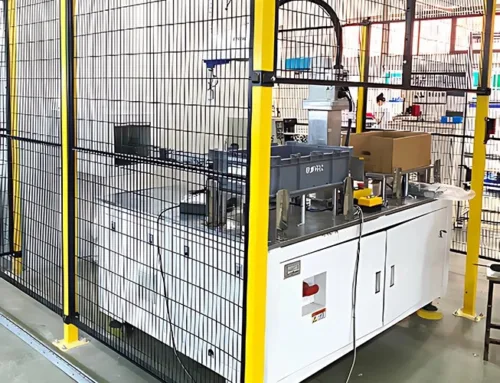
The key reason this fence guarding system fits cramped recycling layouts is the precision mesh geometry. It gives the line a controlled barrier profile instead of a bulky perimeter, so the guarding line follows the equipment footprint instead of forcing the room to grow around it.
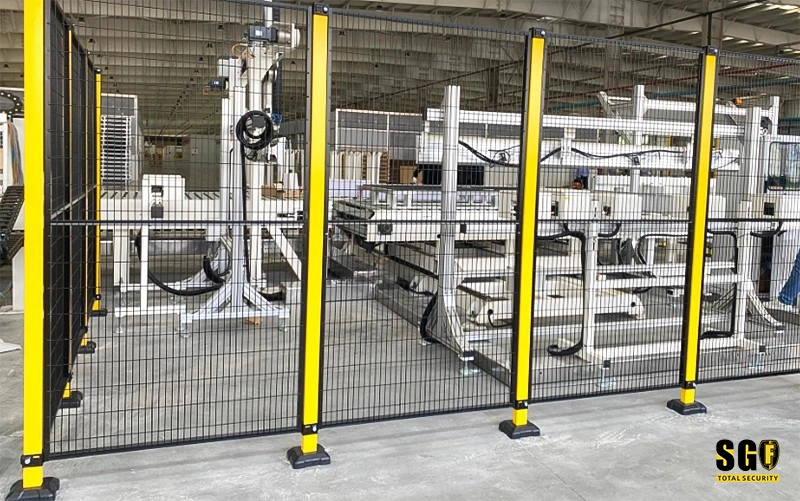
Anchoring details that keep the installation controlled
Dense sites need repeatable installation, not guesswork. The base plate drilling, expansion bolt fixing, and retaining ring sequence give the fence guarding structure a clear mechanical path from layout to finished protection, which matters when the line has to be installed around active storage and transfer zones.

Post and clamp layout that supports tight perimeter control
The post, mesh panel, and fixing clamp relationship is the structural proof that this is a working fence guarding system, not just a visual barrier. It is built to organize the boundary cleanly, keep the edges consistent, and support compact machine-side isolation where every millimeter matters.
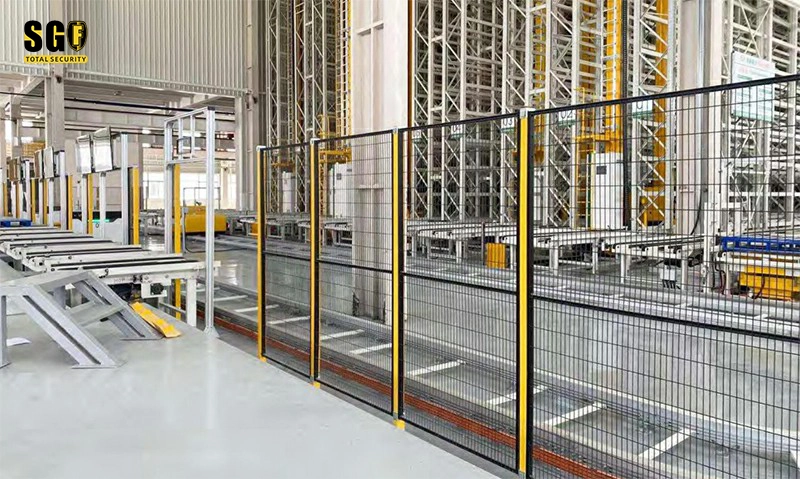
Where this fence guarding layout fits best
- Indoor scrap sorting centers where storage density is high and aisle width is already limited
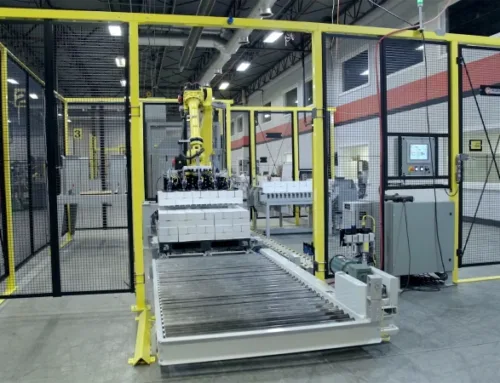
- Metal recycling lines that need compact separation around conveyors, transfer points, and baling equipment
- Retrofits that must reclaim usable floor area without losing compliance
- Multi-site operators that want one standardized fence guarding rule across many locations
For a global recycling group with 135 sites, the benefit is cumulative. A small saving at each machine line becomes a large gain in usable storage, staging, and circulation space when the same fence guarding standard is repeated across the network.
What to check before a compact fence guarding retrofit
Start with the real machine footprint, the traffic path, and the storage edge. Then verify where the legal separation can be compressed to 120 mm, where the 20×100 mm mesh will protect the hazard zone, and where the base plates can be fixed without blocking future maintenance access.
Turn wasted clearance into working space
If your plant is short on room, Mdfence gives you a fence guarding strategy that protects the process without surrendering expensive floor area. Share your layout and we will help map the compact isolation path.