EN
EN  DE
DE  RU
RU  PT
PT  JA
JA  ES
ES  IT
IT Machine Fencing
Machine Fencing for ISO and OSHA Audit Readiness Across Multi-Site Manufacturing
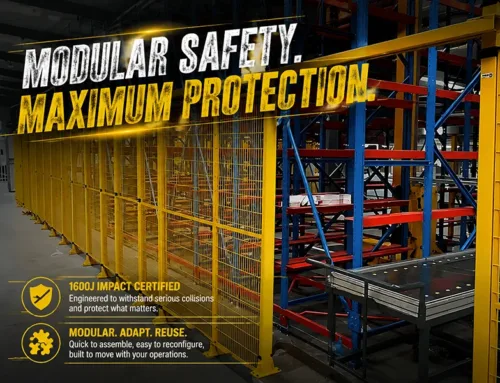
For a North American industrial group running multiple plants, the compliance problem is rarely the fence alone. The real issue is whether every site can use one repeatable Machine Fencing standard that keeps auditors, EHS teams, and operations managers aligned. Mdfence turns that requirement into a consistent physical boundary, a documented installation method, and a visible inspection trail.

Why old perimeter guarding fails under strict review
Many plants still rely on mixed fence repairs, local subcontractor habits, and ad hoc gate placement. That approach may keep machines separated from day-to-day traffic, but it does not scale when ISO documentation and OSHA scrutiny become part of the same review cycle. Machine Fencing is the safer answer because it standardizes the boundary, the fixing method, and the maintenance access points so every site can be inspected with the same logic.
| Audit requirement | Mdfence response |
|---|---|
| One standard across regions | Machine Fencing uses a repeatable layout of posts, mesh panels, gates, and base plates so global sites do not drift into one-off local fixes. |
| Evidence that can be shown to an inspector | The product images document weld seams, coating quality, caliper checks, and base plate details, which gives the safety team a clear physical record. |
| Predictable installation on live sites | The installation sequence shows drilling, expansion bolts, and retaining ring assembly, helping field teams follow the same method at every plant. |
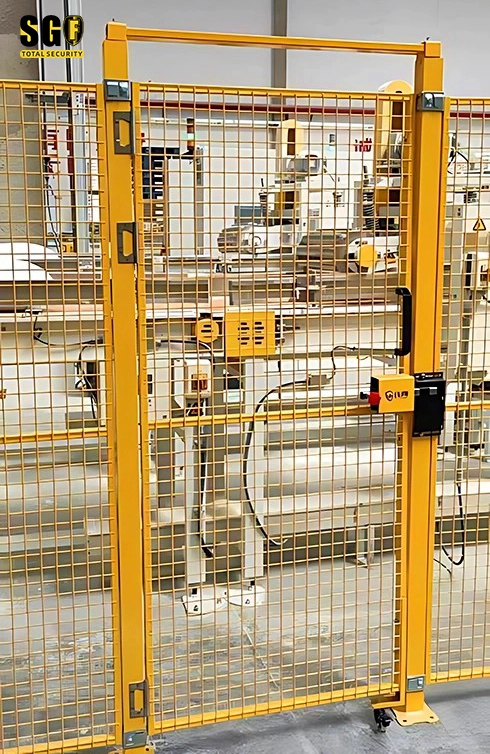
| Controlled access around machines | Gate hardware and framed mesh access points separate operator movement from maintenance entry without sacrificing visibility. |
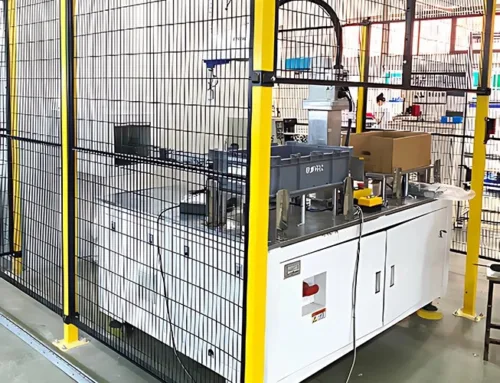
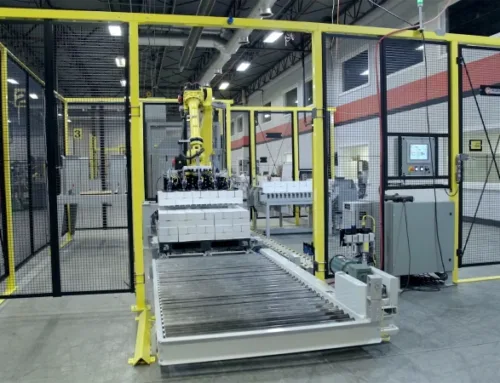
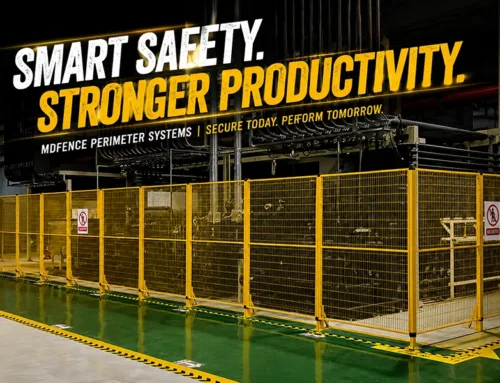
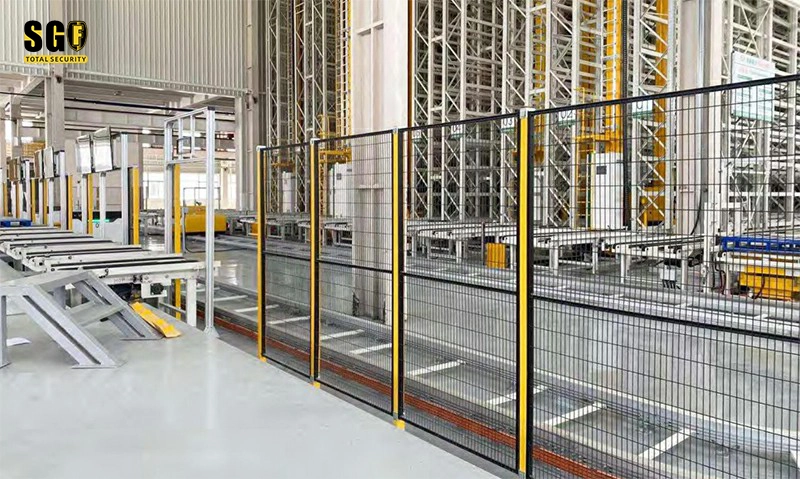
| Clean perimeter result after retrofit | Continuous guarding around a machine line creates a boundary that is easy to explain during an OSHA walk-through and simple to replicate for future expansions. |
Structure and photo evidence that support a compliance standard
Installation that safety teams can sign off
The installation image shows the practical side of Machine Fencing: base plate positioning, drilling, expansion bolts, and retaining ring assembly. This matters because compliance projects fail when site crews improvise. With a defined fixing sequence, Mdfence gives each plant a repeatable installation method that can be added to SOPs, handed to contractors, and reviewed after the fact. That is the difference between a barrier that exists and a barrier that is documented.

Structure that can be inspected, not guessed
The technical front view shows the relationship between post, mesh panel, and fixing clamp. For a multinational manufacturer, that visual clarity is valuable because auditors do not just ask whether a fence is present; they ask how the parts are joined, how the perimeter is maintained, and whether the same structure appears at every location. Machine Fencing supports that review by keeping the physical logic straightforward and visible.
Access control at the point of entry
The gate close-up shows framed mesh, lock hardware, and a controlled access point. That detail is important in an ISO and OSHA environment because the fence is not only a perimeter; it is a procedure boundary. Maintenance can enter when required, operations can keep the normal path closed, and the plant can demonstrate that entry points are managed rather than left to habit. This is one of the clearest reasons Machine Fencing fits a global compliance program.
Where Machine Fencing fits best
- Multi-site factories that need one safety fence standard instead of different local versions at each plant.
- Machine lines and automation cells that must stay visible, reachable for maintenance, and isolated for daily operation.
- Retrofit projects where the old barrier was patched over time and no longer provides a clean audit story.
- Facilities facing global review cycles where ISO documentation and OSHA expectations must match the same physical layout.
For these scenarios, Mdfence is not just a product line. It is a compliance language that safety, engineering, and operations can all read the same way. The fence, the gate, the fixings, and the installation record work together so the result is easier to approve, easier to inspect, and easier to replicate when the next site comes online.
What to confirm before rollout
Before a global deployment, confirm the gate locations, base plate fixing method, coating finish, and site photo record. Those four points are usually what separate a quick local install from a defendable compliance standard. The product images in this article show each of them in a way that can be translated into procurement notes, contractor instructions, and internal audit files.
Build a site-wide Machine Fencing standard
If your plant network needs a fence system that can survive both day-to-day use and formal safety review, Mdfence can help you turn scattered barriers into one consistent Machine Fencing baseline. Use the same structure, the same install logic, and the same visual proof across every site.