EN
EN  DE
DE  RU
RU  PT
PT  JA
JA  ES
ES  IT
IT Machine safety fencing for audited manufacturing
Machine safety fencing for ISO and OSHA audit readiness in multi-site manufacturing
When a North America–headquartered multinational must pass strict OSHA review across every plant, machine safety fencing stops being a line-item purchase and becomes a compliance baseline. Mdfence gives AIM a single guarding standard that can be applied across sites without weakening the audit trail.
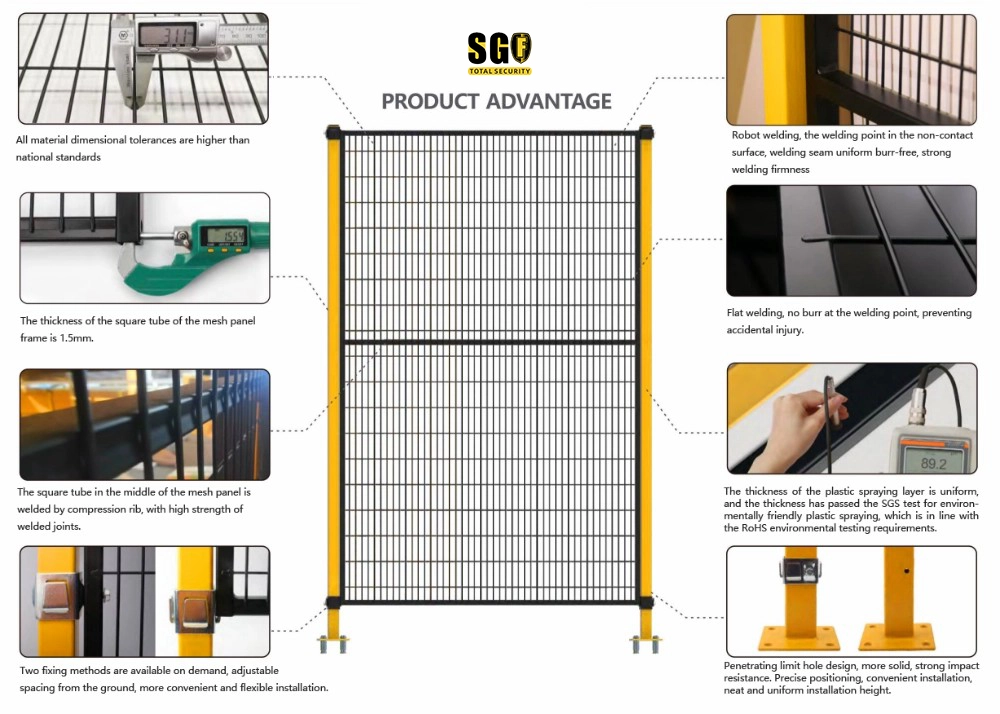
Why the old guarding approach fails audit review
AIM’s problem is not simply machine exposure. The real risk is inconsistency: one plant uses a different fence height, another uses a loose gate detail, and a third has guarding that looks acceptable on the floor but cannot survive an OSHA question-by-question review. Machine safety fencing must therefore do three things at once: separate people from moving equipment, support a repeatable plant standard, and leave a clear evidence trail for internal and external audits.
| Audit requirement | Mdfence response |
|---|---|
| Uniform guarding standard across sites | Modular machine safety fencing can be duplicated plant to plant without changing the baseline protection logic. |
| OSHA-facing physical separation | Black mesh panels and framed access points create a visible, continuous barrier around the hazard zone. |
| Clear maintenance access | Gated sections keep the cell serviceable while maintaining controlled entry. |
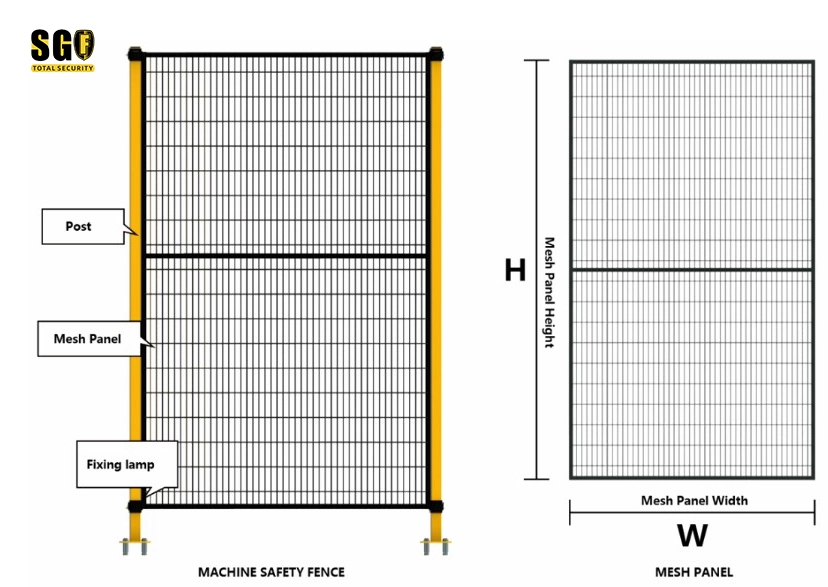
| Documentation-friendly installation | Fixed posts, base plates, and clamp-based panel layout make the installation easy to verify and reproduce. |
Why Mdfence fits this compliance use case
1) A frame that reads as a real safety boundary
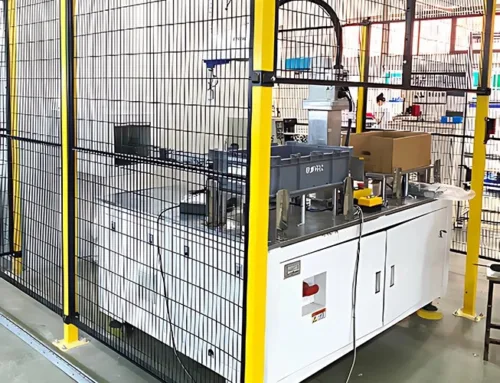
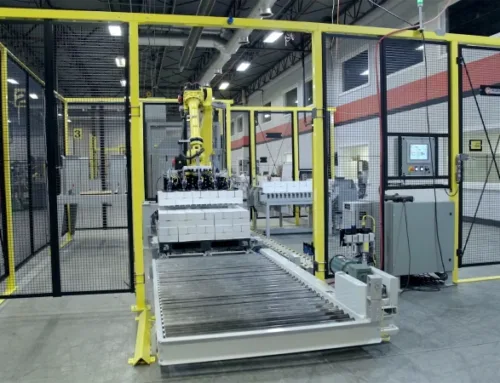
For audit-heavy operations, appearance matters only because it reflects structure. The framed guarding cell in this installation shows a clean perimeter with yellow posts, rigid top members, and mesh infill that makes the protected zone obvious from a distance. That is useful when a plant manager needs the barrier to be self-explanatory on a walk-through, not just defensible on paper.
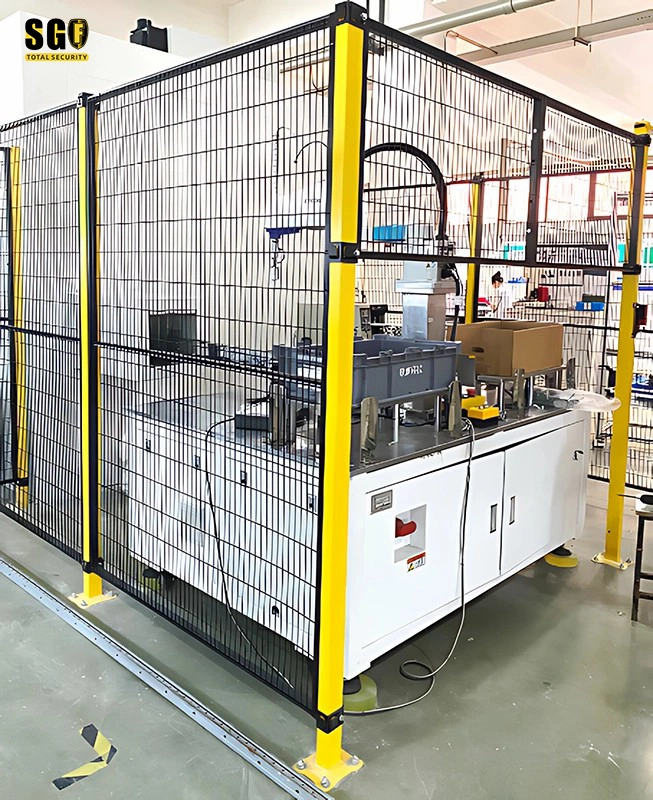
2) Separation that supports traffic control and workflow discipline
OSHA review often exposes a larger operational weakness: people, carts, and transfer equipment are moving through the same space. Mdfence reduces that risk by creating a predictable perimeter around the machine line and the transfer path. That lets the site establish a single traffic model instead of a different local workaround at each plant.
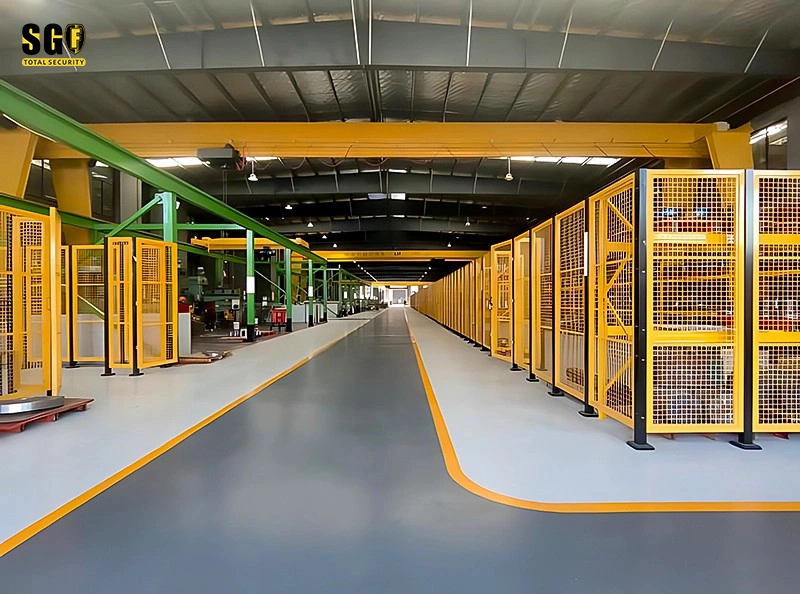
3) A layout that can be standardized across multiple factories
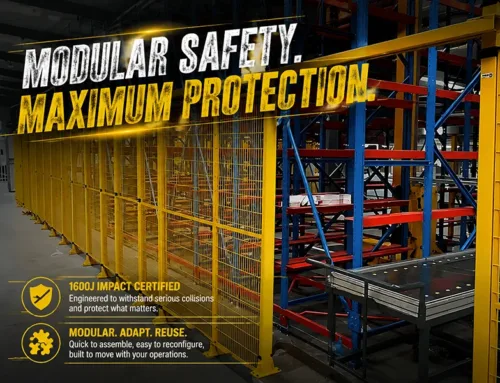
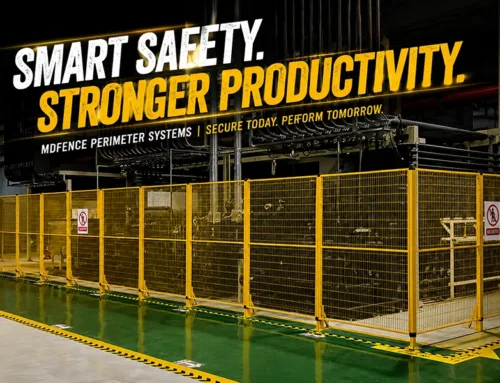
The wider aisle view shows how the same guarding logic can run continuously along a production zone. That matters for a multinational buyer because the strongest compliance program is not the one good cell in one flagship site; it is the one that can be repeated across every facility with the same geometry, access logic, and maintenance expectation.
Where this machine safety fencing is most effective
- Robot or automation cells that need a visible, auditable perimeter
- Machine lines where forklifts, carts, or transfer equipment share the building
- Multi-site manufacturers that must apply one guarding standard globally
- Plants preparing for OSHA review, internal safety audits, or corporate compliance inspection
For AIM, the value is not a generic fence. It is a repeatable machine safety fencing platform that turns safety into a standard operating condition. Once the same guarding logic is rolled out across plants, the company reduces interpretation errors, shortens review cycles, and gives auditors a consistent physical baseline to verify.
What to lock before rollout
Before deployment, define the protected machine envelope, the controlled access points, the traffic side of the perimeter, and the installation sequence for each site. Then keep the same machine safety fencing logic across every plant so the compliance story stays identical from one audit to the next. The install detail in the gallery supports that approach: fixed base points, panel alignment, and clear clamp structure make it easier to specify, replicate, and inspect.
Build one guarding standard that stands up everywhere
When OSHA review is strict, the safest choice is not a patchwork of local fixes. It is a machine safety fencing system that can be repeated, inspected, and defended across every site. Mdfence gives your team a practical way to standardize compliance without slowing production planning.