EN
EN  DE
DE  RU
RU  PT
PT  JA
JA  ES
ES  IT
IT 
Profile Rack Guard development history

In the early 2000s, a group of innovative engineers set out on a mission to address a crucial issue faced by businesses operating in warehouses and storage facilities – the protection of industrial racking systems from damage caused by forklifts and other heavy equipment. Traditional steel barriers were not always practical or cost-effective for every business, sparking the need for a new, innovative solution. Thus began the development of the Profile Rack Guard, a product that would revolutionize warehouse safety.
Inception and Ingenious Material Choice
The journey of the Profile Rack Guard commenced with extensive research and brainstorming sessions. The team of engineers recognized that finding the right material was pivotal for success. After months of experimentation and evaluation, they struck gold with the idea of using high-density polyethylene (HDPE) as the primary material for the rack guard. HDPE’s exceptional durability, capable of withstanding heavy impacts and abrasions, proved to be an ideal choice for the application. Additionally, its lightweight nature and ease of installation presented an attractive advantage for businesses seeking an affordable safeguard for their racking systems.
Modular Design for Versatile Application
One of the key breakthroughs in the development of the Profile Rack Guard was its innovative modular design. The engineers devised a system where individual panels made of HDPE could be effortlessly interconnected to form a complete guard. This design enabled easy customization to fit the specific dimensions of any racking system, making it versatile for various warehouse configurations. The simplicity of installation meant that businesses could quickly install or remove the guard as needed, without extensive downtime or labor costs.
Rigorous Testing and Ongoing Improvements
Before its official launch in 2005, the Profile Rack Guard underwent rigorous testing to ensure it met industry standards for impact resistance and durability. Various weights and types of equipment were used to simulate real-world warehouse conditions, and the results were overwhelmingly positive. Satisfied with the product’s performance, the engineers proceeded to launch it, and its popularity soared among businesses looking for a cost-effective and reliable solution to safeguard their valuable racking systems.
Since its inception, the Profile Rack Guard has continued to evolve. In 2010, a new interlocking system was introduced, simplifying installation further and reducing the installation time. Five years later, the product was upgraded to include reflective strips, enhancing visibility in low-light conditions and further improving warehouse safety.
The Profile Rack Guard’s development history is a testament to the power of innovation and problem-solving in the engineering field. Its widespread adoption by businesses worldwide stands as a testament to its effectiveness and value as a protective solution for industrial racking systems. As warehouses and storage facilities continue to evolve, the Profile Rack Guard remains steadfast in its commitment to ensuring warehouse safety and the protection of valuable assets.
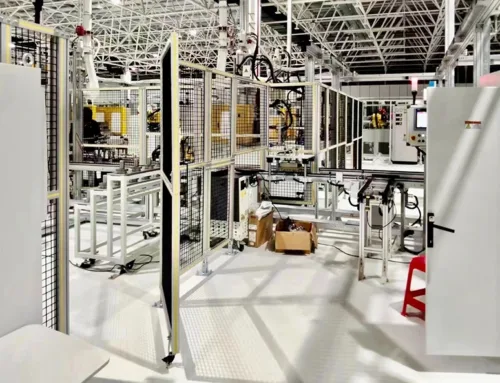
Equipment isolation fence for robot loading cells: Alfence stops nuisance shutdowns
For robot loading cells, Alfence equipment isolation fence keeps sensors, interlocks, and cable routes off painted steel posts so the PLC does not trip on false door signals.
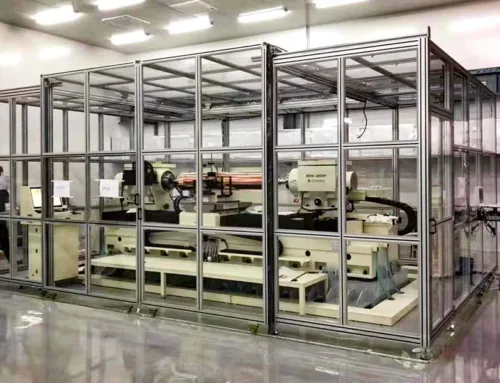
Machine Guard Fencing for Hygienic Food and Pharma Lines | Alfence
Alfence machine guard fencing uses aluminum profile safety fence construction and powder-coated corrosion protection to support hygienic food, beverage, pharma, and cleanroom layouts.
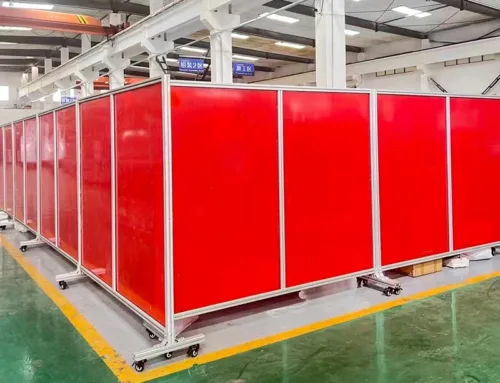
Machine Guard Fencing for Hygienic Food, Beverage, and Pharma Plants | Alfence
Alfence machine guard fencing uses aluminum profiles and powder coating to protect hygiene-sensitive lines with a cleaner, easier-to-maintain barrier.