EN
 DE
 RU
 PT
 JA
 ES
 IT
Profile Rack Guard : The FAQ
When it comes to security, there are a lot of moving parts. If you’re not in the security business, it can be difficult to keep track of all the different products and services that are offered. Protective barriers are one such service. But what exactly are they? How do they work? In this blog post, we’ll answer all your questions about protective barriers so you can make an informed decision about whether they’re right for you.

A protective barrier, also known as a security barrier, is a physical structure or device that is designed to block or prevent unauthorized access to a restricted area. Protective barriers can be found in a variety of environments, from high-security facilities such as military bases and government buildings to more mundane places such as schools and office buildings.
There are many different types of protective barriers, from simple fences and gates to complex electronic systems. The type of barrier used will depend on the level of security required and the nature of the threat. In some cases, multiple layers of security may be used, with each layer providing progressively tighter levels of protection.
A protective barrier works by creating a physical barrier between you and the person or object you are trying to protect yourself from. This physical barrier is the most common type of barrier, and this type of protective barrier can be made of a variety of materials, including wood, metal, or concrete.
There is a lot of debate around the effectiveness of protective barriers, some people believe they are an important part of keeping people safe, while others assert that they do more harm than good Are protective barriers effective? The short answer is that it depends. How the protective barrier should be used and the scenario in which it is used.
Now that we have a basic understanding of what protective barriers are and how they work, the best way to find out if they are right for you is to experiment with them.
A Tool Crib Is Not a Standard Shape: Custom Wire Mesh Storage Cages Drawn to the Floor You Actually Have
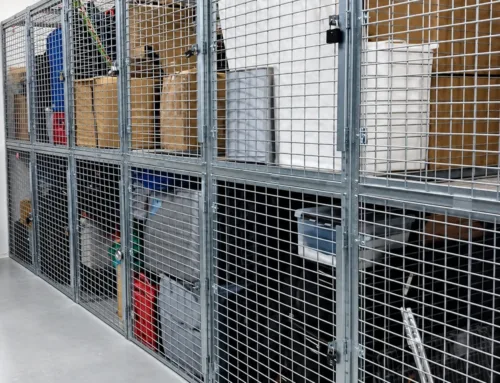
A catalogue tool crib assumes a rectangular room and a forklift arriving through the long side. Real spare parts stores have a column mid-bay, a rack depth set by the pallet that actually arrives and a two-and-a-half-metre wall beside a running machine. A custom wire mesh storage cage is specified from those numbers — bay height, widened and deepened bays, base plinths, shelves and mesh fill drawn per bay, one long-strip hinged mesh door per bay with its lock position scribed on the door bar, galvanised welded panels drawn back to back with straight bolts and through-nuts on 90-degree angle screws, expansion bolts after squaring. Two people, a hand drill and a wrench, no welder, no wet trades.
Top Mesh or Open Top: Sizing a Wire Mesh Storage Cage Around Sprinkler Deflectors and Air Paths
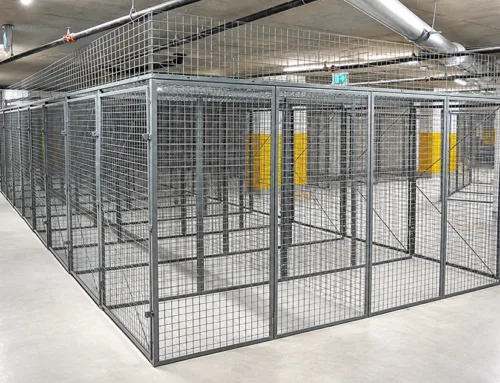
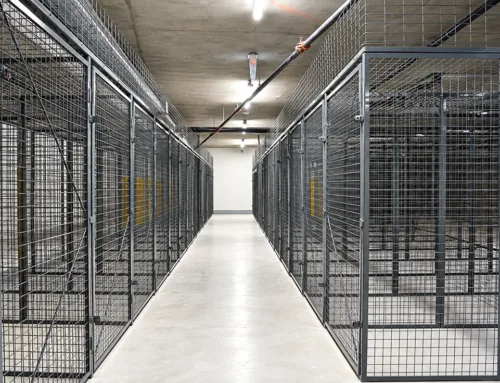
Solid partitions close two paths a storage room depends on: the air path that keeps a basement dry, and the spray path from the sprinkler deflector above the goods. A wire mesh storage cage keeps the lock and gives up the surface — galvanised welded mesh panels bolted to steel posts with 90-degree angle screws, one hinged mesh door per bay with its lock position scribed on the door bar, and a top mesh panel on a top rail only where the run stops below the sprinkler piping. Two people, a hand drill and a wrench, no welding under a live line.
A Tool Room That Dismantles: Bolt-Together Wire Mesh Storage Cages for Temporary Site Tool Lockup
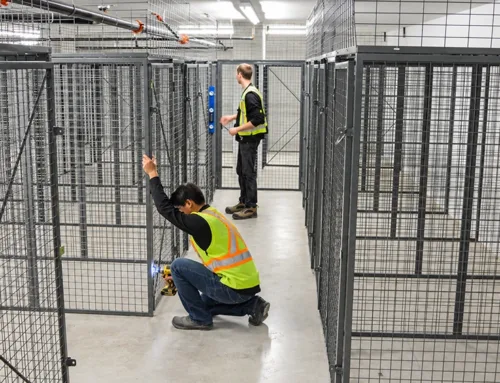
A temporary project needs a lockable tool room for the length of the programme and not a day longer. A bolt-together wire mesh storage cage goes up from parts — galvanised welded mesh panels bolted to steel posts with 90-degree angle screws, panels drawn back to back with straight bolts and through-nuts, one long-strip hinged mesh door per bay with its lock position scribed on the door bar, and expansion bolts driven after the run is squared. Two people, a hand drill and a wrench, no welding and no wet trades, and the same parts leave on the truck to the next site.