EN
EN  DE
DE  RU
RU  PT
PT  JA
JA  ES
ES  IT
IT Machine guarding for dense recycling aisles
machine guarding fence panels for dense indoor recycling aisles
Machine guarding fence panels are the right fit when floor space is expensive, equipment is packed tight, and safety rules still have to be met. For indoor metal recycling and sorting centers, Mdfence uses a 20×100 mm precision mesh design to cut the legal safety separation distance down to an extreme 120 mm, helping operators keep more room for storage, movement, and daily throughput.

Why the old setback model breaks in dense recycling sites
In indoor scrap sorting and recycling halls, every meter of aisle width is expensive. Traditional guarding often protects the machine but steals too much operating room, forcing teams to give up valuable staging space just to stay compliant. Mdfence was designed for exactly this problem: keep the machine boundary clear, keep the access path controlled, and keep the safety gap as small as the rules allow.
| Requirement | Mdfence response |
|---|---|
| Space pressure in indoor recycling aisles | Compact guarding footprint that preserves valuable floor area for scrap stacking and movement |
| Compliance without large setbacks | 20×100 mm precision mesh supports a legal safety separation distance down to 120 mm |
| Dense equipment layout | Modular panels let the fence follow the machine boundary instead of forcing a wide open buffer |
| Multi-site rollout consistency | Repeatable panel logic makes it easier to standardize layouts across 135 global sites |
What the structure proves on site
Close access control without wasted width
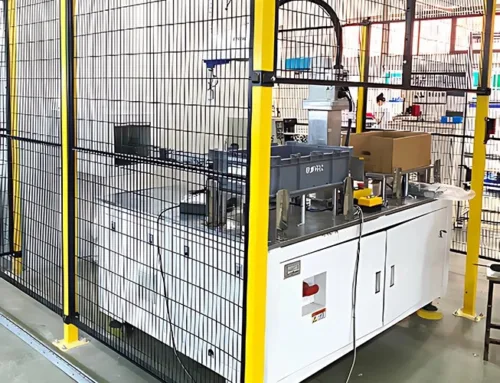
The lock-hardware close-up shows that the system is not just a mesh screen; it is a machine guarding fence panel with controlled entry. That matters in recycling lines, where operators need a safe gate, a clear boundary, and a compact footprint in the same package. The 20×100 mm mesh supports tight compliance while keeping the install line close to the equipment.

Panel geometry that wraps real machine cells
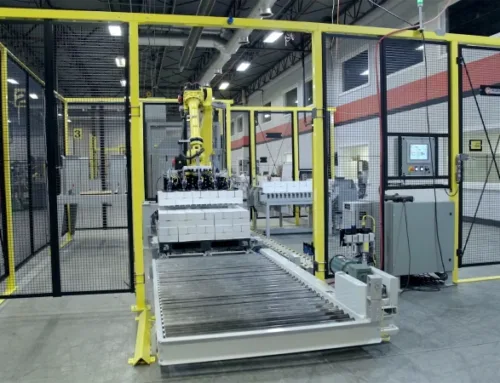
The automation-cell image proves the panels are built for real industrial boundaries, not showroom conditions. Yellow posts and black mesh define a clear perimeter around equipment, which is the same logic needed in dense sorting centers. Instead of leaving a wide protective moat, Mdfence keeps the guarding line tight so operators can protect the cell and still keep the hall productive.

Continuous perimeter isolation for long aisles
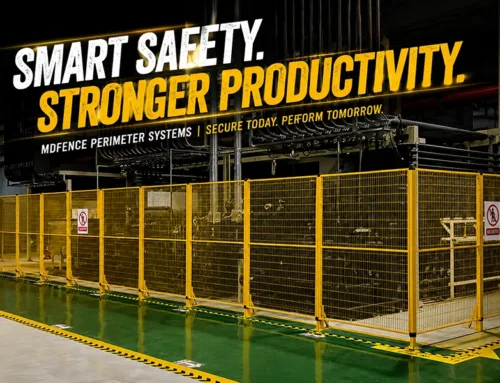
The long factory-line view shows how machine guarding fence panels can run along a perimeter without breaking the flow of the workspace. For recycling sites that rely on conveyors, transfer points, and narrow logistics lanes, that continuity is the difference between a safe layout and a cramped one. The result is a fence that protects the line while leaving more room for stock and handling.

Where machine guarding fence panels make the biggest difference
- Indoor metal recycling sorting centers with expensive floor area
- Scrap handling aisles that need compliance without a wide setback
- Conveyor and transfer zones packed close to storage and loading paths
- Multi-site operators that need one repeatable guarding standard
- Retrofit projects where safety cannot come at the cost of productivity
That is why machine guarding fence panels are a strong fit for Mdfence: the product answers the layout problem first, then the compliance problem, then the maintenance problem. In dense sites, those three things have to work together. A fence that saves space but creates access risk is not enough. A fence that is safe but wastes aisles is not enough either. Mdfence is positioned in the middle, where safety distance, machine access, and usable space can all be balanced.
What to specify before you standardize the layout
If you are comparing guarding options, start with the real site constraint: how much aisle width can you afford to lose. Then map that back to the structure. For Mdfence, the practical references are the 20×100 mm precision mesh, the 120 mm legal separation distance target, the gate hardware, and the continuous panel path around the machine zone. Those are the details that turn a generic fence into a space-saving guarding system.
Need machine guarding fence panels for a tight recycling site?
Send us the layout, the machine boundary, and the aisle width you need to preserve. We will review whether Mdfence can keep the compliance gap tight while protecting the working area you cannot afford to lose.