EN
EN  DE
DE  RU
RU  PT
PT  JA
JA  ES
ES  IT
IT MACHINE GUARDING FOR SCRAP METAL LINES
Scrap Metal Sorting Line Industrial Safety Fencing: Stop Jam-Clearing Accidents at the Gate
When a scrap-metal sorting line or baler jams, maintenance personnel may need to enter the danger zone repeatedly. A framed machine guarding fence with a safety interlock interface makes the access gate part of the machine safety circuit: when the gate opens, the project-defined STO or emergency-stop logic can remove machine energy before cleaning begins.
Why a jam-prone line needs more than a welded barrier
On heavy machinery, the old approach is often a welded safety fencing section with a padlock added later, or a basic mesh barrier that only signals “keep out.” Neither arrangement automatically proves that opening the access point has removed hazardous motion. Cutting, welding, grinding and repainting also extend downtime, while a rigid welded layout is difficult to modify when a conveyor, baler or shredder changes position.
| Engineering point | Specified approach for this physical guarding solution |
|---|---|
| Access during a jam | Use an interlocked safety gate and connect the selected switch to the machine safety circuit through the project-approved control architecture. |
| Switch installation | Use a prefabricated safety lock mounting carrier for Omron D4NL or Pizzato FS series devices; final switch, wiring and safety validation remain project responsibilities. |
| Panel construction | Typical system uses Q235 carbon steel posts and framed wire mesh panels, with common 20x100mm mesh and 3.0/4.0mm wire options subject to risk assessment. |
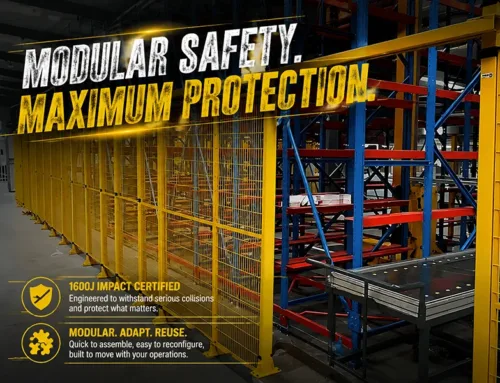
| Impact and anchoring | Standard documentation identifies a ≥1600J impact design basis; the applicable configuration must be confirmed with the contract, test evidence, floor condition and risk assessment. |
| Layout changes | Bolted panel-to-post connections support replacement, extension and reconfiguration without treating the whole guarding system as a permanent welded assembly. |
How the system closes the maintenance risk
1. A visible perimeter around the danger zone
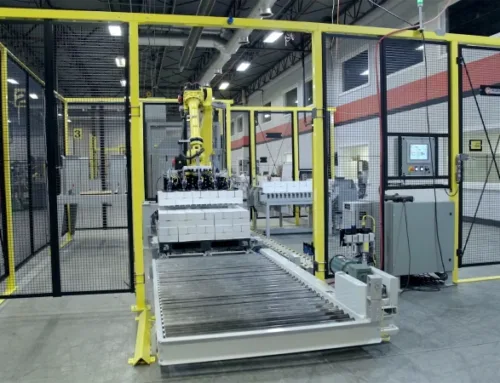
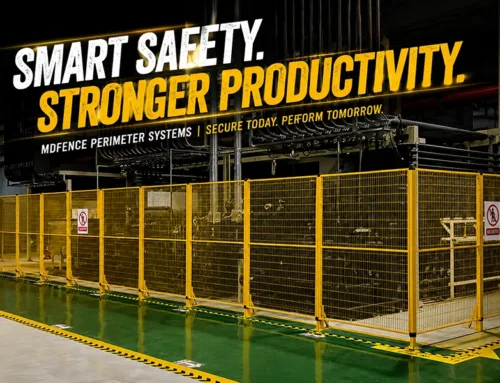
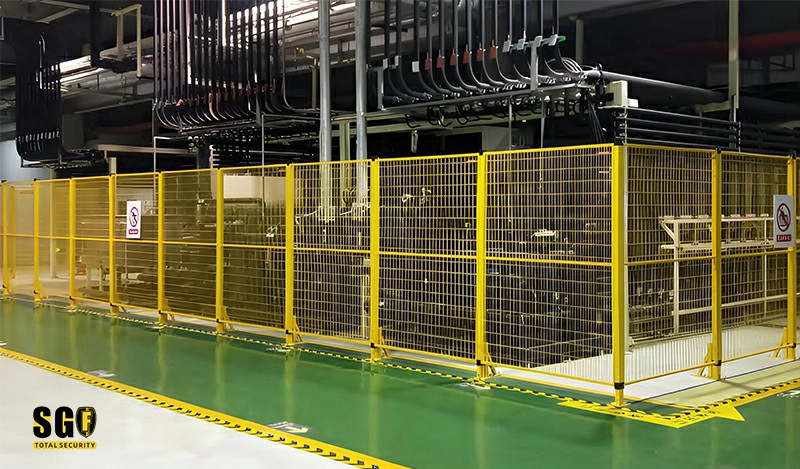
The continuous yellow mesh layout separates the automated line from the maintenance route and makes the machine perimeter guarding boundary clear at a glance. Framed panels, steel posts and floor-mounted bases create a defined equipment-isolation zone instead of relying on floor markings or a warning sign. This is the first layer of automated material handling safety: people are directed to a controlled entry point, while the line remains visible for supervision.
2. A gate prepared for the chosen safety interlock device
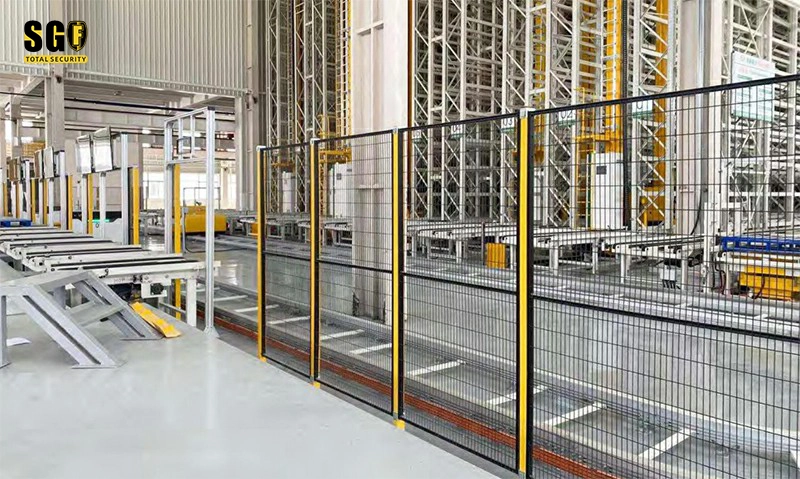
Frequent jam clearing makes the gate interface an engineering detail, not an accessory. The supplied adaptive lock carrier is prepared to mount mainstream Omron and Pizzato safety interlock devices without asking the installer to improvise a drilled plate on site. With an Omron D4NL or Pizzato FS series device selected for the application, opening the gate can provide the safety input that initiates the designed stop sequence. The carrier does not replace a safety relay, PLC, STO circuit or validation procedure; it gives the integrator a repeatable mechanical interface.
3. A gate structure that can be checked and maintained
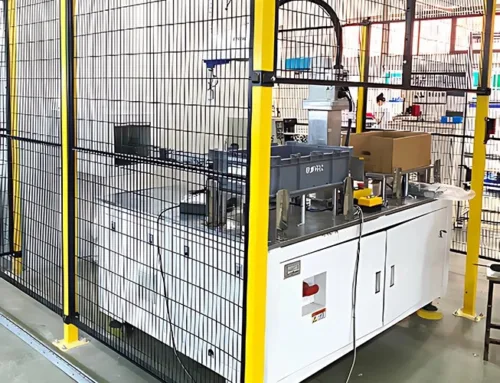
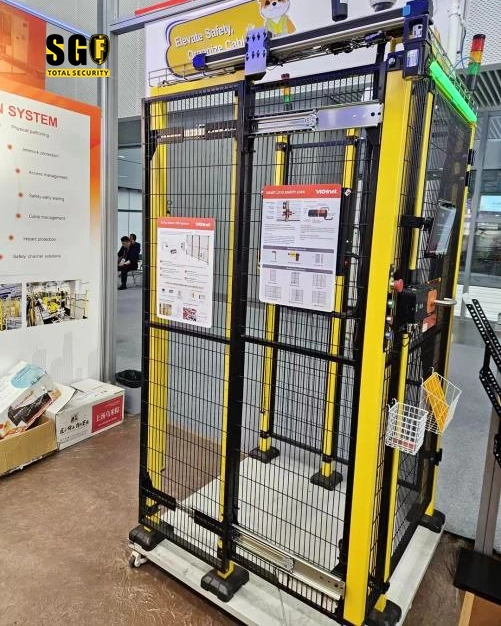
For a high-frequency maintenance route, the frame, latch position, hinges, gate stop and floor fixing must remain aligned. The illustrated gate shows the steel frame, black mesh infill and base-plate relationship used to organize that inspection. RAL1023 safety-yellow powder coating and RAL9005 dark mesh provide visual contrast; flat, burr-free welded joints and a framed panel help keep the access assembly predictable. Confirm the final post section, wall thickness, gate width, safety distance and anchoring hardware against the machine layout rather than copying a generic dimension.
Where this machine safety fencing approach fits
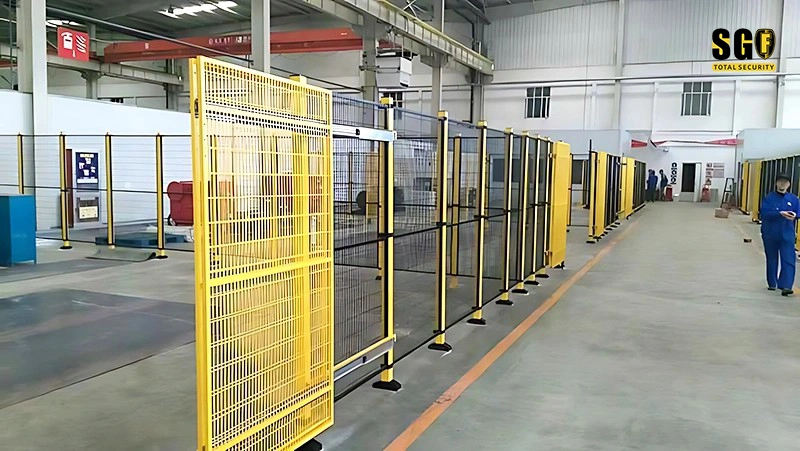
- Scrap-metal sorting and baling: control repeated access for jam clearing around shredders, conveyors and balers.
- Conveyor line safety guarding: coordinate transfer openings, guarded tunnels and access gates so material can pass without creating an uncontrolled personnel route.
- Machine perimeter guarding: isolate high-energy equipment while preserving inspection visibility and a defined maintenance entrance.
- Industrial automation safety: support EHS and automation teams as they document gate logic, lockout/tagout steps and verification points.
The same modular safety barrier concept can be configured for robot cell guarding, CNC machine guards and smart warehouse zoning, but the mesh, gate, safety distance and impact basis must be selected for the actual hazard.
What to confirm before release for fabrication
Send the machine perimeter drawing, hazard-zone dimensions, gate locations, conveyor openings, floor construction, required height and selected safety interlock device. The engineering review should check ISO 14120 and ISO 13857 or the applicable OSHA machine guarding requirements, then verify the safety circuit and STO response. Confirm whether the standard ≥1600J basis applies to the proposed configuration; do not extend that figure automatically to custom dimensions or different materials.
Turn repeated jam clearing into a controlled access procedure
Use a machine guarding fence as the physical boundary and the interlocked gate as the controlled signal point. SGF can review the line layout, panel configuration, gate type and Omron/Pizzato carrier requirement so the final BOM matches the maintenance risk—not just the perimeter.