EN
EN  DE
DE  RU
RU  PT
PT  JA
JA  ES
ES  IT
IT Mefence Industrial Safety Fencing | See-Through Perimeter for Robot Zones
See-Through Mefence Frameless Mesh for Robot Zones — Cameras and LiDAR Stay in the Loop
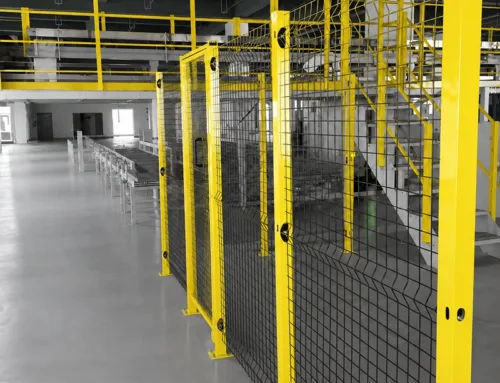
An AMR- or AGV-equipped fulfillment floor needs a hard physical line between the picker and the robot zone, but a solid wall or solid panel turns the perimeter into a blind spot for overhead cameras, LiDAR scanners and laser navigation. Mefence industrial safety fencing is a frameless welded wire mesh with a 50×50 mesh opening — open enough for LiDAR pulses and camera angles to pass through, tight enough to physically stop a person from entering the robotic workstation enclosure. The clip-fixed, yellow-black Q235 carbon steel perimeter carries OSHA, ANSI B11.19 and ISO 14120 guarding duty and the high-visibility warning signal at the same time, and it relocates with the robot zone when the floor plan changes.
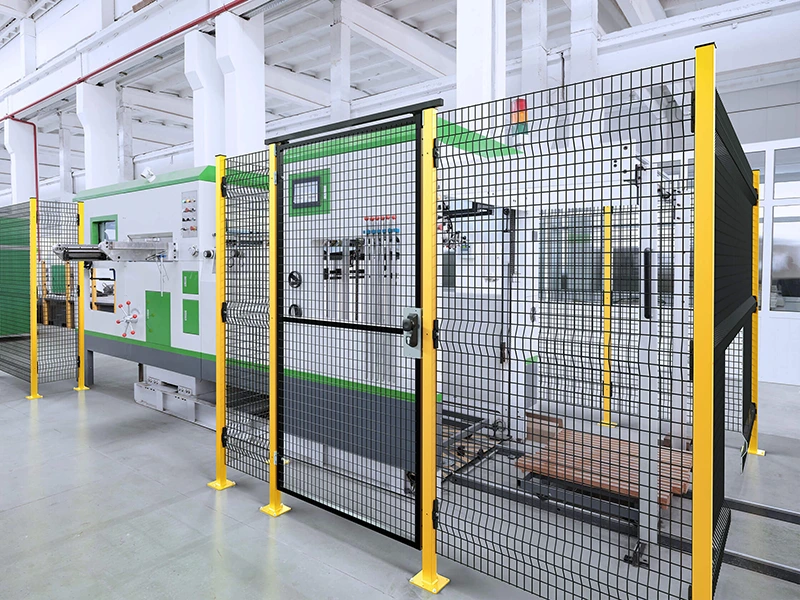
A Solid Wall Around a Robot Floor Hides What the Cameras and LiDAR Need to See
An AMR- or AGV-equipped fulfillment floor needs a hard physical line between people and the robot zone — but a solid wall or solid panel quietly turns the perimeter into a blind spot. Overhead picking cameras lose their line of sight, LiDAR scanners and laser navigation bounce off the panel instead of mapping the aisle, and supervisors cannot see a stalled robot or a fallen tote without walking over. The chain-link or rope alternative is the opposite failure: it marks the line but does not physically stop a distracted picker from stepping into the robot lane, so the safety case for the floor never closes. The perimeter has to do two things at once, and a single-material barrier cannot do both.
- Open welded wire mesh, 50×50 mesh opening: the same grid that physically stops a person also passes LiDAR pulses, overhead camera angles and the supervisor’s eye-line through the panel — the robot zone stays a guarded zone and a visible zone at the same time.
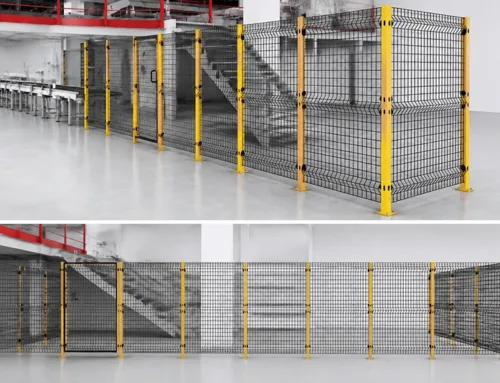
- Frameless 3D mesh, no frame border: the bent panel has no top or side frame to create a visual edge, so there is no thick rail to slice a sightline and no corner pocket to hide a stalled AMR.
- Q235 carbon steel, yellow-black powder coated: the warning colour is carried by the posts and the mesh pattern itself, not by an added solid plate, so the high-visibility signal does not come with an opaque surface.
- Mesh panel width 200–1400 mm, height 200–3000 mm: panels are cut on site against the actual robot aisle width and the camera mounting height, so the see-through band lines up with the vision system instead of fighting it.
- Posts 40×60 / 60×60 mm with base plate fixing: the slim post profile keeps the vertical edge narrow, so the camera’s field of view through the mesh is not eaten by a chunky column.
- Clip fixing, no welding required: plastic clips and self-tapping screws hold panels to posts, so the perimeter can be reconfigured when the robot zone moves without burning the existing fence.
Why a Frameless Welded Mesh Holds the Line on Safety and Sightline
1. A guarded zone the cameras and LiDAR can actually map
The core complaint with solid panels around an AMR or AGV aisle is that the safety barrier and the perception barrier are the same object: the moment the wall goes in, the LiDAR map loses a side of the aisle and the overhead picking camera loses its angle on the tote presentation station. A Mefence panel is a welded wire mesh in a 50×50 opening with 3–4 mm wire diameter — open enough that LiDAR pulses return from the floor and the racking beyond the panel, open enough that an overhead camera reads tote labels and pick faces through the mesh, and tight enough that a hand, a foot or a forearm cannot pass through to the robot cell. The same perimeter that protects the picker also keeps the perception stack intact.
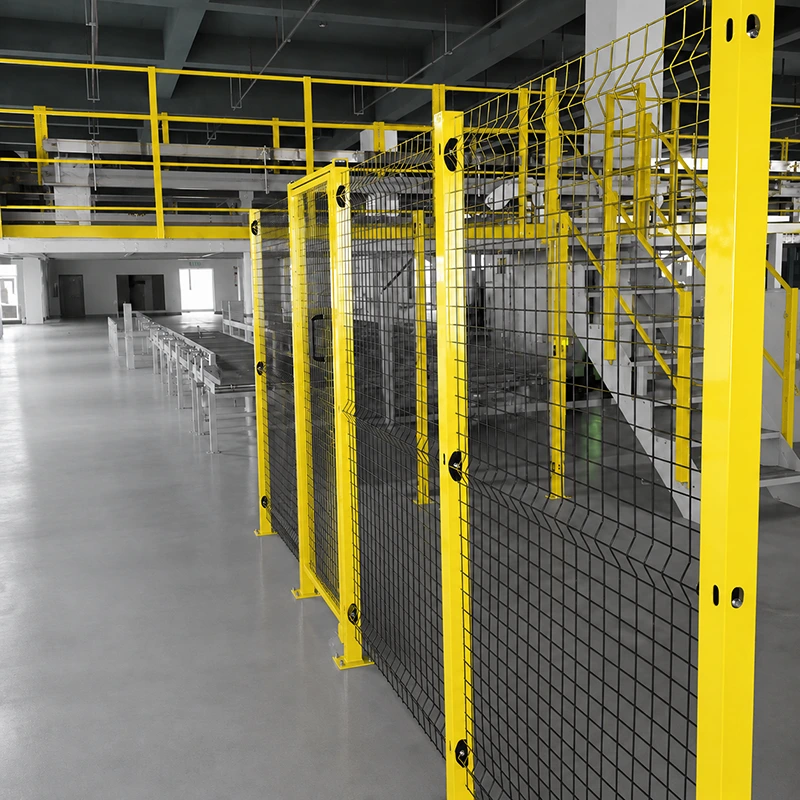
2. No frame border, no blind corner, no hidden AMR
Most framed mesh panels carry a top and bottom rail, and the rail is the first place a stalled tote or a low AMR disappears from a supervisor’s view. The Mefence panel is frameless by design — the 3D bent ridge replaces the frame, so the mesh runs from the floor fixing to the full panel height (up to 3000 mm) without a thick horizontal member interrupting the sightline. There is no top rail for a camera to look under, no side frame to occlude the corner of a robotic workstation enclosure, and no painted plate to wash out under the facility’s lighting. The robotic cell safety perimeter stays readable from the supervisor station, the WMS screen and the overhead pick-to-light camera at the same time.
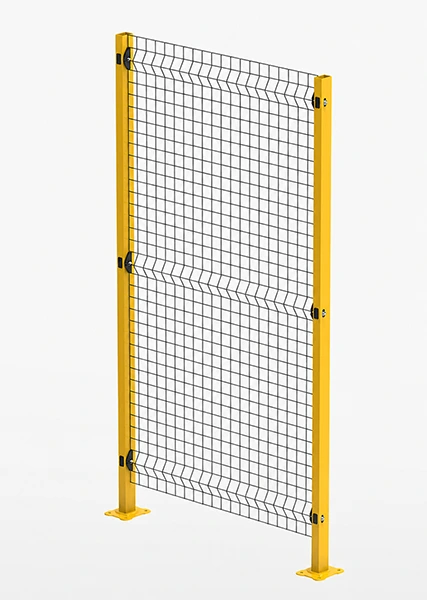
3. The perimeter moves when the robot zone moves
An AMR or AGV floor is not laid out once. Pilot fleets expand, picking walls get rebalanced, conveyor belt isolation gets rerouted, and the robotic workstation enclosure that guarded cell A in Q1 becomes the conveyor servicing cell in Q3. A Mefence module is held by plastic clips and self-tapping screws on base-plate posts, so a re-layout is a dismantle-and-relayout job rather than a second capex line. The same welded mesh that carries the warning colour and the LiDAR-permeable opening moves with the robot zone, so the see-through property is preserved across every reconfiguration — and the floor never inherits a solid wall left over from a layout that no longer exists.
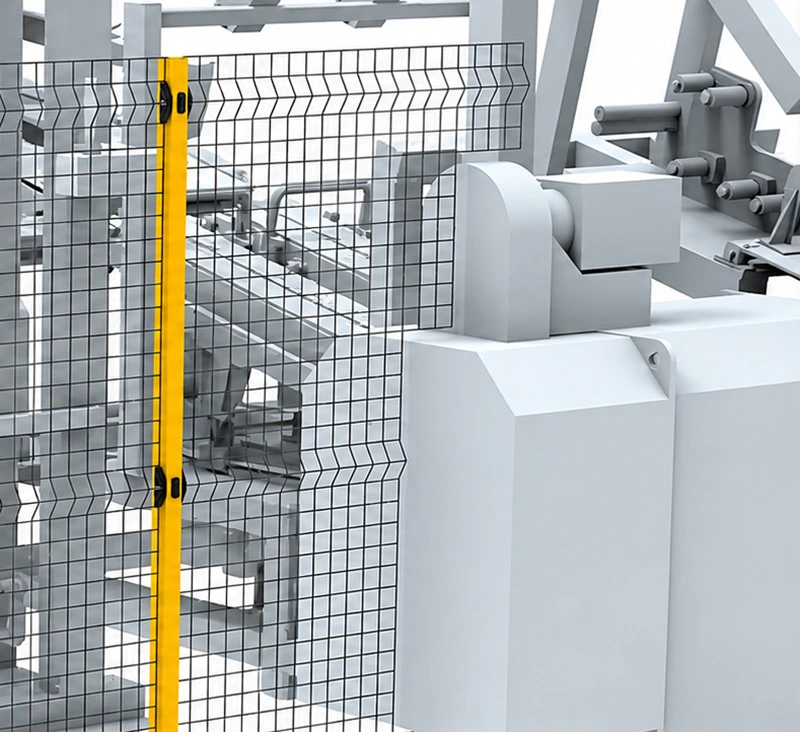
Where a See-Through Mefence Perimeter Earns Its Keep
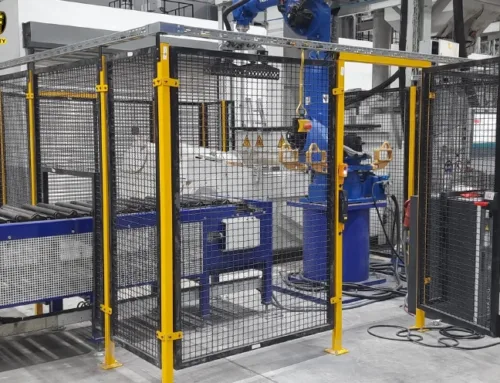
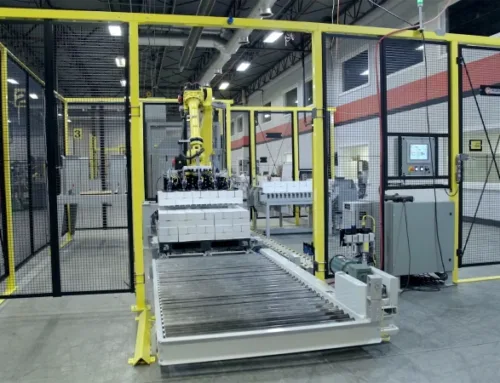
- AMR / AGV aisles and robotic picking cells: the welded wire mesh perimeter is the guard and the sightline at once, so LiDAR mapping, overhead cameras and the supervisor’s eye all keep working across the fence.
- Conveyor belt isolation around sortation: physical separation between people and moving conveyors, with the mesh grid staying readable for line cameras and fault diagnostics.
- Vision-guided picking and pack stations: the camera reads tote labels and pick faces through the 50×50 mesh opening instead of around a solid wall, so vision systems do not need a cut-out.
- Automated storage and retrieval zones: the mesh enclosure marks the AS/RS robot lane as a hazard zone separation while leaving the aisle mappable to the vehicle’s safety scanner.
- Warehouse zoning and pedestrian-vehicle separation around the robot perimeter: the same perimeter carries the OSHA, ANSI B11.19 and ISO 14120 guarding duty and the high-visibility warning signal without occluding the floor.
The brief for the perimeter is not “build a wall”. It is “keep the people out and keep the sight in”. Mefence industrial safety fencing solves both with one welded mesh panel — open enough for LiDAR and cameras, strong enough to be the guard, and clip-fixed so the perimeter moves with the robot zone it protects.
Send the Floor Plan, Get a See-Through Mefence Layout
Share the robot floor plan, the AMR or AGV aisle widths, the overhead camera mounting heights, the LiDAR scanner positions, the conveyor servicing routes and the gate / access positions. The Mefence team matches the welded wire mesh panel dimensions (200–1400 mm wide, 200–3000 mm high), the 50×50 mesh opening, the 3–4 mm wire diameter, the 40×60 / 60×60 base-plate post and the clip fixing layout to the floor, so the see-through perimeter lands aligned to the perception stack, not as an afterthought that hides it.
Keep the People Out, Keep the Sight In
Mefence Industrial Safety Fencing gives AMR-, AGV- and robotic-cell floors a guarded perimeter that does not eat the camera’s field of view or the LiDAR’s map — a frameless welded wire mesh, clip-fixed and relocatable, in yellow-black Q235 carbon steel. Contact SGF to price the see-through perimeter against your robot floor plan, and keep the perception stack intact at go-live.