EN
EN  DE
DE  RU
RU  PT
PT  JA
JA  ES
ES  IT
IT INDUSTRIAL SAFETY FENCING FOR AUTOMATED WAREHOUSE MAINTENANCE
Automated Warehouse Maintenance Access: Mefence Keeps the Hazard Zone Closed—and Serviceable
An automated warehouse is normally unmanned inside the equipment perimeter, but maintenance staff still need a controlled route in. Mefence frameless 3D safety fence combines visible hazard zone separation with on-site cutting, lockable maintenance access, and quick-removable sections—so pedestrian vehicle separation stays clear without turning routine service into a dismantling project.
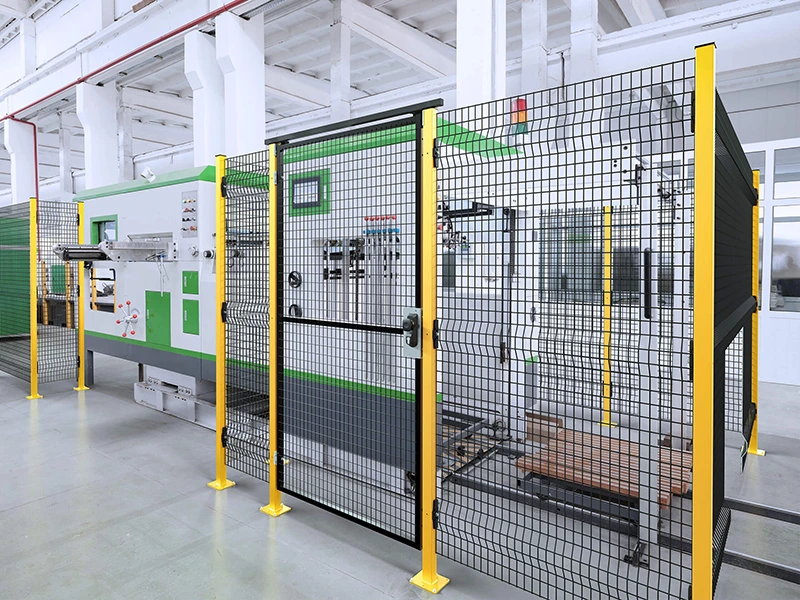
Why the maintenance route must be designed with the fence
In an AGV or AMR warehouse, the normal condition is “no entry.” The operating condition during inspection is different: a trained maintenance worker must reach sensors, drives, conveyors, and guarding interfaces without creating an uncontrolled opening. A barrier tape or rope barrier does not provide a durable boundary. A traditional framed fence can be harder to adapt when a door opening, a new cable route, or a relocated machine changes the perimeter. Welding on the floor during a retrofit adds hot work, coordination, and a longer return-to-service window.
| Design requirement | Mefence industrial safety fencing response |
|---|---|
| Keep the area visibly restricted | Black welded wire mesh with yellow posts creates a readable workplace safety barrier and hazard zone separation. |
| Reach the equipment for service | On-site cutting supports door openings and irregular dimensions; the layout can combine a lockable maintenance door with a quick-removable section. |
| Keep cables out of walkways | The 3D bent mesh profile provides a route for door-control and sensor cables instead of leaving lines hanging outside the fence. |
| Restore the boundary after work | Clip fixing and self-tapping screws support cold-work installation, removal, and reassembly without a square-tube welding step. |
Structure that supports controlled access and fast reset
1. Make the access point part of the machine guarding plan
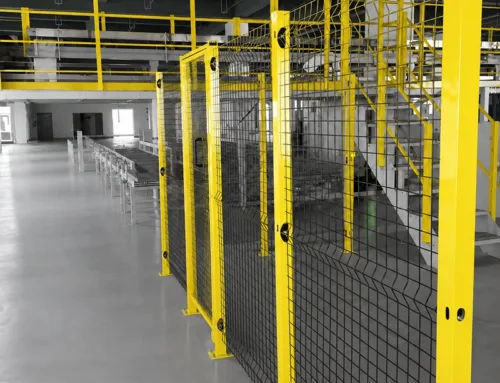
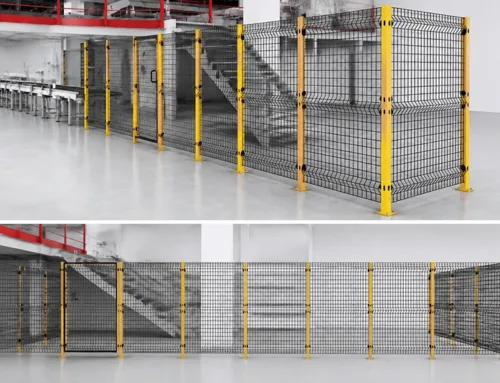
The gate is not an afterthought. Mefence can be laid out around the actual maintenance path, with an access gate and locking hardware at the controlled entry point. The visual boundary remains continuous when the gate is closed, while authorized staff have a defined route for inspection. This is the practical distinction between a robot safety fence that supports a process and a temporary warning line that merely signals a problem.
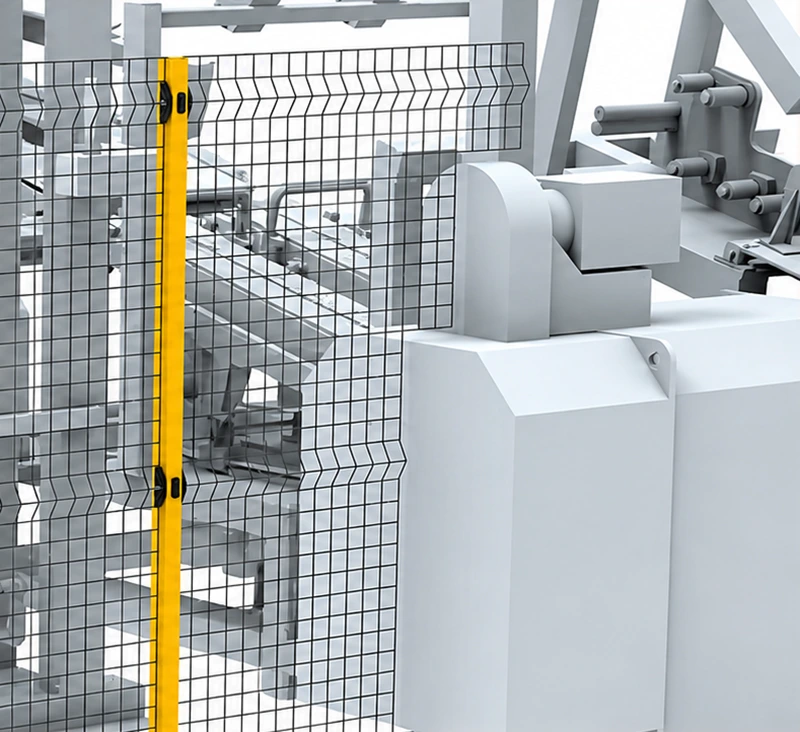
2. Use the raised mesh profile for the services that follow the perimeter
Mefence is a frameless safety fence built from 3D welded mesh rather than a perimeter frame. Multiple horizontal T-shaped ridges create useful clearance in the panel profile. That space can carry cable runs for a gate, sensor, or access-control device, and it can accept wood slat inserts where visual shielding is needed. The result is a cable management fence and visible divider in the same modular system, without adding a separate cable tray to the pedestrian side.
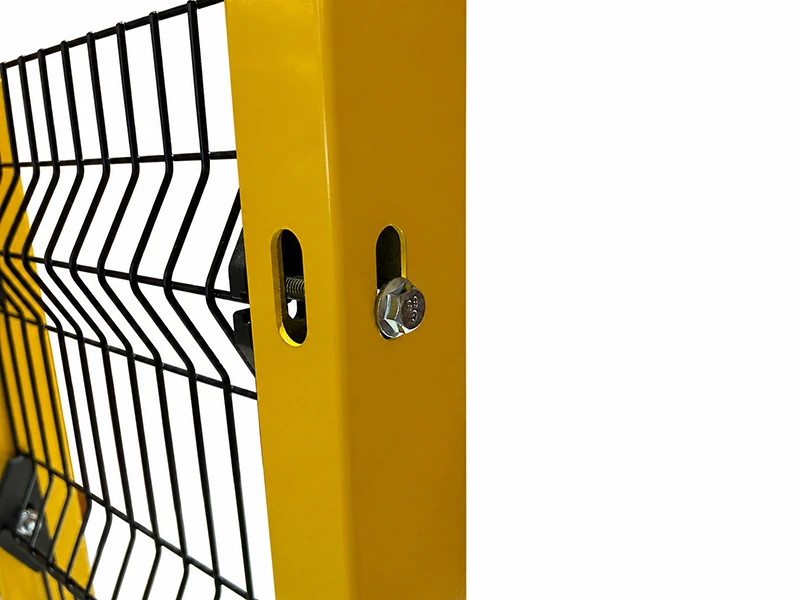
3. Choose a cold-work assembly that maintenance teams can reset
For a retrofit, the useful question is not only whether the panel blocks entry; it is whether the team can remove and restore it consistently. Mefence uses Q235 carbon steel wire mesh with electrostatic powder coating, plastic clips, and self-tapping screws. Typical options include 3 mm or 4 mm wire, 20×100 mm or 50×50 mm mesh openings, panel widths of 200–1400 mm, panel heights of 200–3000 mm, and 40×60 mm or 60×60 mm posts. Base-plate posts and expansion bolts support floor fixing. The documented installation method is one-person, three-step assembly with 50%+ installation-time savings.
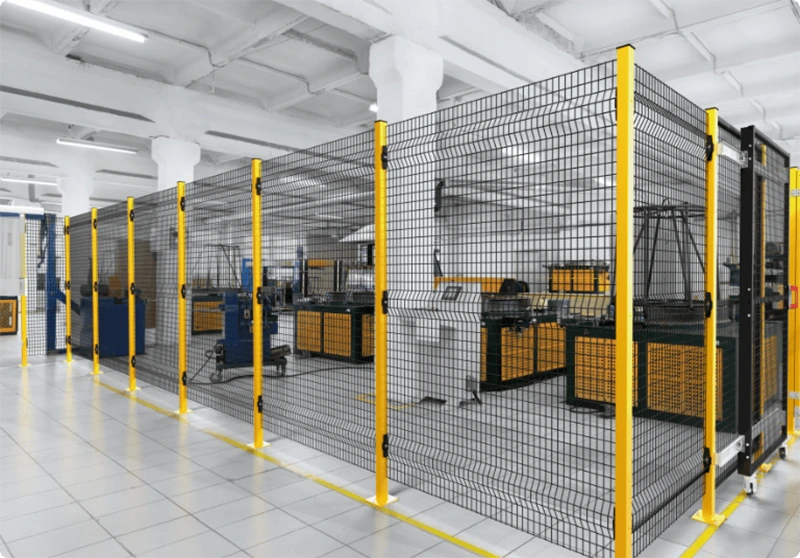
Where this access-ready layout fits
- Automated warehouse zoning: separate AGV and AMR routes from maintenance walkways while keeping controlled entry visible.
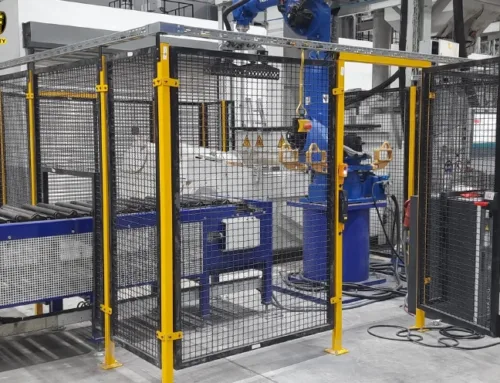
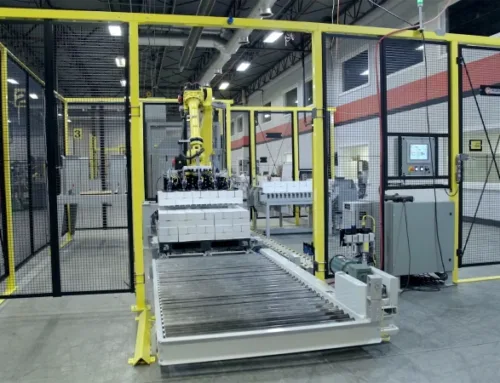
- Robot workstation enclosure: combine a lockable access gate with a removable panel section for planned service.
- Conveyor and line-side guarding: route sensor or door-control cables through the raised profile rather than across a traffic path.
- Workshop isolation and retrofit partitions: cut panels on site, reuse modules when equipment moves, and avoid hot work during assembly.
Mefence is intended for non-high-impact area demarcation, machine guarding perimeters, and traffic control. It should not be specified as certified anti-collision containment. Where direct impact containment is the design requirement, use SGF’s higher-spec Machine Fence line and confirm the guarding assessment against the applicable site standard.
Specify the fence around the maintenance workflow
Before requesting a layout, identify the equipment perimeter, normal pedestrian and vehicle routes, service-side clearances, gate position, lock or interlock requirements, cable destinations, floor condition, and any section that must be removed during planned maintenance. These inputs connect directly to Mefence choices: on-site cutting for irregular openings, 3D welded mesh for cable routing, clip fixing for reconfiguration, and base-plate posts for bolted installation.
Keep the zone closed in operation and reachable in maintenance
Mefence industrial safety fencing gives automation factories and warehouse contractors a practical way to combine hazard zone separation with controlled access. The boundary stays visible, the service route is defined, and a maintenance worker—not a specialist welder—can remove and reset the planned section.