EN
EN  DE
DE  RU
RU  PT
PT  JA
JA  ES
ES  IT
IT Warehouse Safety Barriers
Where Forklifts, Steam, Solvents or Sub-Zero Air Meet the Same Steel, the Substrate Has to Outlive the Conditions
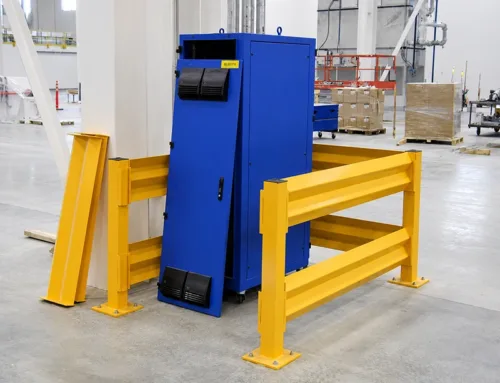
Daily hot-water washdown, paint-line solvent mist and cold-storage condensation eat painted warehouse guard rails at the seam, the bolt and the floor pocket first. Specifying a 4 mm Q235 corrugated steel guard rail with custom 160 × 160 × 16 mm hot-dip galvanized base plates shifts corrosion protection onto the steel itself — so the CNC chuck, hydraulic press column or rack upright it wraps stays inside its service interval instead of being pulled into the repair queue.
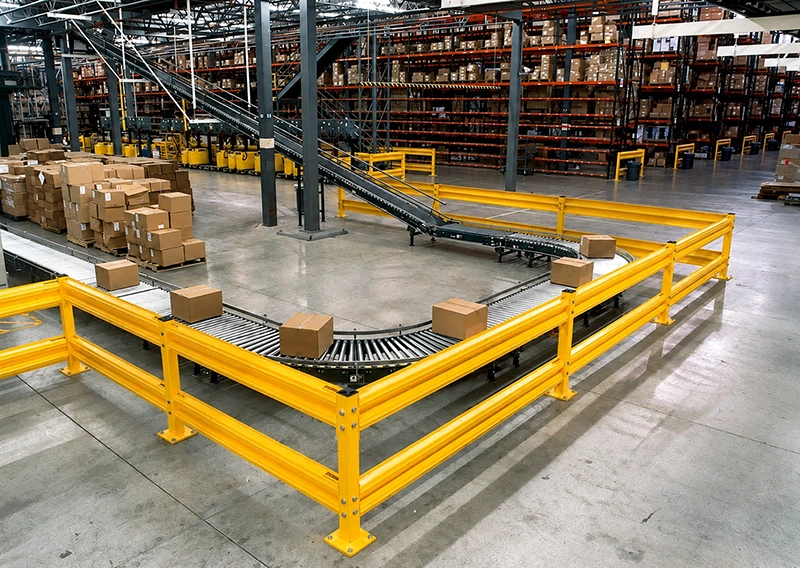
15176 Project Reference: 4 Workshop Zones, 4 Lengths, One Custom 160×160×16 mm Base Plate
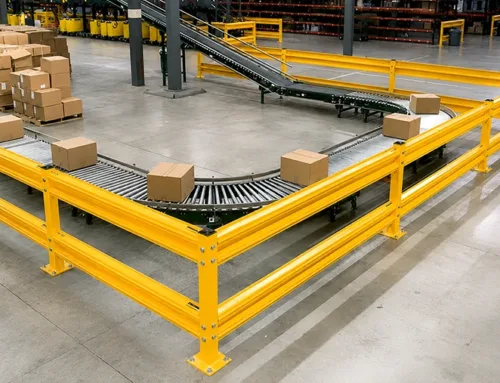
A 15176 deployment grouped four uneven workshop edges behind a single specification so engineering could size one base-plate detail and four rail layouts. Heights stayed at 1,000 mm; lengths moved with each zone; the post and base stayed where the forklift load entered. The same custom base plate anchors every run, which keeps procurement, drawing review and on-site install on one document instead of four.
| Zone (length, mm) | Rail layout and post count |
|---|---|
| 11,900 mm | 14 pcs × 1,500 mm standard beam + 2 pcs × 680 mm filler panel; 9 posts |
| 12,000 mm | 14 pcs × 1,500 mm standard beam + 2 pcs × 780 mm filler panel; 9 posts |
| 17,000 mm | 20 pcs × 1,500 mm standard beam + 2 pcs × 1,040 mm filler panel; 12 posts |
| 17,100 mm | 20 pcs × 1,500 mm standard beam + 2 pcs × 1,140 mm filler panel; 12 posts |
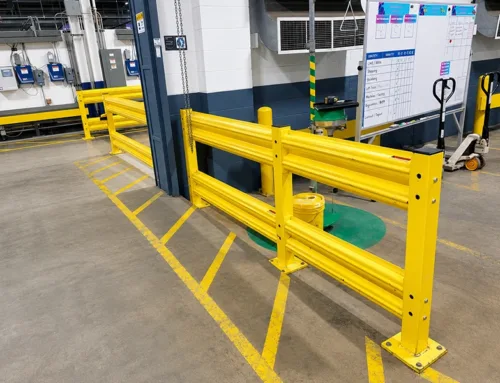
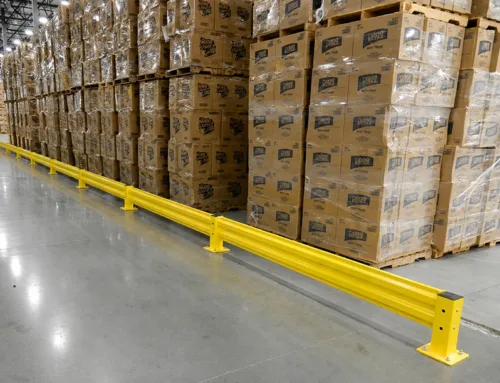
Shared detail across all four runs: 80 × 80 × 6 mm square post, 160 × 160 × 16 mm welded base plate, double-rail W-beam profile with the lower beam sitting roughly 106 mm off the floor. Standard 1,500 mm module plus project-cut filler panels, hot-dip galvanized on the wash-zone runs, bolt-down install that does not need a hot-work permit.
Three Design Choices That Actually Move the Needle on a Harsh Floor
4 mm Q235 Plate Where Catalog Stock Stops at 3 mm
Most heavy duty guardrail catalogs ship a 3 mm corrugated beam. On a floor where a 3-ton forklift catches the rail at working speed, the 3 mm profile can dish in and the damaged beam returns to the supplier. Hsafety ships the same double-rib W-beam at 4 mm for washdown, paint and freezer zones. The extra thickness raises the section modulus of the corrugated profile without changing the standard length-to-module ratios, so 1,500 mm modules plus 680–1,140 mm fillers still fit the same layout drawing and the rail passes the same M-class anchor pattern the engineering team already validated on the 15176 plan.
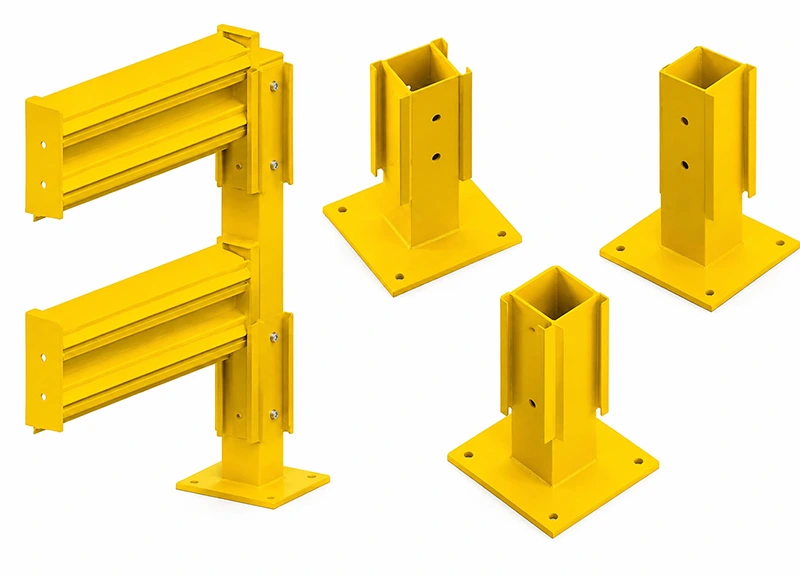
Custom 160 × 160 × 16 mm Base Plates for the Edge the Standard Drawing Misses
A standard guardrail drawing normally pairs the post with the thinnest base plate that warehouse stock will carry. Under a single lift-out strike, that thin plate pulls toward the slab at the anchor and the post starts to lean on the next pass. Hsafety sizes the base to 160 × 160 × 16 mm on this class of project — a wider footprint so the load spreads across the concrete, the anchor pocket sits further from the rail face, and the slab sees a distributed load instead of four point pulls. The same plate pattern takes four M-class expansion bolts set into the slab at the recommended depth, so the rail absorbs the strike cycle without punching the floor underneath.
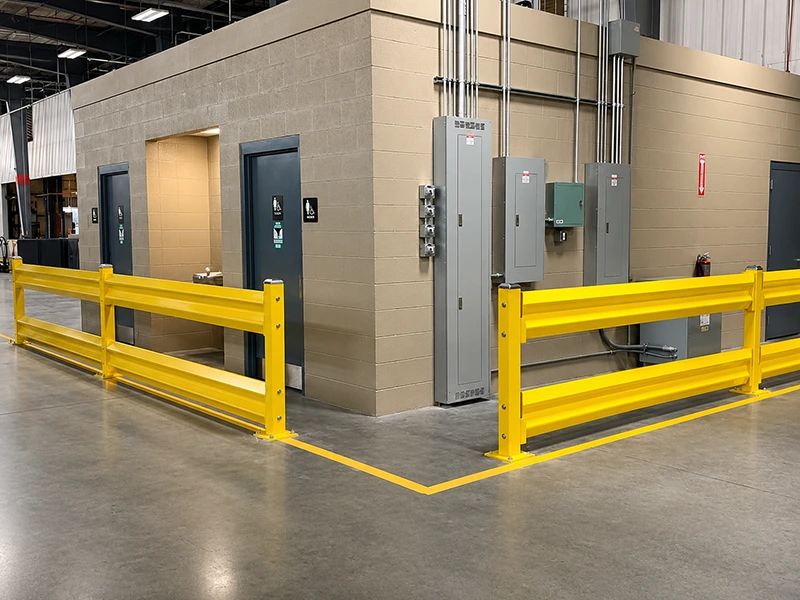
Hot-Dip Galvanized Inside the Zinc Bath, Not Painted On
Powder coating only protects the surface it covers. The weld seam, the cut edge, the bolt hole, the floor pocket — every joint stays open to humidity, solvent mist and chloride. A hot-dip galvanized finish dips the fully welded and punched rail into molten zinc, so the protective skin bonds to the steel substrate at every cut edge and threaded fitting. In a washdown bay with daily 60 °C cleaning, a paint line with isocyanate mist, a cold-storage freezer dock or a battery charging room, the zinc skin keeps working while paint film blisters off in year two. Hot-dip galvanizing is a separate finish option on the standard Hsafety SKU; we pair it with the same custom base plate detail on every hot-wet work zone we quote.
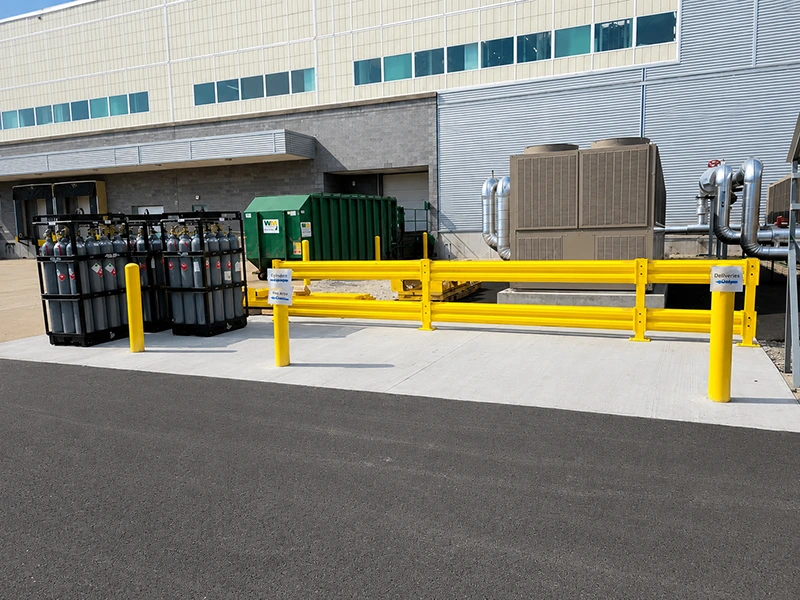
Where This Rail Earns Its Place
- Washdown bays in food, beverage and pharma plants — daily hot-water cleaning and detergent residue attack the paint film and weld seams on standard stock before the second repaint cycle.
- Paint lines, e-coat and powder coating lines — solvent and isocyanate mist strip every coated edge of a painted rail while it is still under the supplier warranty window.
- Cold storage and blast freezer docks — condensation cycles inside the base-plate anchor pocket and freeze-thaws the bolt threads on a smooth black-steel plate.
- Battery charging rooms and AGV charging cells — hydrogen residue and humidity corrode the floor pocket before the visible rail ever shows rust.
- Welding cells and stamping cells — coolant splash and floor abrasive load force repaint on standard rails every quarter, and the repaint cycle is what hits the maintenance budget.
The same custom base plate anchors heavy duty warehouse guard rail runs up to 17,100 mm on a single drawing; the rail height stays at 1,000 mm to clear forklift fork-tip impact, and the rail length covers any layout the bay needs without falling back to a standard catalogue beam at the wrong thickness.
Spec the Base Plate First, Not the Rail
When a hot-dip galvanized finish is on the order, send the post cross-section, base plate thickness, anchor bolt size and concrete slab condition in the same RFQ. Hsafety returns a matching drawing for production review against your bay layout. Cold storage and battery room layouts often need an anti-condensation gasket under the base plate — flag this in the inquiry so it lands on the first drawing, not the third RFQ round.
Send Your Floor Plan, Get a HDG Custom-Base Layout
Drop the CAD or PDF sketch of the bay, the rail length you need, and the wash, paint or freezer environment it sits in. Hsafety engineering returns a base-plate, anchor and rail layout sized to your slab and your wash cycle, with a matching 4 mm or 3 mm call-out on the corrugated beam.