EN
 DE
 RU
 PT
 JA
 ES
 IT
AREA DEMARCATION ROI · EMS & CONTRACT MANUFACTURING
One Guarding Budget, Two Scopes: Frameless Area Demarcation for the Whole Floor, Impact-Rated Steel Only Where It Is Actually Needed
A contract electronics plant running single-digit margins still has to zone the floor, keep pedestrians out of AGV lanes and keep visitors out of the SMT support area — the difference is that every metre has to be defended in a capex review. Mefence industrial safety fencing is SGF’s frameless 3D welded mesh panel system, supplied factory-direct at roughly $10–32 per running metre against $105–213 for European certified-brand framing of the same application class. That price band turns one demarcation budget into 3–5 times the running metres of warehouse zoning, while the strike points that genuinely need impact containment are quoted separately on SGF’s Machine Fence line.
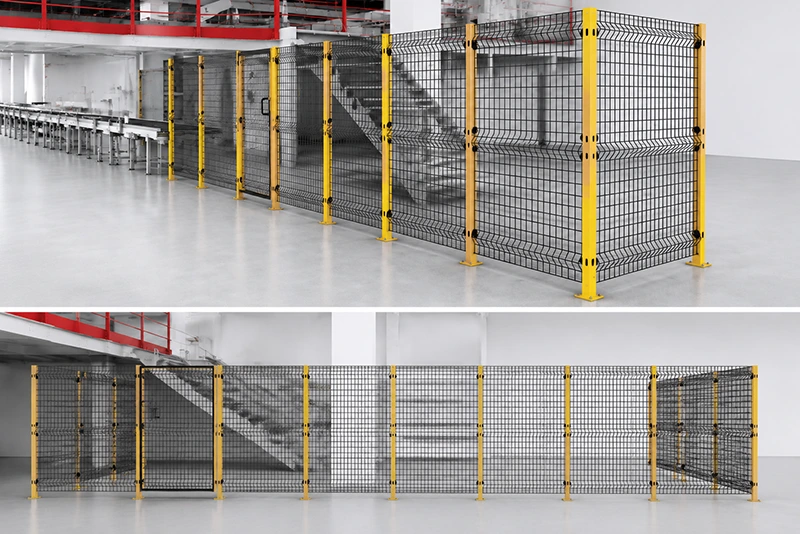
Mefence specifications, before the guarding budget is split
Procurement rarely rejects a fence outright. It rejects a fence that is priced as a certified containment system while being used as a zone boundary. The honest scope is this: Mefence is area demarcation, traffic guidance and equipment perimeter zoning with no certified impact rating. Splitting the tender into a large demarcation package and a small impact package is what keeps the safety/compliance scope intact and the spend defensible.
| Item | Mefence frameless 3D safety fence |
|---|---|
| Panel construction | Frameless welded wire mesh, no frame border, multiple horizontal T-shaped ridges pressed into the panel |
| Material | Q235 carbon steel wire |
| Wire diameter | 3 mm / 4 mm |
| Mesh opening | 20 × 100 mm / 50 × 50 mm |
| Panel width | 200 – 1400 mm, cut to size on site |
| Panel height | 200 – 3000 mm |
| Ground clearance | 140 mm |
| Post | 40 × 60 mm / 60 × 60 mm base plate post with slotted mounting holes |
| Finish | Electrostatic powder coating (powder coated steel); standard yellow-black, custom colours including orange |
| Connection method | Plastic clip + self-tapping screw, clip fixing — no site welding |
| Floor fixing | Base plate post + expansion bolt, slotted holes for alignment on existing slabs |
| Ridge function | Cable management trough plus wood slat insert slot for visual shielding |
| Installation | One person, three steps; source video states 50%+ installation time reduction versus conventional framed fence |
| Scope boundary | Non-high-impact area demarcation. Direct strike points are specified on the impact-rated Machine Fence line. |
Three structural facts that decide whether the fence pays back
Clip-fixed panels take the labour line off the quote
Conventional framed mesh arrives as welded square-tube sections: cutting, touch-up and on-site welding all bill by the hour, and on a live electronics floor they also carry a hot-work permit and a fire watch. Mefence panels are clamped to the post with plastic clips and self-tapping screws, through slotted mounting holes that absorb alignment error on an existing slab. The documented sequence is one person, three steps, with the source video claiming 50%+ less installation time than framed alternatives — which matters more to a thin-margin plant than the panel price, because installation is the line procurement cannot see in a catalogue.
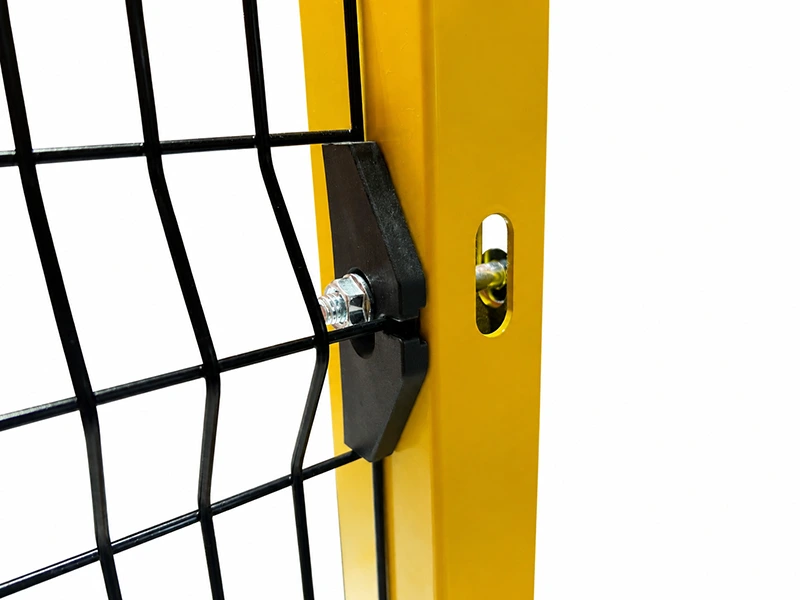
Frameless panels cut on site instead of being re-ordered
A frameless panel has no perimeter tube to re-weld when a bay is 1,180 mm wide instead of 1,200 mm. Width runs 200–1400 mm and height 200–3000 mm, and the mesh can be trimmed on site to fit column lines, pipe runs and conveyor legs — the on-site cutting fence case that framed systems handle with a custom purchase order and a lead time. The same property supports reuse: when a line moves or a cell shrinks, panels, posts and base plates come apart, and the modular reconfigurable system travels with the layout instead of being written off with it. Ground clearance stays at 140 mm, so the floor under the fence can still be cleaned and inspected.
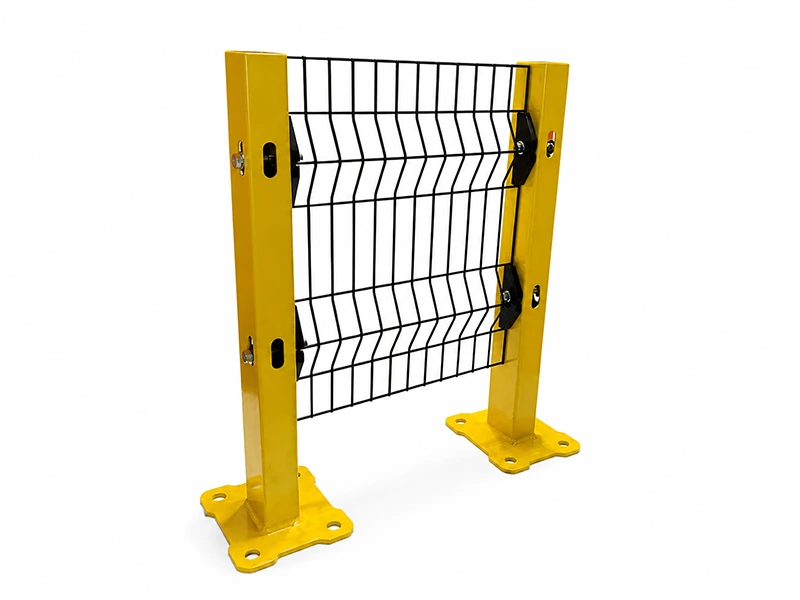
Equipment perimeter demarcation that is not a blind wall
The other common way to cheapen this scope is a solid panel wall, and it is the wrong saving: it hides the cell from the supervisor, blocks line-of-sight at the walkway and closes off light and ventilation. A 20 × 100 mm or 50 × 50 mm welded mesh panel in the standard yellow-black safety fence palette keeps the boundary visible from the aisle, keeps the automated equipment observable, and still reads as a physical line rather than a painted one. On automated equipment guarding and robotic workstation enclosure perimeters, that visibility is the difference between a supervisor catching a rising problem at the cell and finding it after the shift.
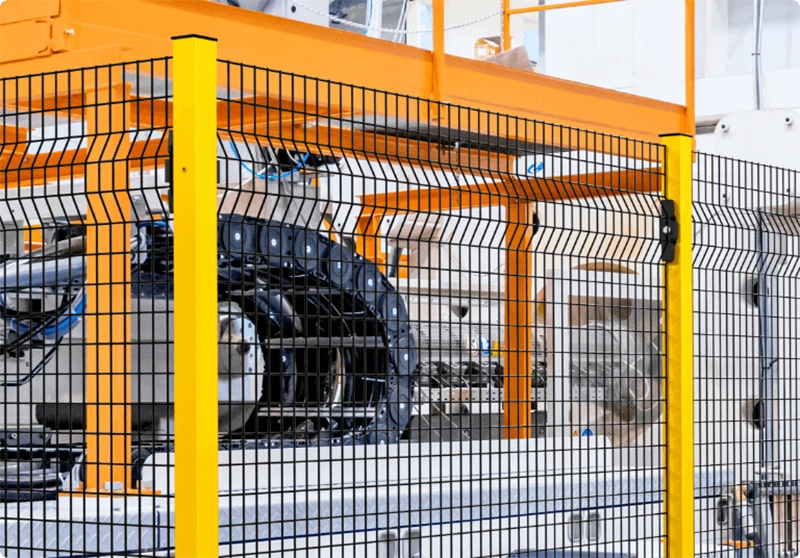
Where the demarcation scope fits on an electronics or contract-manufacturing floor
- Warehouse zoning and storage area separation between raw material, WIP and finished-goods buffers
- Pedestrian vehicle separation and forklift path barrier lines along mixed-traffic aisles
- AGV lane separation that turns random crossings into planned access points and removes ghost stops
- Robotic workstation enclosure and automated equipment guarding perimeters around conveyors and transfer zones
- CNC machine guarding periphery — demarcation and access control, not impact containment
- Tool crib enclosure and customer-owned material segregation in multi-customer plants
- Temporary partition and workshop isolation during a retrofit window that cannot take a hot-work permit
- Cable management fence routing: camera, interlock and access-control cables run inside the panel ridge instead of on the outside face
None of those lines needs a crash-rated barrier, and pricing them as one is what gets a demarcation request cut in the first review. Where a loaded forklift, a tow tractor or a pallet truck can genuinely reach a column, a robot cell post or a conveyor leg, the specification changes — that portion belongs to SGF’s higher-spec Machine Fence, and Mefence stops at the boundary of the impact envelope. Customers comparing this against Troax- and Axelent-class framing, or against welded square tube fence and chain link fence alternatives, are comparing it to systems sold as certified containment; against the same $105–213/m framing band, a $10–32/m demarcation package buys the metres that actually go on the drawing.
Put a number on both halves of the scope
Send a marked-up floor plan, a DXF or even a photo of the layout with the zones drawn on it. We return a panel schedule with post positions, cut panel widths, gate locations and an itemised metre price in the $10–32/m band, plus a short note on which of your strike points we would move to the impact-rated line rather than cover with demarcation fencing. Comparing that against a European framed quote is then a line-by-line exercise instead of an argument about brands.
Standardise the demarcation, then protect the strike points
Mefence meets the deployment standards your auditors will reference — OSHA 29 CFR 1910.212, ANSI B11.19, ISO 14120, ISO 14119 and ISO 13857 are the comparison points buyers use for machine guarding and safe distances — and it stays inside its honest boundary: no certified impact rating, no containment claim. Zone the floor with the money you have, and spend the impact budget only on the metres that need it.