EN
 DE
 RU
 PT
 JA
 ES
 IT
Industrial Safety Fencing · Paper, Print and Recycling Plants
The permit queue is longer than the installation
In a plant where every horizontal surface collects paper dust, the fence itself was never the hard part of the project — the hot-work permit was. Mefence frameless 3D industrial safety fencing is assembled with plastic clips and self-tapping screws on base plate posts, anchored with expansion bolts through slotted mounting holes. No welder, no arc, no fire watch, no cleared fire zone: the perimeter goes up inside a night shift or a weekend maintenance window while the corrugator, the press or the baler keeps its day schedule. It is built for warehouse zoning, material segregation, pedestrian vehicle separation and forklift path barriers — not for certified impact containment.
A paper-based packaging plant, a print hall or a recycling bale yard all carry the same fire load: loose fibre, stacked bales, ink mist, dust on beams and cable trays. That is exactly why the hot-work permit for a traditional welded square tube fence or framed fencing takes weeks. Production agrees to a stop, the EHS officer opens a fire zone, a second person stands watch with an extinguisher, and the window is still only a few hours. On a site running a 14-day order book, that window is the most expensive slot in the building.
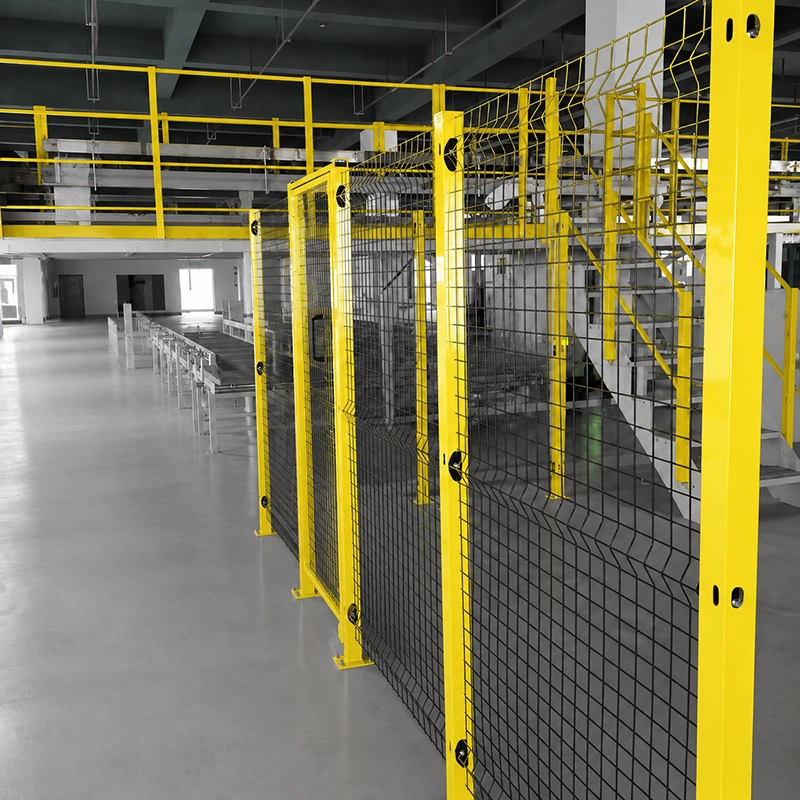
What gets bolted to the floor instead of welded
The difference is not assembly speed alone — it is that the joint itself carries no heat source. Every connection in the Mefence perimeter is mechanical: moulded plastic clip, self-tapping screw, base plate post, expansion bolt. A maintenance fitter can move a run on a Tuesday afternoon without opening a permit file, which is the only reason a plant made of combustible fibre can re-zone its floor at all.
| Specification item | Mefence frameless 3D safety fence |
|---|---|
| Material | Q235 carbon steel welded wire mesh panel |
| Surface finish | Powder coating (electrostatic spray) |
| Wire diameter | 3 mm / 4 mm |
| Mesh opening | 20 × 100 mm / 50 × 50 mm |
| Mesh panel width | 200 – 1400 mm |
| Mesh panel height | 200 – 3000 mm |
| Ground clearance | 140 mm |
| Posts | 40 × 60 mm / 60 × 60 mm |
| Panel fixing | Plastic clip + self-tapping screw, no field welding |
| Floor anchoring | Base plate posts + expansion bolts, slotted mounting holes for vertical adjustment |
| Panel structure | Frameless welded mesh with horizontal T-shaped ridges (cable route, wood slat insert) |
| Colour | Yellow + black as standard; custom colours including orange |
| Installation | One person, three steps; video figure of 50%+ less install time than conventional framed fence |
Why no welding torch enters the building
No arc, no fire watch, no cleared fire zone
The panel is fixed to the yellow post with a plastic clip and a self-tapping screw, and the post is fixed to the slab with a base plate and expansion bolts. There is no ignition source anywhere in the process, so the fire zone never has to be cleared of bales, roll stock or palletised blanks, and no second person has to stand watch with an extinguisher. On the honest boundary: Mefence is a division and flow-control boundary without a certified impact rating — where a robot or an AGV can actually reach and strike the fence, that strike point is quoted on the SGF Machine Fence line instead.
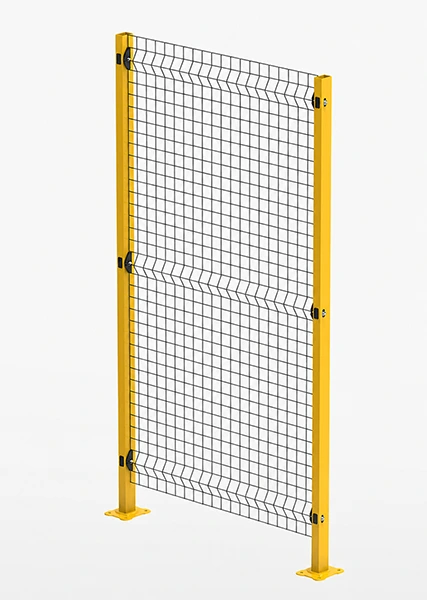
Cut to the bay that actually exists, measured after handover
Paper plants are never survey-clean. Pipework drops out of the ceiling, a column sits 40 mm off the drawing, and the last bay is narrower than the panel schedule assumed. Because the frameless 3D welded mesh has no perimeter frame to preserve, the panel is cut on site: a 200 – 1400 mm panel becomes the 1130 mm the floor needs, and a 3000 mm-high panel is trimmed to the platform edge. Cutting is a hand tool task, not a hot-work task, so the fit-up happens after the shift handover — and the same modules are unbolted and re-used when the AGV lane or the converting bay moves.
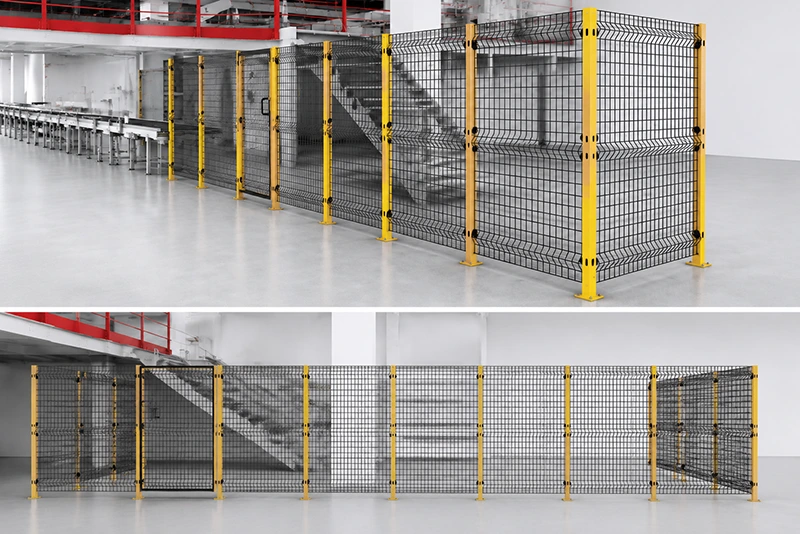
Base plate posts and slotted holes on a slab poured decades ago
Expansion bolts need a floor that will hold them, and paper and recycling plants rarely have a flat, crack-free apron everywhere. The base plate posts spread the load through a four-hole flange, and the slotted mounting holes let the fitter bring each post back to plumb after the anchor is set — no shimming, no re-drilling, no welded gusset. The 140 mm ground clearance keeps the mesh clear of wash-down water and fibre piles, and the horizontal T-shaped ridge pressed into every panel carries door-control and camera cable instead of leaving a loose loom on the floor.
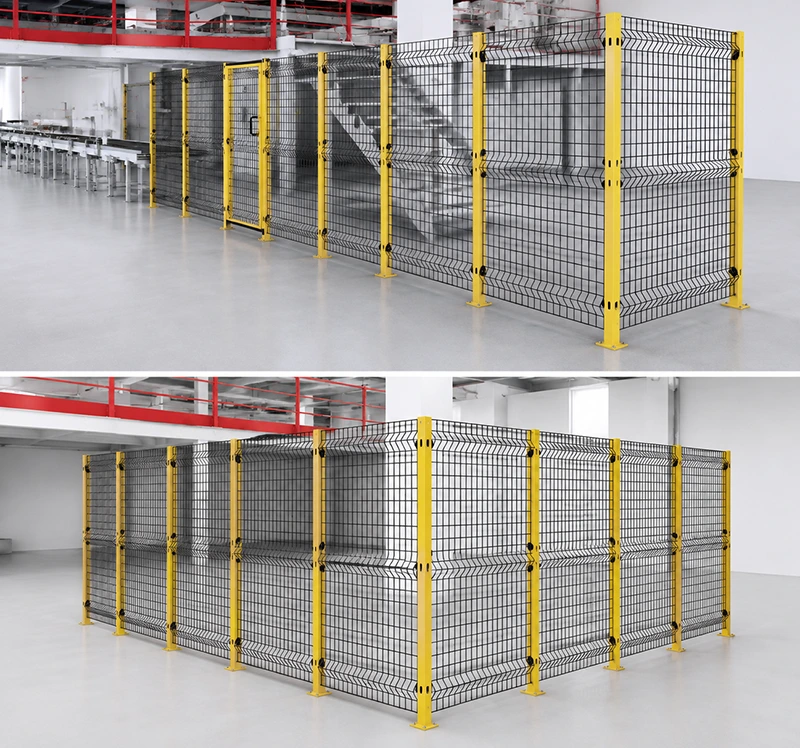
Where the boundary goes in a paper, print or recycling plant
- Warehouse zoning and warehouse partition between roll stock, blanks and finished pallets
- Material segregation around customer-owned stock and WIP buffers
- Pedestrian vehicle separation along QC, maintenance and sample-pick walkways
- Forklift path barrier and traffic flow planning at the reel clamp and bale route
- Robotic workstation enclosure and automated equipment guarding on the converting side
- Conveyor belt isolation and temporary partition during a rebuild
- Tool crib enclosure, workshop isolation and site demarcation of the baler bay
- Construction site barrier for equipment bays shut down between shifts
These are the areas where the plant needs a visible, see-through boundary and a fixed crossing point — and where a solid wall would blind the supervisor and the line cameras. Panels that insert a treated wood slat give visual screening where the process requires privacy, using the same T-shaped ridge, with the slat fixed by self-tapping screws through the horizontal wire support.
Download the Mefence specification sheet
Panel widths and heights, wire diameters, mesh openings, post sections, clip and base plate hardware, colour options and the mounting-hole drill pattern — everything your maintenance planner needs to schedule the night-shift window before the fence arrives on site.
Give us the shift window, not the shutdown date
Send a marked-up floor plan, the bay widths you actually have, and the maintenance window your production manager will protect. We return a panel schedule, an anchor layout and a fixing list that one person can install without a welder, a permit or a fire watch. Where there is a real strike risk from a forklift, a robot or an AGV, we will say so and quote that section on the impact-rated Machine Fence line instead.