EN
EN  DE
DE  RU
RU  PT
PT  JA
JA  ES
ES  IT
IT INDUSTRIAL SAFETY FENCING FOR FAST WAREHOUSE DELIVERY
12-Month CFC Delivery: How Mefence Frameless Safety Fence Keeps Warehouse Zoning on Schedule
When an automated fulfillment center must be built or retrofitted in roughly 12 months, industrial safety fencing cannot become the final critical path. Mefence uses a three-step clip-fixed assembly, supports on-site cutting, saves 50%+ installation time, and avoids hot work so warehouse zoning, pedestrian vehicle separation, and machine guarding can finish alongside the main project.
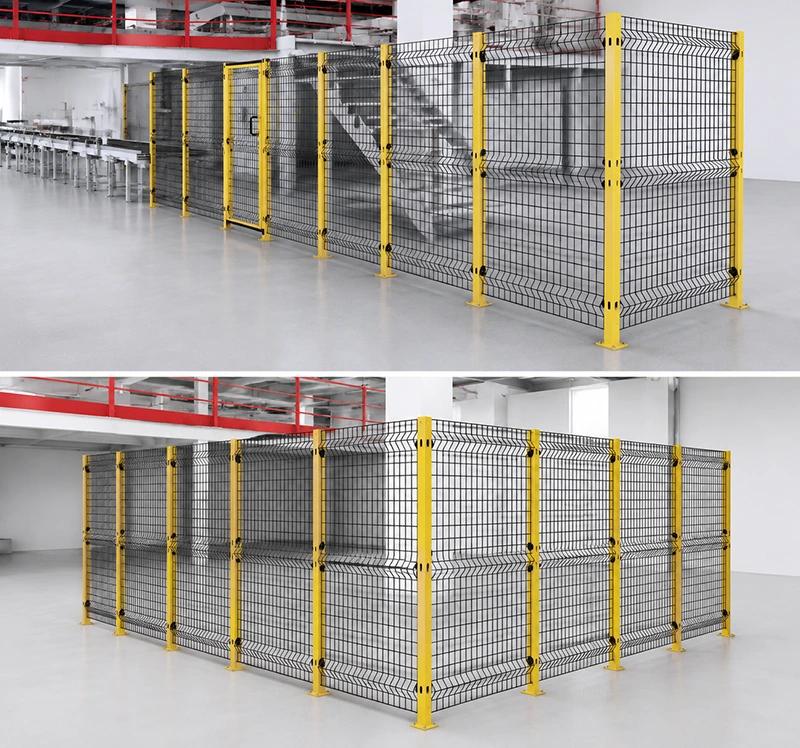
Why Traditional Welded Fencing Slows a Fast CFC Project
Automation factories and logistics contractors are compressing construction and retrofit windows to capture a market opening. A traditional welded square tube fence adds a separate work package: hot-work permits, fire-watch controls, specialist welders, grinding, touch-up, and a longer handover sequence. If equipment commissioning changes an aisle or AGV route, the same rigid framed fence is difficult to resize without sending the work back to fabrication.
| Fast-delivery requirement | Mefence industrial safety fencing response |
|---|---|
| Install during a short night or weekend window | Three-step clip fixing with plastic clips and self-tapping screws; one-person installation is documented in the product video. |
| Avoid hot-work approval and welding labor | Cold-work site assembly with no square-tube welding step, helping the fence follow the construction schedule without a hot-work package. |
| Fit columns, corners, and irregular retrofit dimensions | Frameless design and on-site cutting support panel widths from 200–1400 mm and layout adjustment at the point of installation. |
| Keep traffic routes visible and controlled | Yellow-black welded wire mesh provides a visible boundary for warehouse zoning, forklift path barriers, and pedestrian vehicle separation without creating a solid blind wall. |
Three Product Details That Make the Schedule Practical
1. Frameless 3D Welded Mesh Can Be Adapted on Site
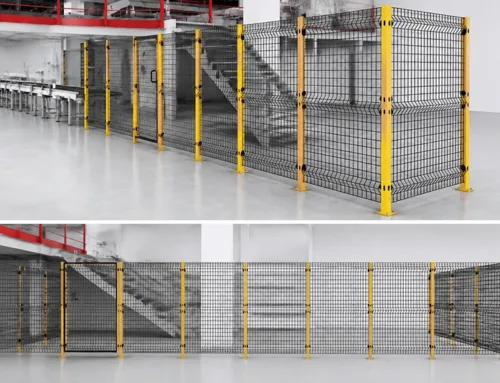
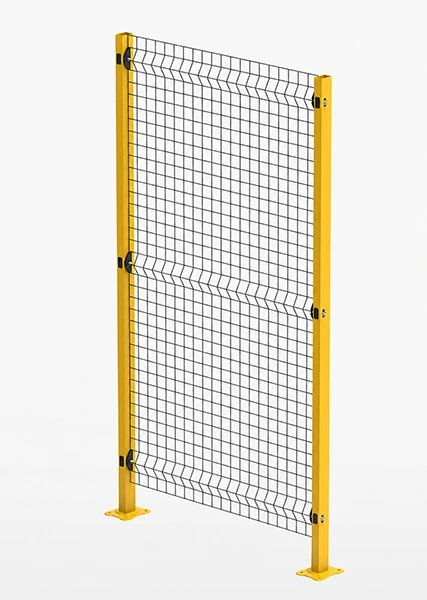
Mefence is a welded wire mesh panel without a perimeter frame. Its multiple horizontal T-shaped ridges add form to the panel while preserving a slim, modular profile. For a retrofit team working around columns, conveyors, or a revised AGV lane, the panel can be cut on site instead of waiting for a new framed section. Q235 carbon steel wire is available in 3 mm or 4 mm diameters, with 20×100 mm or 50×50 mm mesh openings and panel heights from 200–3000 mm.
2. Clip-Fixed Assembly Reduces Work at the Operating Site
The connection sequence is simple: position the powder-coated steel post, attach the wire mesh panel with the plastic clip, then secure the fixing with the self-tapping screw. Base plate posts and expansion bolts support floor fixing where the slab is ready. Post options are 40×60 mm or 60×60 mm, with a documented 140 mm ground clearance. This is the practical difference between a quick install safety fence and a project that depends on welding crews arriving before handover.
3. One Boundary Can Support Access, Routing, and Visibility
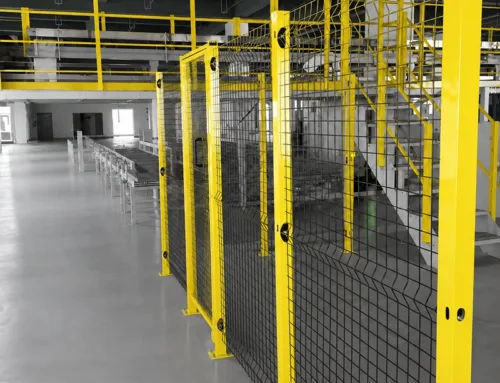
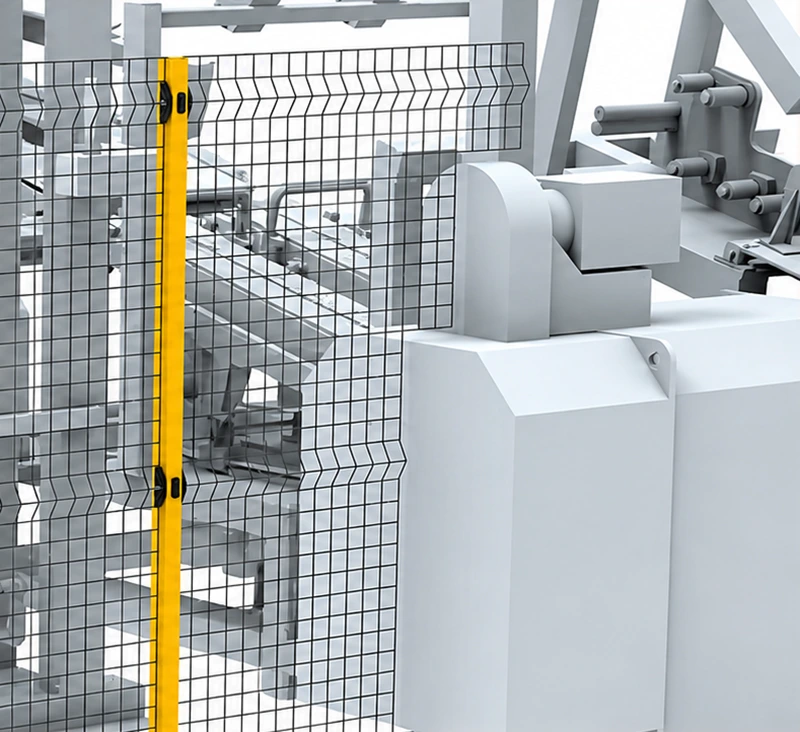
A CFC does not only need a perimeter. It needs readable pedestrian separation, controlled access points, and clear relationships between people, forklifts, AGVs, and automated equipment. Mefence modules can form robot safety fence perimeters, forklift path barriers, and temporary workshop isolation. The raised 3D mesh profile can carry cables so lines do not hang outside the fence, and it can accept wood slat inserts where visual shielding is required. The gate relationship shown here supports access planning without replacing a site-specific risk assessment.
Where Mefence Fits the Fast-Track Handover
- Warehouse zoning: separate storage areas, tool cribs, service aisles, and material segregation zones before operations begin.
- Pedestrian vehicle separation: make forklift paths and walking routes visible, reducing random crossings that interrupt traffic flow planning.
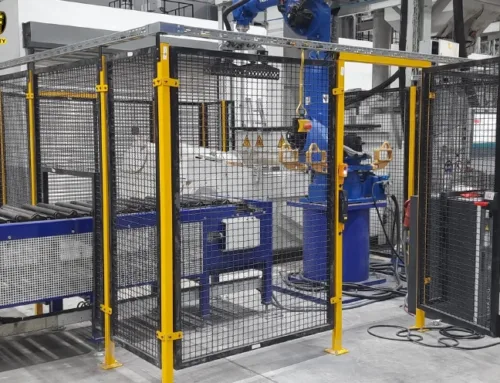
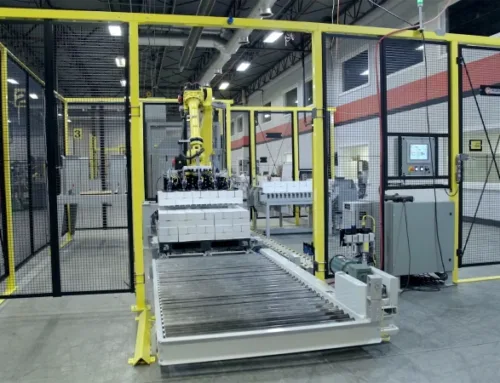
- Automated equipment guarding: define robot workstation enclosures, conveyor belt isolation, and line-side machine guarding around commissioned equipment.
- Retrofit and phased construction: install temporary partitions, then relocate or reconfigure reusable modules as the layout changes.
Mefence is intended for fixed or semi-fixed demarcation and non-high-impact guarding. It is not a certified anti-collision barrier or a substitute for the higher-spec Machine Fence line where direct impact containment is required. Project teams can compare the final layout against applicable references such as OSHA 29 CFR 1910.212, ANSI B11.19, ISO 14120, ISO 14119, ISO 13857, and ISO 13855 during their own safety review.
Specify the Fence Before the Final Construction Window
For a 12-month CFC program, provide the fence supplier with the latest floor plan, equipment boundaries, access points, AGV or forklift routes, slab conditions, and any cable-routing or visual-shielding needs. SGF can then align the frameless safety fence modules, post sizes, mesh opening, color, and base fixing method with the installation sequence. The result is not just a fence delivered at the end: it is a modular work package that can be installed in parallel with commissioning and close-out.
Keep Industrial Safety Fencing Out of the Critical Path
Send your warehouse zoning or automation retrofit layout to review a no-welding Mefence installation plan, panel sizing, access points, and pedestrian vehicle separation details.