EN
EN  DE
DE  RU
RU  PT
PT  JA
JA  ES
ES  IT
IT AGV / STR Pick-Interface Boundary Layer
AGV Pick Stations, Charge Cells and the Q235 Warehouse Guard Rail: The Static Map Reference Beneath an ATS Re-Route
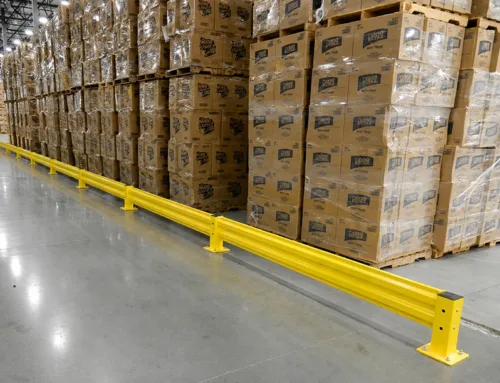
An AGV / STR pick cell concentrates 3-ton forklift handover, picker reach and AGV deceleration into a 3 m cell. The ATS map can re-draw every shift, but the safety case cannot. A bolted, modular Q235 corrugated steel warehouse guard rail becomes the static map reference that the pick cell anchors to. It defines the AGV approach envelope, blocks cross-traffic forklifts and pedestrians from the same cell, and absorbs the out-of-zone recovery strike when an AGV exits its map-defined lane — the visible hardware layer beneath every ATS re-route.
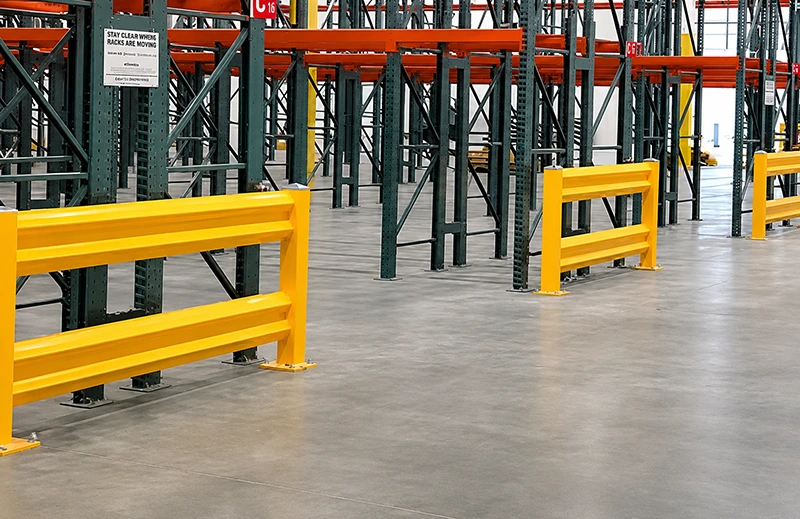
Pick-Cell Boundary Hardware: What Stays Fixed When the Map Changes
The numbers below describe the rail that anchors the AGV approach line. They are not an independent crash rating. The 16,680 N figure is a project demand condition from a recorded multi-cell opportunity (3-ton forklift at 10 km/h) — it is the value the rail was designed against, not a third-party impact test result.
| Parameter | Value |
|---|---|
| Material | Q235 carbon steel, hot-dip galvanized or powder coated (yellow standard, custom RAL on request) |
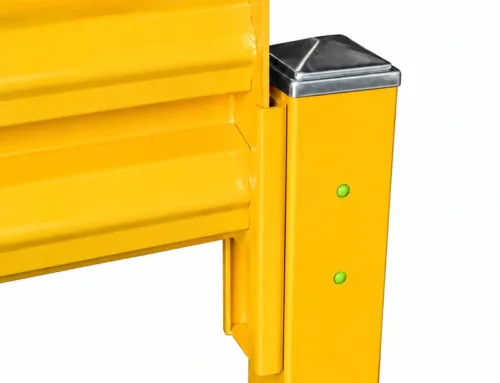
| Rail profile | 2-rib corrugated steel beam, 85 mm wave height, 310 mm rail width, 3 mm or 4 mm panel thickness |
| Configuration | Double-rail (2-rib stacked) for AGV pick cells; single-rail available for low-energy charge cells |
| Post | 80 × 80 × 6 mm square tube, 1,000 mm above floor |
| Post spacing | 1,500 mm standard; 680 / 780 / 1,040 / 1,140 mm custom fillers for cell length close-out |
| Base plate | 160 × 160 × 16 mm, four M16 anchor bolts into ≥ 150 mm concrete slab |
| Length cut | 1,500 mm standard panels; 680 – 1,140 mm project-cut fillers to close any cell length |
| Project envelope | 3-ton forklift @ 10 km/h → 16,680 N demand condition (project design value, not third-party test) |
Three Jobs the Rail Does in an AGV Pick Cell
The AGV approach anchor
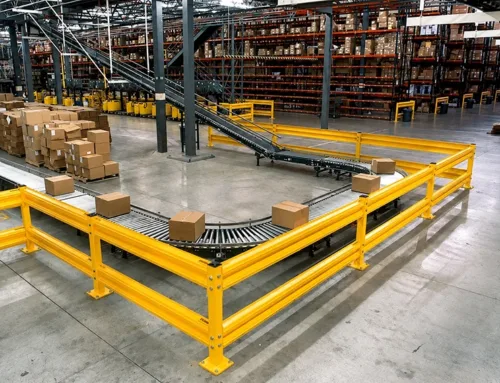
The bolted Q235 corrugated steel rail is fixed to the slab at 1,500 mm post centres. The rail line itself is the AGV approach boundary that the ATS map references. The AGV pilot never crosses the rail; the picker works inside it; the forklift drop-off stops outside it. Three traffic flows in the same cell, one physical line that does not change when the ATS map re-draws for the next peak or the next slot.
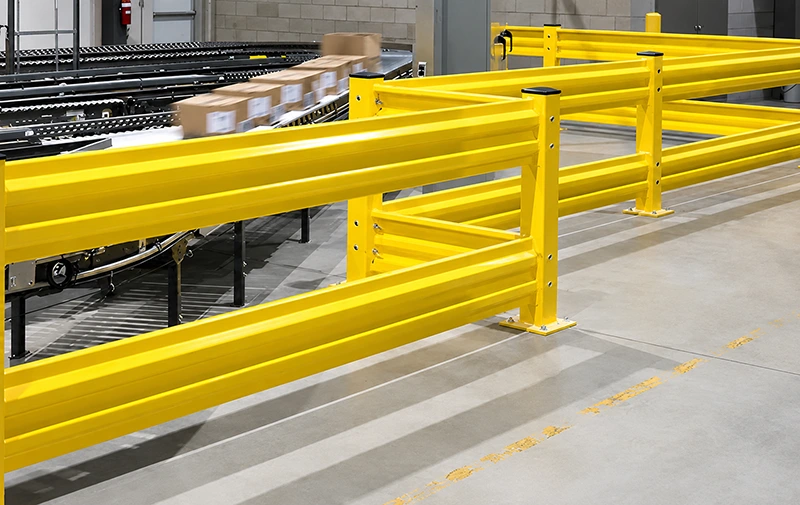
The cross-traffic blocker
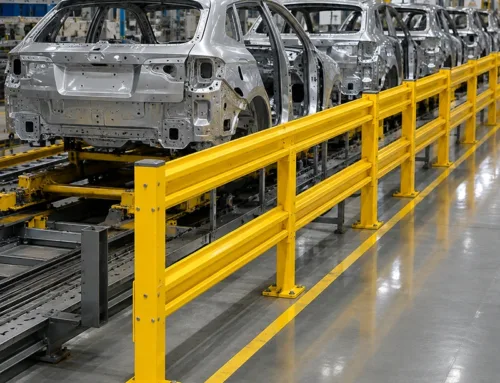
Without a fixed boundary, a counter-balanced forklift cuts across the AGV approach path to reach a downstream pick face. The 1,000 mm double-rail beam — 160 × 160 × 16 mm base, M16 anchor bolts, 85 mm wave height — is sized to absorb the project demand-condition strike (16,680 N) without panel separation. The corrugated profile keeps the rail on the floor after the impact, so the pick cell stays locked and the AGV does not lose its approach reference.
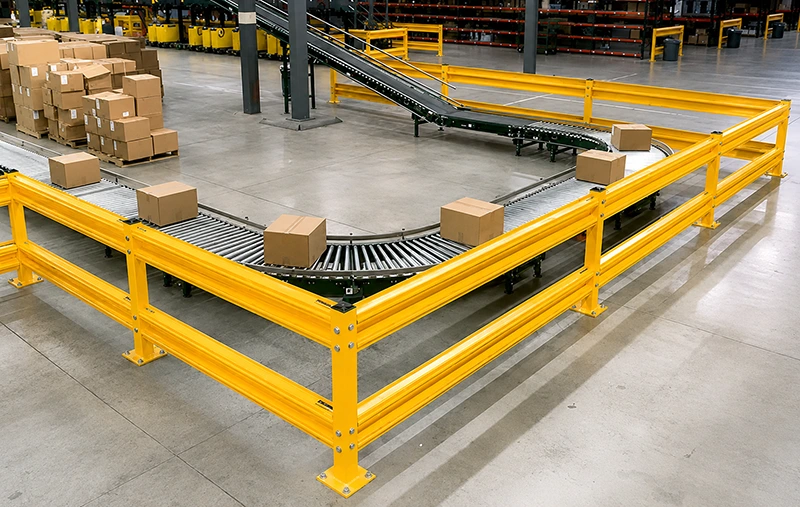
The out-of-zone recovery absorber
When an AGV exits its map-defined lane — a recovery manoeuvre after a LiDAR drop-out, a magnetic-tape splice, a low-battery pull-in — the corrugated beam carries the residual strike energy. A 3 mm or 4 mm Q235 carbon steel panel, 85 mm wave height and 310 mm rail width give the EHS pack a visible hardware layer for ISO 3691-4 and ANSI/RIA R15.08 documentation. The rail is the static physical artifact that the audit reads; the ATS map is the dynamic overlay the safety case is anchored to.
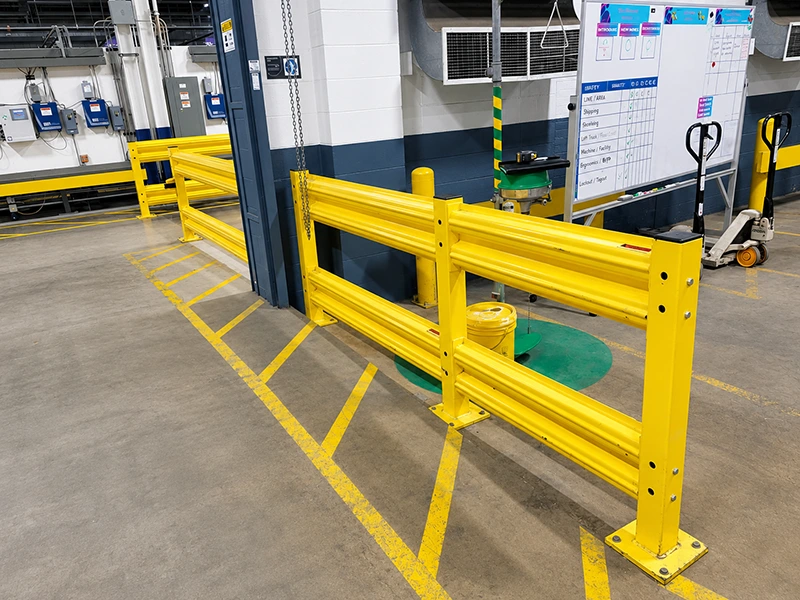
Where the Rail Sits in an AGV / Forklift / Picker Cell
- AGV pick station — the AGV stops at the rail, the picker reaches into the cell, the forklift drop-off halts outside the rail.
- AGV opportunity-charge cell — the rail bounds the lithium-bay and the AGV pull-in envelope; cross-traffic forklifts cannot enter while a charge cycle is live.
- AGV drop-off dock — the rail lines the dock face; forklift drop-off halts on the dock side, the AGV picks up on the cell side.
- AGV-elevator interface — the rail defines the elevator approach envelope and prevents forklift lift-pin strikes into the AGV wait zone.
- AGV-conveyor interface — the rail lines the conveyor-to-AGV handover cell, blocking the forklift that would otherwise cut across the conveyor to reach a downstream pallet face.
The rail is modular. The same 1,500 mm standard panel that closes an 11,900 mm cell also closes a 17,100 mm cell with two 1,140 mm custom fillers, so the pick-cell boundary stays the same component across the whole multi-cell project — one spare-parts list, one anchor-bolt pattern, one EHS dossier per plant.
Spec Sheet for the AGV Pick-Cell Boundary
Request the pick-cell boundary spec sheet: Q235 corrugated steel modular layout, 1,500 mm post spacing, 80 × 80 × 6 mm post, 160 × 160 × 16 mm base plate, M16 anchor bolt pattern, 1,000 mm height, and the four-zone length cut list (17,000 / 12,000 / 17,100 / 11,900 mm) from a working multi-cell project. The spec sheet is the same drawing the ATS integrator and the EHS lead cross-reference during the ISO 3691-4 / ANSI/RIA R15.08 risk assessment.
Send the pick-cell drawing; we return a cut list and a static map overlay
Send a DXF or PDF of the AGV pick cell, the AGV approach envelope, and the four candidate anchor-bolt positions. We return a rail cut list, an M16 anchor-bolt pattern, and a static map-overlay drawing the ATS team can drop into the WMS / WCS layer. The pick-cell boundary stays fixed; the ATS map stays flexible; the safety case stays auditable.