EN
EN  DE
DE  RU
RU  PT
PT  JA
JA  ES
ES  IT
IT Mixed-Fleet AGV / STR Floors
AGV Routes, Forklifts and Pickers on the Same Floor: A Q235 Corrugated Steel Warehouse Guard Rail as the Physical Boundary Behind the ATS Schedule
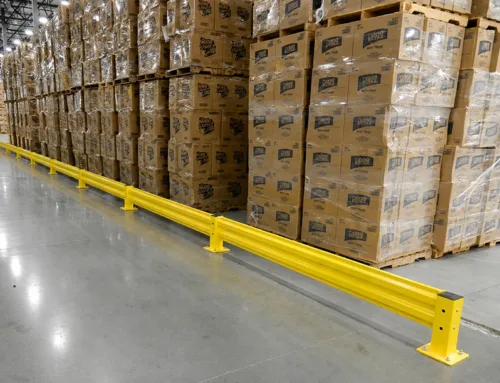
When AGV, STR, counter-balanced forklifts and human pickers share the same floor, a digital dispatch schedule alone cannot hold the line. A bolted, Q235 corrugated steel warehouse guard rail becomes the physical boundary layer beneath the ATS — a fixed, modular rail that keeps the robot route inside its lane and stops a wayward forklift or picker before it enters a no-go cell. With project-cut filler panels, 1,500 mm standard modules and a 160 × 160 × 16 mm base plate, the same bolted guard rail absorbs the new collision dimension and gives the EHS pack a tangible, line-of-sight artifact for the mandatory risk-assessment audit.
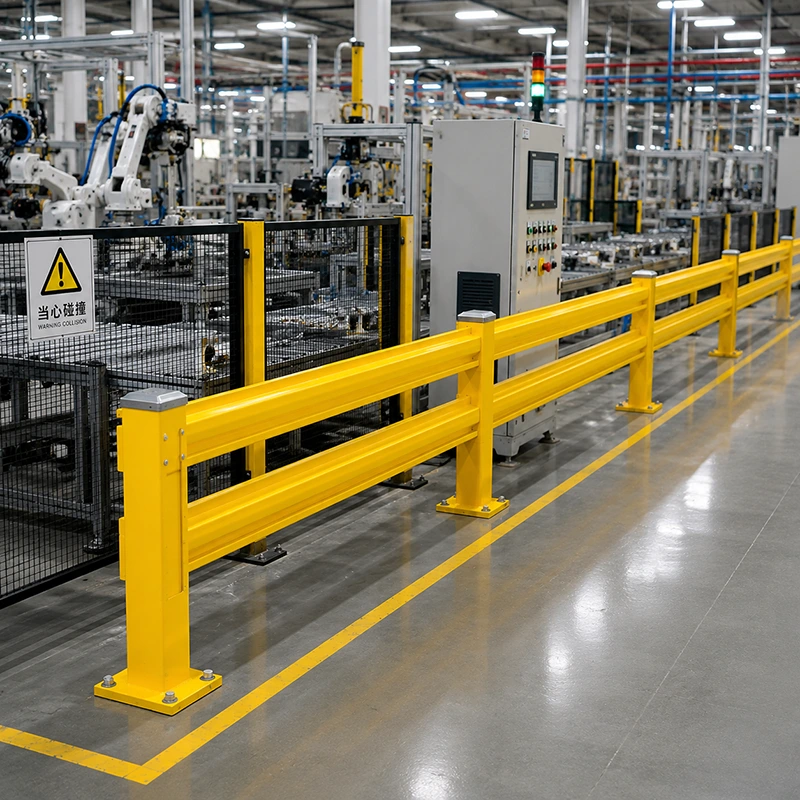
What the Physical Boundary Layer Has to Deliver
When AGV/STR routes thread between traditional forklift aisles and picker walk-paths, the warehouse guard rail cannot be decorative. The bolted Q235 corrugated steel guard rail below is the line-of-sight artifact an auditor will measure during the mandatory risk assessment. The table records the dimensions and options Hsafety currently publishes — every figure is a base spec or a verified opportunity 15176 project condition, not a marketing exaggeration, and a final spec must still be locked against the latest project drawing.
| Specification | Hsafety W-beam / Corrugated Warehouse Guard Rail |
|---|---|
| Base material | Q235 carbon steel (equivalent to S235JR / ASTM A283M Gr.D) |
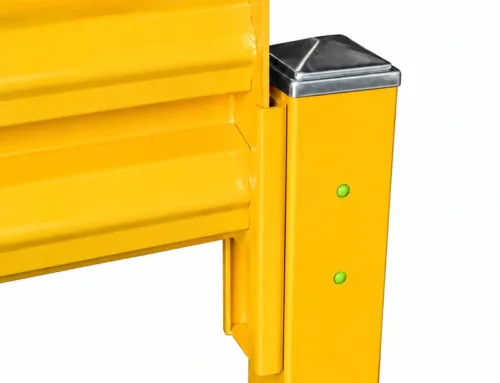
| Corrugated beam (W-beam) | 2-rib (W-beam guardrail) or 3-rib (thrie-beam guardrail), 194 mm crest pitch, 85 mm wave height, ~310 mm panel width, 40 mm wave amplitude |
| Panel thickness | 3 mm or 4 mm heavy duty guardrail |
| Standard panel length | ~1,500 mm modular guardrail module, with project-cut filler panels from 680 mm up to 1,140 mm (verified in opportunity 15176) |
| Rail configuration | Single rail guardrail or double rail guardrail (two-rib W-beam guardrail) |
| Post | 80 × 80 × 6 mm square tube, height 1,000 mm, three pre-drilled holes per side (compatible with both 2-rib and 3-rib corrugated guardrail beam systems) |
| Base plate | 160 × 160 × 16 mm bolted guardrail base plate, four M-class expansion anchor bolts, 150 mm minimum concrete floor anchored guardrail slab |
| Panel layout | Lower corrugated rail sits 100 + 6 mm above the floor; upper rail flush with post top; overall industrial guard rail height 1,000 mm |
| Surface finish | Powder coated guardrail (yellow safety guardrail default, custom colours on request) or hot-dip galvanized guardrail; reflective tape guard rail optional |
| Module replaceability | Bolted guard rail system at every post and at every panel-to-panel splice; lift-out guardrail inserts supported |
| Verified custom-length cut | Opportunity 15176: 8 filler panels (1,140 / 1,040 / 780 / 680 mm) closing four lanes of 17,100 / 17,000 / 12,000 / 11,900 mm — 1,000 mm height, double-rail layout |
Why a Bolted, Q235 Corrugated Steel Warehouse Guard Rail Is the Right Physical Boundary Behind an ATS
A Modular Bolted Boundary That Tracks Every AGV / STR Lane Redraw
When the ATS pushes a new AGV/STR layout, the physical boundary has to move with it without a hot-work permit and without a slab re-pour. Hsafety ships each warehouse guard rail as a 1,500 mm standard module with project-cut filler panels down to 680 mm — opportunity 15176 used eight filler panels (1,140 / 1,040 / 780 / 680 mm) to close four lanes of 17,100 / 17,000 / 12,000 / 11,900 mm at a uniform 1,000 mm height. Bolted connections at the post and at every panel-to-panel splice let a maintenance crew lift a single corrugated steel beam, set a new lane, and bolt it back down with a ratchet wrench and a torque bar. The ATS digital schedule stays the master, the Q235 corrugated steel guard rail stays the slave, and the floor mounted guardrail boundary tracks every redraw without a single weld.
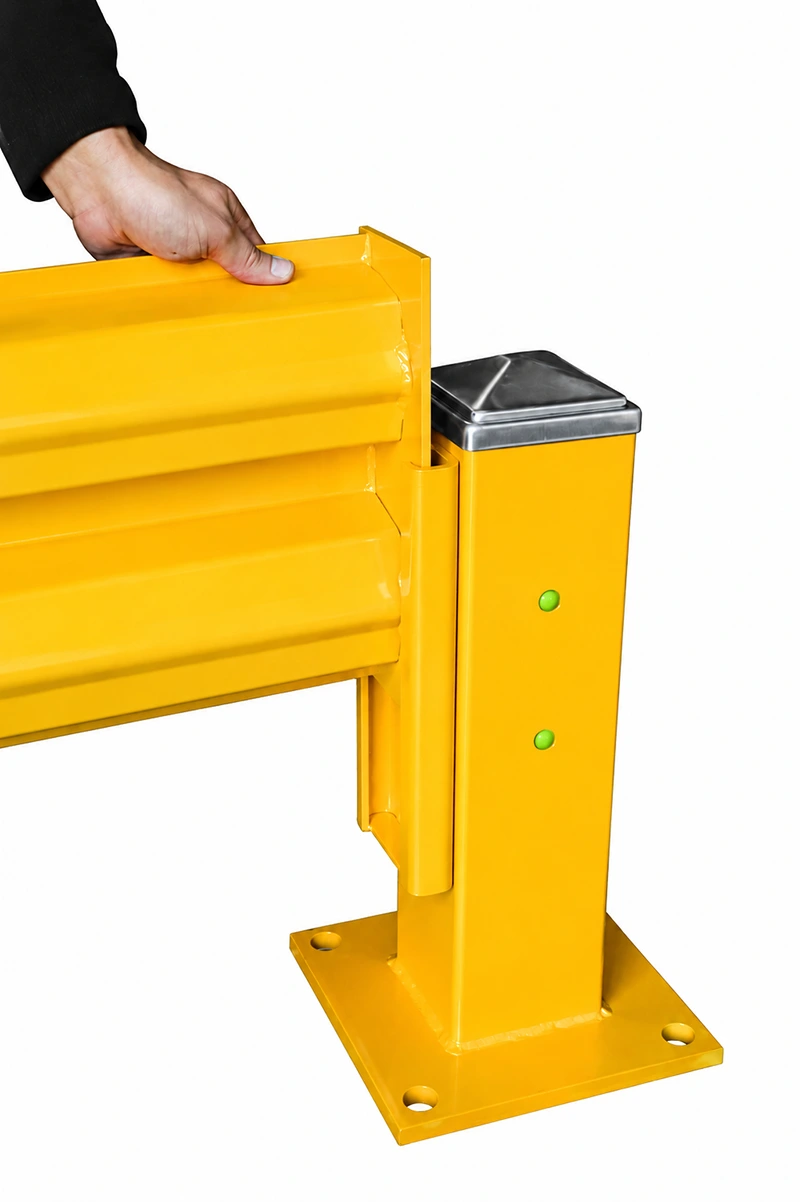
A Corrugated Beam That Holds the Lane After the First Strike
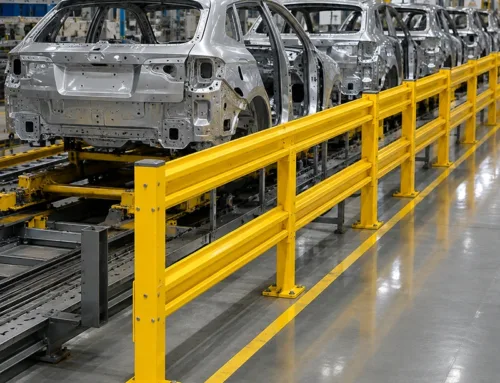
A painted floor line cannot catch a 3-ton forklift that drifts into the AGV lane, and a polymer post will rebound but leave the conveyor on the other side exposed. The double-rail W-beam guardrail uses a 194 mm crest pitch and an 85 mm wave height so the strike energy is absorbed by the corrugated steel panel geometry, not by the post base; the W-beam guard rail may dent locally but the structure stays standing and the lane stays closed. Powder coated guardrail or hot-dip galvanized guardrail, the yellow safety barrier stays visible under a dim racking aisle, and the 160 × 160 × 16 mm bolted base plate plus M-class expansion anchor bolts keep the warehouse safety barrier on the slab even after multiple low-speed forklift impacts. The aisle keeps running, the EHS log keeps recording, and the maintenance ticket is one panel swap rather than a slab patch.
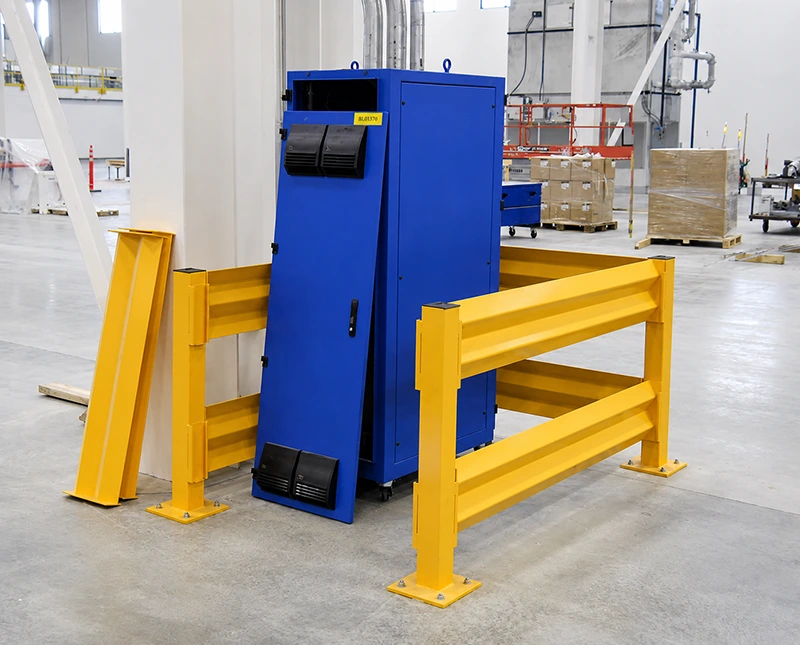
A Line-of-Sight Artifact the Mandatory Risk Assessment Can Verify
A 2026 safety auditor wants to see the boundary, not read a slide about it. The double-rail W-beam warehouse guard rail delivers a visible, measurable, hot-dip galvanized guardrail or powder coated guardrail yellow line at 1,000 mm height, with documented post spacing (1,500 mm centres in the 15176 case) and a documented base-plate footprint the auditor can tape-check on the floor. The walk-through confirms the rail is continuous, confirms the lower corrugated beam is no more than 100 + 6 mm off the slab, and ticks the engineering control box on the hierarchy-of-controls form. The Q235 corrugated steel guard rail becomes the physical evidence the EHS pack attaches to its risk-assessment write-up, while the ATS log remains the digital evidence — together they close the mandatory assessment for forklift impact protection on a mixed-fleet AGV / STR floor.
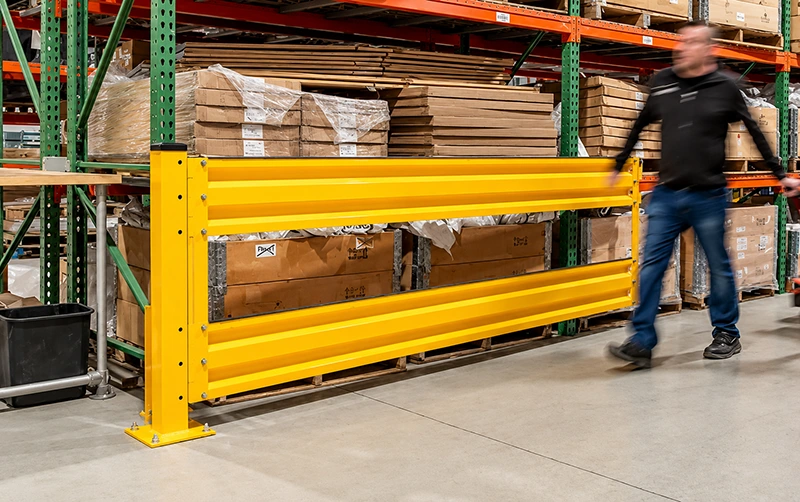
Where the Physical Boundary Layer Pays for Itself in Mixed-Fleet Plants
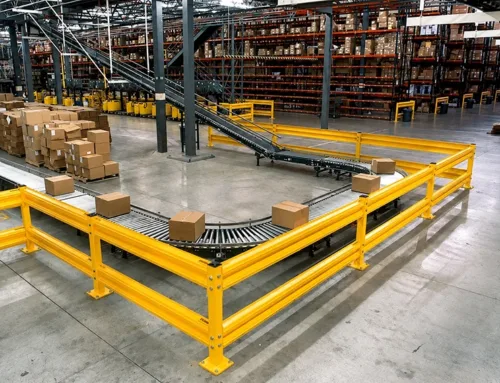
- AGV / STR pickup lanes beside counter-balanced forklift aisles — yellow double-rail W-beam guardrail with custom filler panels holds the robot route inside its mapped corridor.
- Robotic palletizing cell perimeter — bolted Q235 corrugated steel barrier at 1,000 mm height separates the cell from the picker walk-path and the charging station.
- Loading dock and dock-door apron — hot-dip galvanized guardrail with reflective tape for low-light docks keeps the lift truck inside the marked bay.
- Rack end and rack-aisle terminator — bolted base plate and 1,500 mm post centres protect pallet rack uprights from a low-speed forklift drift.
- Electrical room and blue equipment cabinet corners — bolted warehouse safety barrier with 160 × 160 × 16 mm base plate anchored to a 150 mm concrete floor.
- Conveyor pick-station return side — modular corrugated guardrail keeps tote overruns off the conveyor structure and the picker reach envelope.
Every entry above is a real, photographable Hsafety installation. The Q235 corrugated steel warehouse guard rail is the same bolted product across each use, so the EHS pack can publish one set of drawings, one anchor-bolt spec, one inspection checklist and one reflective-tape layout for the entire mixed-fleet plant — and the ATS keeps publishing lane coordinates against a boundary it can actually see on the floor.
Get the Project Datasheet and the Mixed-Fleet Boundary Drawing
Request the Hsafety mixed-fleet boundary package: Q235 corrugated steel guard rail datasheet, 1,000 mm-height double-rail general arrangement, custom filler panel worksheet, base plate and expansion anchor bolt schedule, and a reference risk-assessment excerpt tailored to an AGV / STR + counter-balanced forklift floor. Send a one-line scope and a lane sketch; engineering will return a quoted layout with project-cut filler panels and post centres within two business days.
Put a Bolted, Q235 Corrugated Steel Warehouse Guard Rail Behind Your ATS
Send your AGV / STR lane drawing and a one-line scope. Hsafety engineering will return a 1,000 mm double-rail general arrangement with 1,500 mm standard modules, custom filler panels for non-standard lengths, base plate and expansion anchor bolt call-outs, and a sample risk-assessment excerpt your EHS team can paste straight into the audit pack — so the ATS digital schedule and the Q235 corrugated steel warehouse guard rail arrive at the mandatory risk assessment as one combined engineering control.