EN
 DE
 RU
 PT
 JA
 ES
 IT
MULTI-SITE ROLLOUT / INDUSTRIAL SAFETY FENCING
One fence standard, 25 countries: what actually varies is the site, not the drawing
A manufacturing group running plants in more than 25 countries cannot let the local welding contractor decide whether the corporate guarding standard looks the same in every plant. Mefence frameless 3D safety fence replaces site welding with a plastic clip and a self-tapping screw, so the same Q235 welded mesh panel module list arrives, bolts down and reads identically at every site — for warehouse zoning, pedestrian vehicle separation and machine guarding perimeters. The install is done by the plant’s own warehouse or facility maintenance crew, not by an external coded welder.
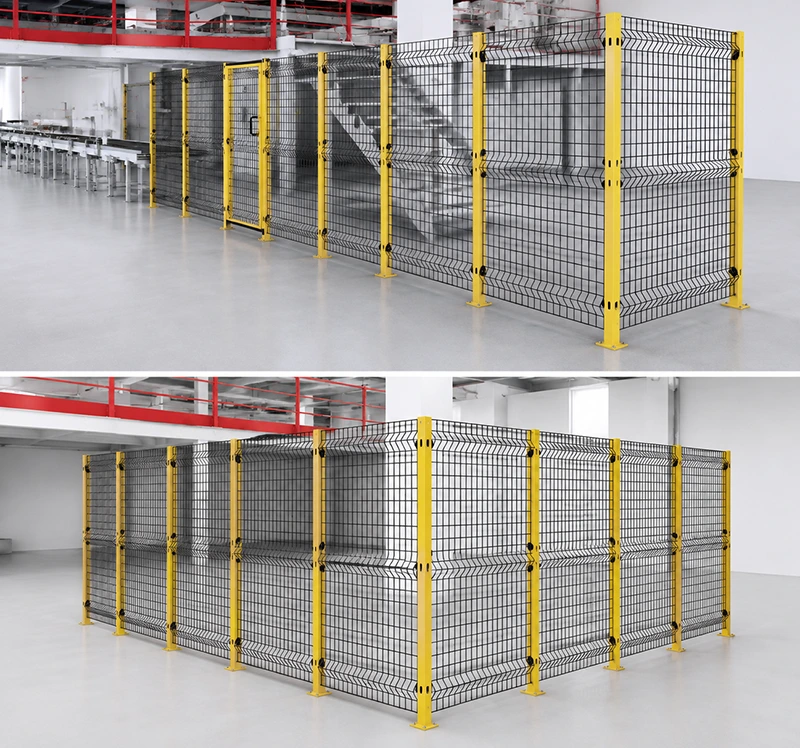
The specification that has to survive 25 countries of site variance
Corporate guarding standards rarely fail in the document. They fail on the floor. Slab tolerance in a 1990s plant is not the tolerance in a 2023 plant, the last bay is never a round number, and cast-in or drilled anchor positions almost never land exactly where the layout drawing shows them. A framed fence closes that gap with welding, grinding and a rattle-can touch-up — so two plants holding the same drawing can end up with two visibly different machine guard fences. Mefence moves that gap into the hardware instead: slotted mounting holes on the post, bolt-mounted panel clamps, and panels that are simply cut on site.
| Item | Mefence fact |
|---|---|
| Base material | Q235 carbon steel, welded wire mesh |
| Surface treatment | Electrostatic powder coating (powder coated steel) |
| Wire diameter | 3 mm / 4 mm |
| Mesh opening | 50 × 50 mm / 20 × 100 mm |
| Panel width | 200 – 1400 mm, trimmed to the bay that actually exists |
| Panel height | 200 – 3000 mm |
| Ground clearance | 140 mm |
| Post | 40 × 60 mm / 60 × 60 mm, base plate post with slotted mounting holes |
| Connection | Plastic clip + self-tapping screw — no site welding, no hot-work permit |
| Post-to-floor fixing | Expansion bolt through the base plate, alignment taken up in the slot |
| Standard colour | Yellow + black; custom colours including orange |
Mefence is area demarcation. It is not an impact-rated containment barrier; strike points at robot, press or conveyor transfer zones belong to the higher-spec Machine Fence line, and the corporate standard should say so in the same clause.
Where the skill goes: into the hardware, not the crew
No hot work, no welding certificate, one person, three steps
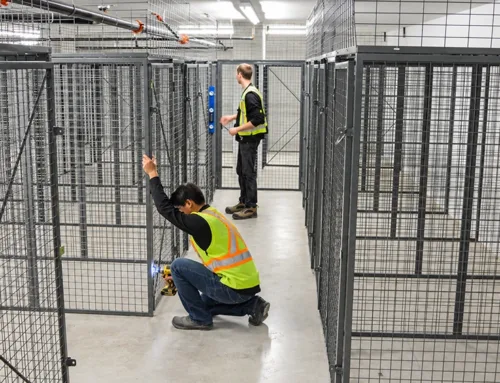
The panel is clamped to the post with a plastic clip and a self-tapping screw, and the post is a base plate post fixed with expansion bolts. There is no arc, no grinding, no heat distortion and no repainted weld scar, so a plant’s own maintenance team can run the install between shifts instead of waiting for an external certified welder and a hot-work permit. That is the documented one-person, three-step assembly behind the quick install safety fence claim of more than 50% less installation time than conventional framed fencing — and it is repeatable by a crew that has never welded in its life.
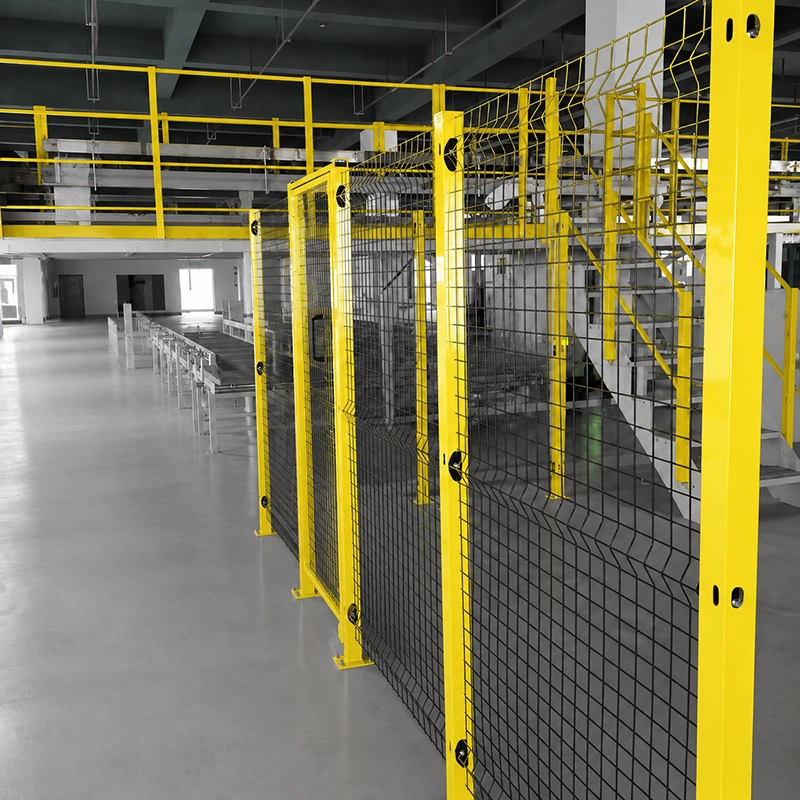
Slotted holes and clamp connectors absorb the tolerance the drawing never had
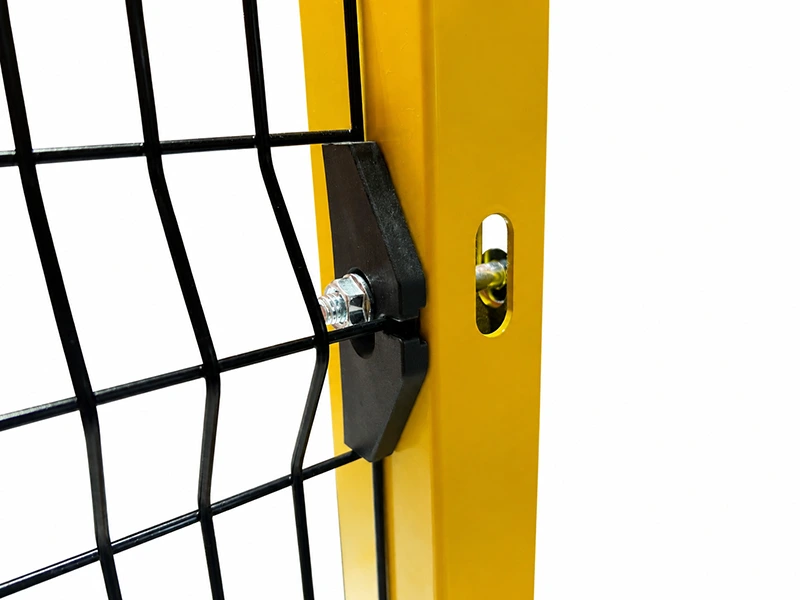
The bolt-mounted connector clamps the frameless panel to the post, and the post carries slotted mounting holes so the fence line can be set out and aligned after the anchors are already in the slab. The last bay is closed by cutting the mesh panel itself — widths from 200 to 1400 mm, heights from 200 to 3000 mm — rather than by fabricating a filler plate on site. Two plants on different slabs therefore produce the same vertical post line, the same mesh tension and the same 140 mm ground clearance, because the variance is spent in the slot and the cut, not in someone’s welding hand.
Access points, cable routing and colour follow the same single standard
Gate modules close at controlled access points so AGV lane separation and pedestrian vehicle separation are planned crossings rather than open gaps. The T-shaped ridge pressed into every panel works as a cable management fence channel, keeping camera, interlock and light runs inside the boundary instead of drooping across the aisle, and the same ridge accepts wood slat inserts where a plant needs visual shielding. Yellow-black remains the default warning palette, with custom colours including orange where a country’s site code requires them.
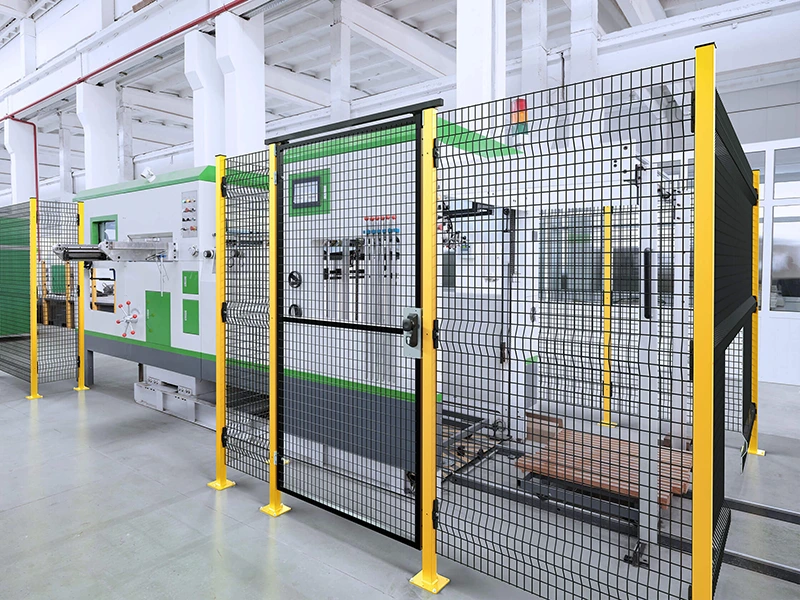
What the standard covers in a 25-country rollout
- Warehouse zoning, warehouse partition and storage area separation between storage, WIP and shipping
- Pedestrian vehicle separation in mixed-traffic aisles, plus a forklift path barrier along travel routes
- AGV lane separation so robot routes stay readable and random crossings become planned access points
- Robotic workstation enclosure and CNC machine guarding perimeters as visible demarcation
- Tool crib enclosure, material segregation and automated equipment guarding around conveyors and transfer zones
- Workshop isolation, temporary construction fence and construction site barrier during retrofit windows
- Stairs, mezzanine and elevated platform edge protection where the slab changes level
Write five items into the corporate clause, and match each one to hardware rather than to a contractor: the module list (panel width 200–1400 mm, height 200–3000 mm, post 40×60 / 60×60 mm), the fixing kit (plastic clip, self-tapping screw, expansion bolt, base plate post), the colour code (yellow-black default, custom options), the ground clearance of 140 mm, and the honest scope split that puts impact containment on Machine Fence instead of on the zoning fence. Mefence already answers all five from one factory-direct module list, which is why the same order can be repeated plant by plant under ISO 14120, ANSI B11.19 and OSHA 29 CFR 1910.212 discussions without re-engineering anything locally.
Panel module list and installation sequence
Ask for the Mefence module list and the one-page installation sequence: panel sizes, post sizes, clip and self-tapping screw fixings, base plate posts with expansion bolts, slotted-hole alignment notes and the colour chart. Your plants attach it to the corporate standard as the single hardware reference, so a maintenance technician in one country installs the same fence as a maintenance technician in the next.
Build the standard once, then roll it out plant by plant
Send the layout of one plant and the countries you are rolling into. We will come back with a panel module list, a fixing kit list and the demarcation-versus-impact split, so every site orders the same hardware and the auditor sees the same fence photograph from Monterrey to Pune.