EN
 DE
 RU
 PT
 JA
 ES
 IT
End-of-Line Automation · Robot Palletizer Cell Guarding
Robot Cell With a View: Frameless 3D Industrial Safety Fence That Blocks People, Not Cameras or AGV LiDAR
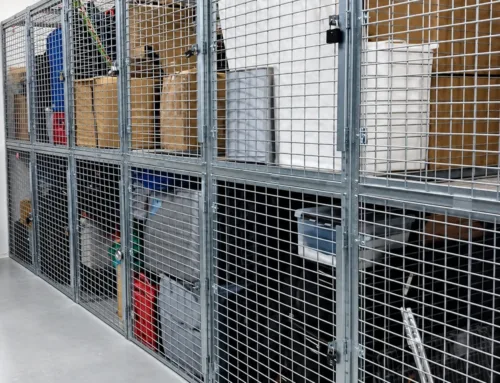
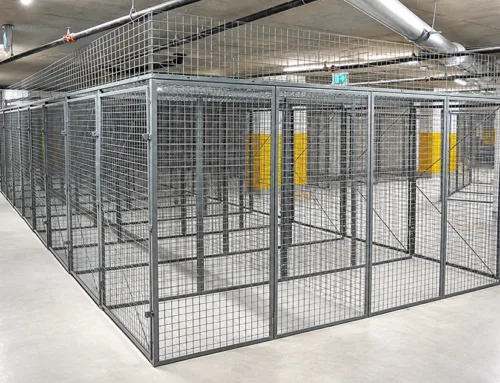
End-of-line automation arrived faster than the floor plan did. A palletizing robot, an AGV lane and a pick aisle now share one slab, and robot cell safety practice expects a physical boundary around the envelope. A solid panel wall gives you the boundary and takes the sightline with it: the operator cannot confirm the cycle from outside, the dome camera records a grey rectangle instead of a pallet pattern, and the AGV map gains a new hard surface in front of the LiDAR plane. Mefence frameless 3D industrial safety fence is a Q235 welded mesh boundary with 20 x 100 mm or 50 x 50 mm openings, clip and self-tapping screw fixing on base plate posts, and horizontal T-shaped ridges that carry door-control, sensor and camera cable. It is an area demarcation and robot cell separation product — certified impact containment at the strike point is quoted on the Machine Fence line.
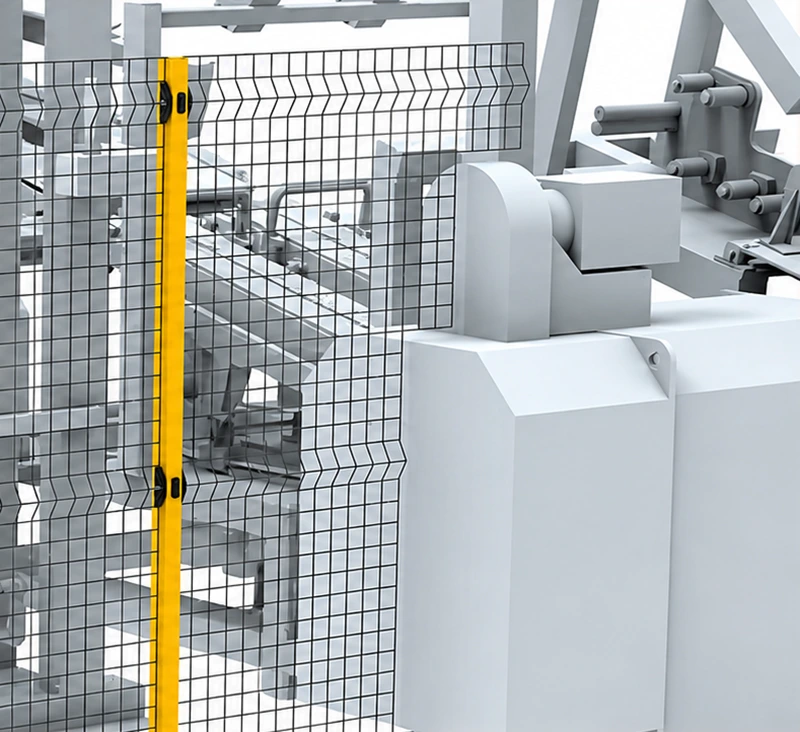
What Decides Whether the Cell Stays Visible: Mesh Opening, Wire Diameter and Post Geometry
Boundary specs are usually argued in millimetres of steel. Around a palletizer they should be argued in millimetres of opening, because aperture settles two questions at once: what a person cannot reach through, and what an eye, a camera or a LiDAR plane can still see past. Solid cladding loses the second question outright. Heavy framed mesh loses it partly, because wide flat frame borders crop the effective field of view of a fixed camera mounted above the cell. The values below are what a robot cell boundary is actually bought on.
| Specification | Mefence frameless 3D industrial safety fence |
|---|---|
| Material and finish | Q235 carbon steel, powder coated (electrostatic spray) |
| Wire diameter | 3 mm / 4 mm |
| Mesh opening | 20 x 100 mm / 50 x 50 mm welded mesh |
| Mesh panel width | 200 – 1400 mm, cuttable on site |
| Mesh panel height | 200 – 3000 mm |
| Ground clearance | 140 mm |
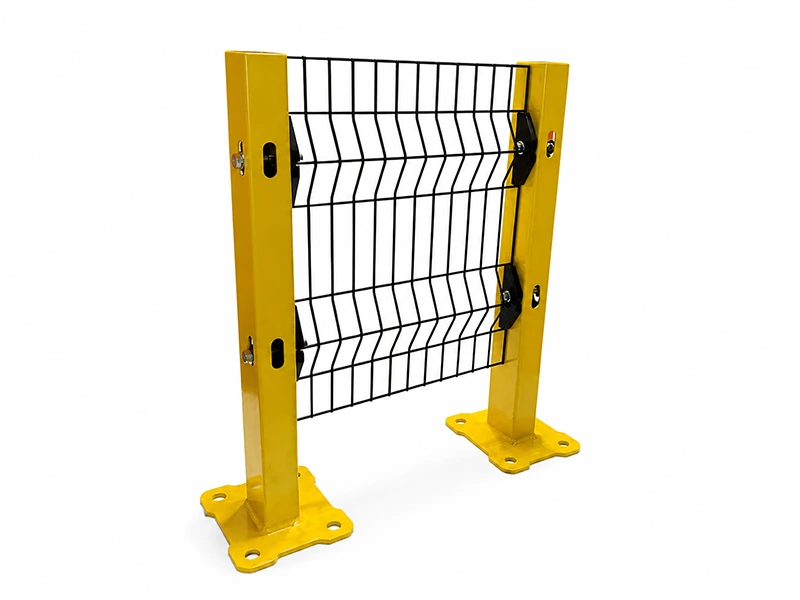
| Post | 40 x 60 mm / 60 x 60 mm, slotted mounting holes for verticality adjustment |
| Panel structure | Frameless welded mesh with multiple horizontal T-shaped ridges (bending fence), cable route and wood slat insert |
| Fixing | Plastic clip + self-tapping screw; base plate posts with expansion bolts |
| Colour | Yellow + black standard; custom colours including orange |
| Installation | One person, three steps; 50%+ less install time than conventional framed fence |
| Scope | Area demarcation, robot cell separation, AGV lane separation; impact-rated containment → Machine Fence |
Three Structural Decisions That Keep a Robot Cell Observable
Open enough to watch the cycle, tight enough to keep hands out
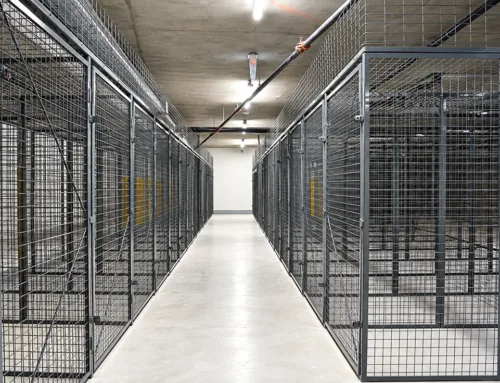
Two apertures cover most end-of-line work. 20 x 100 mm with 3 mm or 4 mm wire is the choice where the boundary runs inside an operator’s reach and small parts, tooling fingers or loose fasteners should not pass through. 50 x 50 mm with 4 mm wire is the choice where the fence is a perimeter around a palletizer, a conveyor discharge or an AGV lane and the priorities are airflow, light, camera coverage and a clean LiDAR return. Neither one is a window, and that is the point: at 20 x 100 mm an operator standing at the fence can still follow arm posture, pallet build pattern and case orientation, a fixed dome camera keeps its full field of view instead of being cropped by a frame border, and an AMR scanning through the fence reads an open mesh instead of a continuous reflective surface. Random crossings become fixed openings, and the ghost downtime caused by an AGV braking for a pedestrian in the lane stops being a daily event.
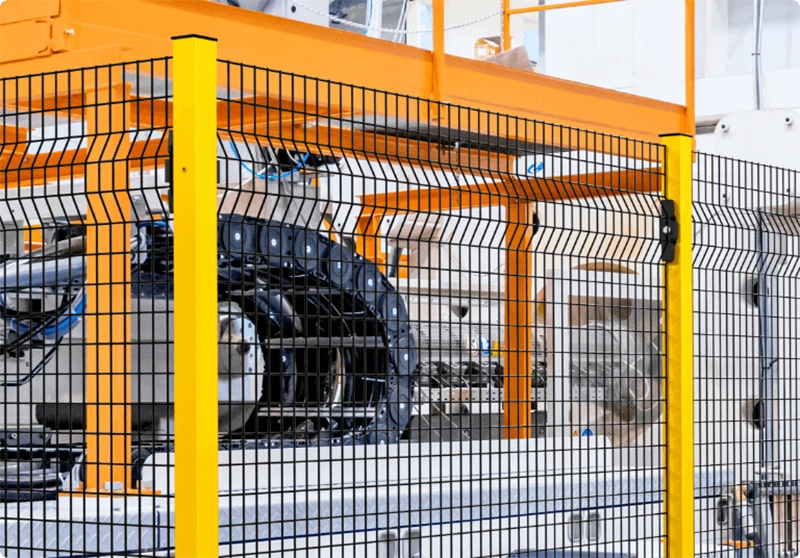
The T-shaped ridge: interlock and camera cable without external conduit
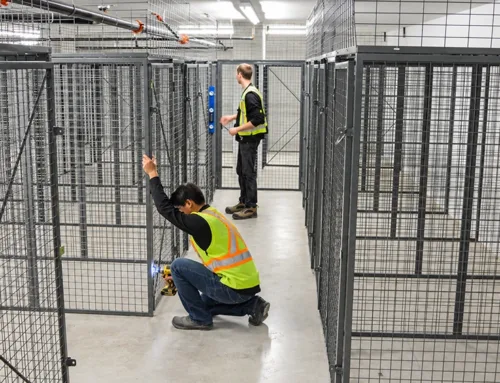
Robot cells are cable-heavy. Door interlocks, light curtains, camera drops, sensor tails and stack lights all need a route from the fence line back to the control panel, and the default answer — surface conduit clipped to the panel — is where the sightline quietly disappears. Mefence presses multiple horizontal T-shaped ridges into the 3D welded mesh, and that ridge is a cable channel inside the boundary itself, so interlock and camera runs sit in the fence rather than in front of it. The same ridge accepts a wood slat insert when a section genuinely has to be screened; slats are fixed through the transverse wires with self-tapping screws and the decision can be made per section rather than per wall. Panels run 200 – 1400 mm wide and 200 – 3000 mm high and are cut on site, with 140 mm ground clearance for wash-down and clean zones. Base plate posts in 40 x 60 mm or 60 x 60 mm use slotted mounting holes and expansion bolts, so verticality is trimmed after the slab tolerance shows up, and the plastic clip plus self-tapping screw fixing means no welding on a live floor.
From the cell perimeter to the mezzanine edge: one modular mesh standard
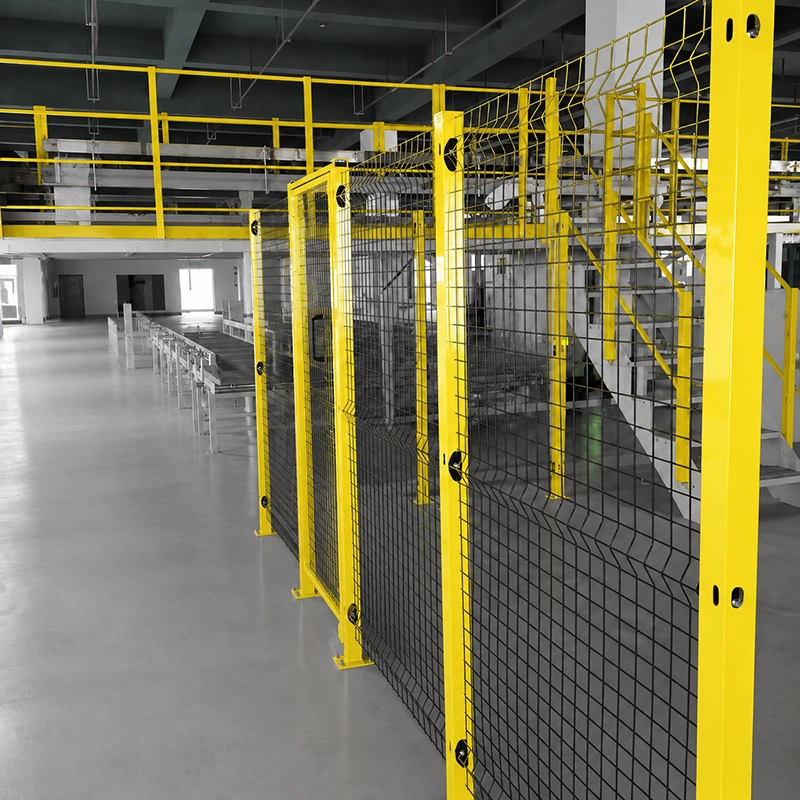
“Blocks people” and “lets the technician in” are two states of the same boundary. A single gate module with lockable hardware gives the cell exactly as many openings as the layout needs — one controlled crossing per aisle, instead of the diagonal shortcuts that appear when a fence stops short of a column. During production the gate stays locked; during a teach, a gripper change or a tooling swap the technician enters through the same gate and closes it behind. The identical post, panel and clip hardware also covers the vertical side of the same automation project: stair openings, mezzanine edges and raised platform perimeters next to the robot cell, at panel heights up to 3000 mm. When the line is re-zoned, the panels unbolt from their base plates and reappear somewhere else, which is why the boundary behaves like equipment rather than like a sunk construction cost. One honest boundary line: where a palletizer throws a case, or where a shuttle or a truck can actually strike the fence, Mefence is not the product — that point is quoted on SGF’s impact-rated Machine Fence, and the two run together on the same drawing.
Where This Boundary Earns Its Place on an End-of-Line Project
- Robotic workstation enclosure and robotic cell safety perimeters
- Automated equipment guarding and machine guard fence runs
- AGV lane separation and AMR lane control
- Pedestrian vehicle separation and forklift path barriers
- Warehouse zoning, warehouse partition and storage area separation
- CNC machine guarding perimeters and conveyor belt isolation
- Stair, mezzanine and raised platform edge protection
- Site demarcation and temporary partition work during a line retrofit
Most buyers arrive with a standard already open in another tab — OSHA 29 CFR 1910.212, ANSI B11.19, ISO 14120, ISO 14119, ISO 13857 or ISO 13855. Mefence answers the part of that file which asks for a visible, physical separation between people and the automated envelope, and it does it without a hot-work permit, without a fabricator and without a camera re-survey. The part of the file that asks for a certified impact-rated barrier at a strike point is answered by the Machine Fence line. Splitting the drawing that way usually ends the argument faster than arguing one product into two jobs.
What We Need to Cut Panels and Price the Cell Boundary
Send the cell plan with the robot envelope marked, the positions of your fixed cameras, the AGV or AMR lane width, the number of access points you want and the strike points you consider impact-rated. With those five inputs we return a panel schedule for 20 x 100 mm or 50 x 50 mm mesh, post positions for 40 x 60 mm or 60 x 60 mm base plate posts, gate and lockable door modules, colour selection including custom and orange, and a separate line for any section that should go to Machine Fence instead.
Specify the sightline, not only the barrier
A robot cell boundary is judged twice: once by the person who has to walk up and confirm the cycle is running correctly, and once by the camera and the AGV that have to keep seeing through it. Get both right at the specification stage and the end-of-line automation speeds up instead of building a blind wall around itself.