EN
 DE
 RU
 PT
 JA
 ES
 IT
Corrugated plant · mixed-traffic aisle
Forklifts, Quality Walkways and One Aisle: Where a Yellow-Black Frameless 3D Safety Fence Draws the Pedestrian–Vehicle Separation Line
A corrugated plant does not have one traffic flow, it has three running at the same time: raw paper reels in, board and boxes moving through transfer, finished pallets out — all on forklifts and clamp trucks. Quality, maintenance and sample inspectors walk into that same footprint dozens of times a shift. Mefence is a frameless 3D industrial safety fence built for exactly that layer: a Q235 carbon steel welded mesh barrier, powder coated in the yellow-black warning scheme, clamped to base plate posts along the walkway edge so pedestrians and forklifts stop sharing a lane. It is area demarcation and pedestrian vehicle separation hardware — not a certified impact containment barrier.
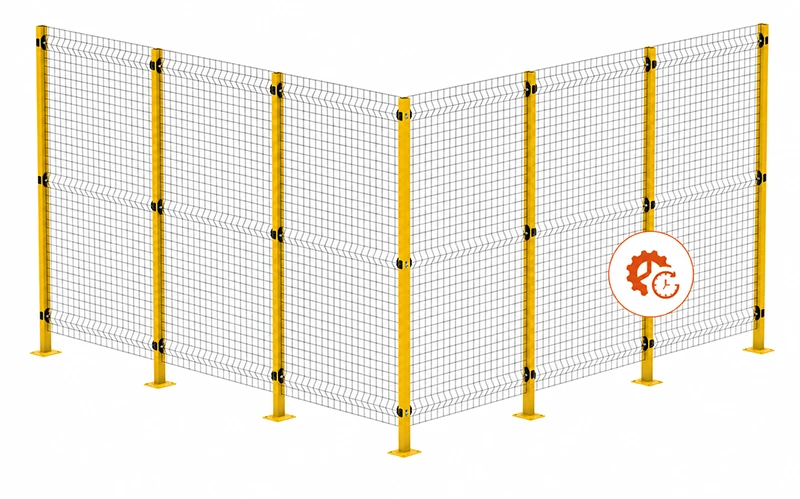
Mefence structure and parameters that decide a mixed-traffic aisle
Painted lines, cones and barrier tape fail in the same place every time: a loaded clamp truck cuts a corner to save forty metres and the line disappears under the wheel. The specification question is not colour, it is whether the boundary is physical, whether it survives a real aisle width, and whether it can be installed inside a production stop. These are the documented figures Mefence is quoted on.
| Item | Mefence specification |
|---|---|
| Material | Q235 carbon steel — welded wire mesh, no perimeter frame |
| Surface treatment | Electrostatic powder coating (powder coated steel) |
| Wire diameter | 3 mm / 4 mm |
| Mesh opening | 20 × 100 mm / 50 × 50 mm |
| Panel width | 200 – 1400 mm |
| Panel height | 200 – 3000 mm |
| Ground clearance | 140 mm |
| Post size | 40 × 60 mm / 60 × 60 mm |
| Standard colour | Yellow + black warning scheme; custom colours available, including orange |
| Panel joint | Plastic clip + self-tapping screw — no welding in production, none on site |
| Post-to-floor fix | Base plate post + expansion bolt, slotted mounting holes for on-site alignment |
| Panel form | 3D pressed / bent mesh with horizontal T-shaped ridge |
| Installation | One person, three-step assembly; 50%+ installation time reduction claimed against conventional framed fence |
| Positioning | Non-high-impact-area demarcation and traffic control — not a crash-rated guard |
Three details that turn a yellow-black fence into a working traffic control measure
Base plate posts and slotted holes close the gap between drawing and floor
A corrugated plant floor is never the drawing. Anchor pockets sit where a previous line drilled them, expansion joints run diagonally across the walkway, and the last bay is never a round number. The Mefence post lands on a base plate with four fixing points and slotted mounting holes, so the erection crew positions the post, checks the line against the painted walkway and tightens. Because the panel itself is frameless welded mesh, the final bay is trimmed to what the floor actually measures instead of being closed by a welder with a hot-work permit. For a plant that only gets a weekend window, that is the difference between a planned shutdown and a shift that starts with an open perimeter.
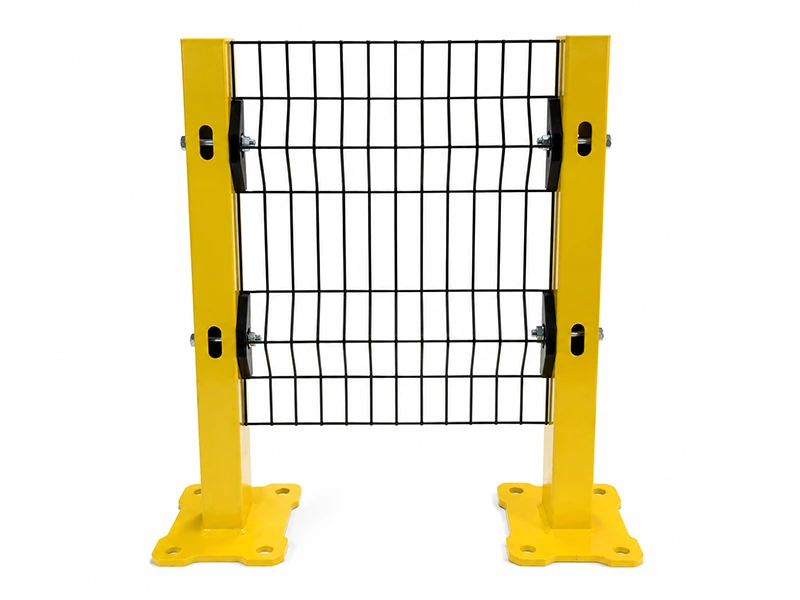
Clip fixing means no welding next to a running corrugator
Welding on a live floor is the reason most pedestrian vehicle separation projects get postponed: hot work permits, fire watch, adjacent equipment shut down, and a maintenance crew pulled off planned tasks. Mefence panels join with a plastic clip and self-tapping screw, and the post is bolted down with an expansion bolt. The work is cold, it is tool-light, and it is sequenced so that one person can set posts and hang panels without a second trade on site. It also means the barrier is not a sunk cost: when the reel store is re-drawn or a new transfer conveyor lands in the aisle, the clips come apart, the panels come off the posts, and the same fence is re-deployed as a modular reconfigurable system.
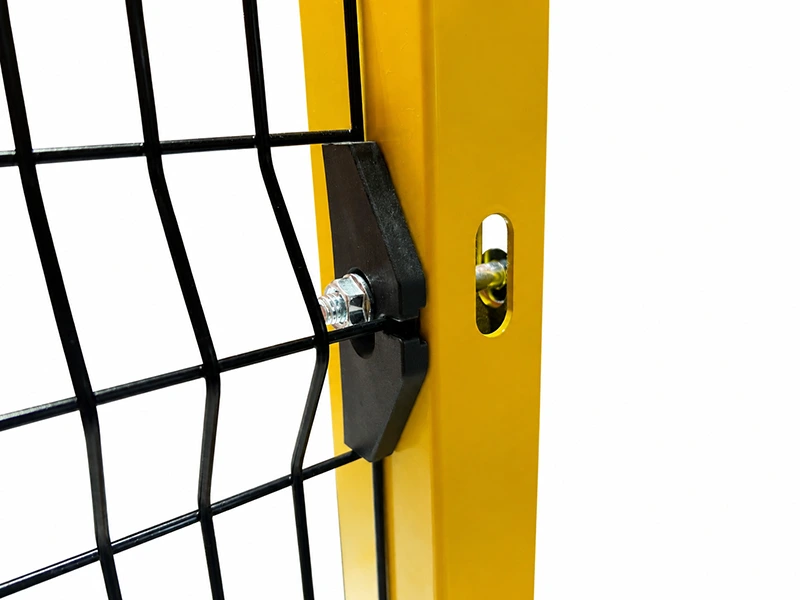
One panel does three jobs: boundary, cable route and access point
Every horizontal T-shaped ridge pressed into the panel is both a stiffening bend and a channel. Interlock cable, sensor leads from a transfer point, camera cable or lighting runs sit inside the ridge instead of being clipped across the outside of the fence where a clamp truck can reach them — the same channel accepts wood slat inserts where a walkway needs visual shielding instead of full see-through mesh. The gate hardware on a Mefence run turns the random crossing into a planned access point: pedestrians use the door, forklifts keep the lane, and the supervisor can still see the aisle through the mesh rather than around a solid wall. Where an aisle is genuinely a strike zone, that stretch belongs on the higher-spec Machine Fence line, and Mefence continues as the zoning fence up to it.
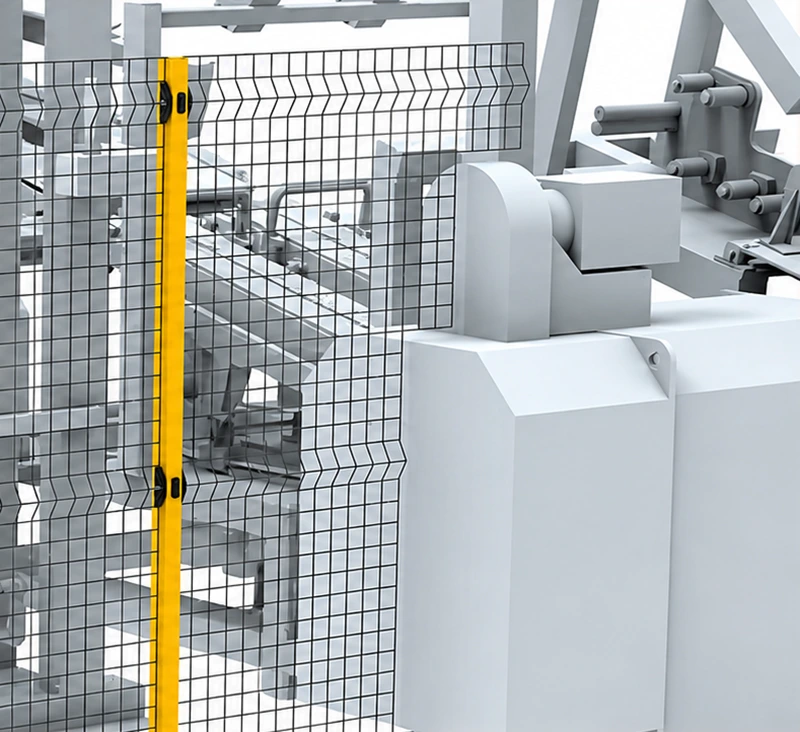
Where Mefence is specified in a corrugated or packaging plant
- Pedestrian vehicle separation along walkways that run parallel to the reel and pallet truck lanes
- Yellow black safety fence marking where the forklift path barrier starts and ends at a doorway
- Warehouse zoning between reel store, WIP buffer and finished goods staging
- Warehouse partition between the quality inspection bench and the vehicle route passing it
- Married automated equipment guarding peripheries around transfer conveyors and palletisers, at demarcation level
- On-site cutting fence work where the last bay is not a standard panel width
- Temporary partition during a line retrofit, then re-used on the next layout
- Cable management fence carrying interlock and sensor cable inside the T-shaped ridge
- Module separation around a robotic palletiser cell, with high-impact strike points quoted on the Machine Fence line
- Stair, mezzanine and elevated platform edges where an operator walkway meets vehicle traffic
In each case the same kit is doing the same job: making the boundary visible from the cab at distance, and making a crossing a decision rather than an accident.
What to send us for an accurate quote
A sketch of the aisle with running metres, the walkway width you need to keep clear, post centres, and where the gate or gates belong. If the last bay is not a round number, note that too — the panel is cut and trimmed on site, so the quote stays a straight running-metre figure rather than a fabricated special. Send your layout and we will come back with a panel-and-post schedule, gate hardware and the fixing set for your floor type.
Physical separation is the part of a traffic management plan an inspector can see
Behaviour, signage and blue-light warnings all depend on attention. A bolted, clip-fixed yellow-black frameless safety fence does not: it is the boundary that exists whether or not someone remembered the rule, and it is the evidence that a traffic management control was actually implemented on the floor. Tell us your aisle and shift pattern, and we will price the running metres.