EN
 DE
 RU
 PT
 JA
 ES
 IT

One Lock for Every Loose Tool: How a Wire Mesh Storage Cage Turns a Plant’s Scattered Tools into a Single Tool Crib
Power tools, diagnostic instruments and copper fittings do not walk out of a locked room — they walk out of twelve unlocked places. A wire mesh storage cage collects them into one walk-in tool crib cage with a single hinge line and a single marked lock position, bolted together by two people with a hand drill and a wrench, no welding and no production stop.
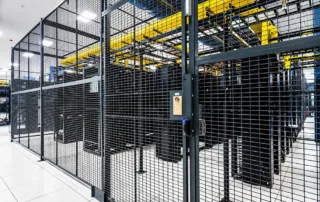
The Auditor Wants a Photograph, Not a Policy: Verifiable Physical Isolation with Wire Mesh Storage Cages
PCI DSS v4.0.1 added 64 new requirements in 2025, ISO/IEC 27001:2022 lists 93 controls and names physical segregation measures explicitly, and GDPR asks who could physically reach the hardware. None of them accept a written procedure as proof. A lockable wire mesh storage cage gives a hosting operator something an assessor can stand in front of and photograph: a full-height galvanised welded mesh enclosure, one hinged mesh door per bay with its lock position marked on the door bar, panels drawn back to back between tenants, and expansion bolts into the slab. Two people, no welding, no shutdown.
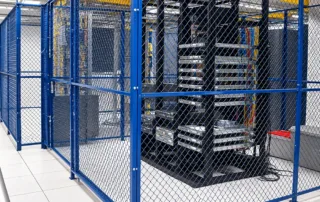
Where the Cold Aisle Ends at a Solid Panel: Open Wire Mesh Server Cages and Data Hall Airflow
A solid enclosure around a rack row gives the tenant a lockable boundary and takes away the air path the CRAC unit was designed around. A wire mesh storage cage keeps both: galvanised welded mesh panels bolted to posts with 90-degree screws, panels drawn back to back with through-bolts, one hinged mesh door per bay with a marked lock position, a top mesh panel on a top rail only where the run stops below the structure, and expansion bolts driven after the run is squared. Two people, no welder, no shutdown.
Racks Land in Weeks, the Enclosure Decides the Invoice Date: Bolt-Together Wire Mesh Server Cages for Data Center Fit-Out
A colocation contract is signed on a date, not a construction programme, and the rent meter starts when the enclosure is locked. A bolt-together wire mesh storage cage ships as parts — galvanised welded mesh panels, posts, hinged mesh doors, a top mesh panel where the run stops below the structure, and expansion bolts driven after assembly. Two people with a hand drill and a wrench, no welder and no wet trades, aisle by aisle as the racks land.

Tenant Rack Counts Change Every Quarter: Re-Laying Modular Wire Mesh Storage Cages Without Demolition
A demising wall freezes the unit mix at drawing stage; a tenant that grows from twelve racks to twenty and back to six leaves either dead floor or a queue for space. A modular wire mesh storage cage is a count of galvanised welded panels and posts — 90-degree angle screws to the post, panels drawn back to back with straight bolts, one hinged mesh door per bay with a marked lock position, a top mesh panel where the run stops below the structure, and expansion bolts driven after assembly. Heights, widened bays, plinths, shelves and fill options are specified per project, so a layout is unbolted and re-laid when the rack count moves. Two people, no welding, no wet trades.
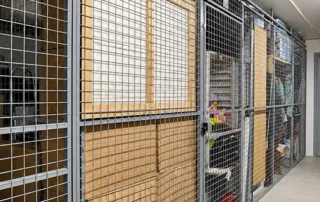
Every Opened Panel Is a Disturbance: Wire Mesh Storage Cages as Walk-Past Boundaries in Equipment Rooms
A closed steel panel turns every inspection into a door event: one bay opened, one status light read, one more chance to disturb a running rack. A wire mesh storage cage keeps the boundary lockable and the equipment readable — welded galvanised mesh panels on posts with 90-degree angle screws, panels drawn back to back with straight bolts, one hinged mesh door per bay with its lock position marked on the door bar, a top mesh panel only where the run stops below the structure, and expansion bolts driven after assembly. Two people, no welding, no shutdown.
The Blind Spot Sits 3 m From the Rack: Wire Mesh Storage Cages as Camera-Visible Server Enclosures
ICAS links 83% of information security incidents to a physical-layer failure, and audit sampling finds 85% of enterprise server rooms with camera blind spots — 30% of them inside 3 m of core equipment. A wire mesh storage cage removes the surface that created the blind spot: welded galvanised mesh panels on bolted posts, one hinged mesh door per bay with a marked lock position, and a top mesh panel only where the run stops below the structure. Assembled by two people with expansion bolts, no welding.
A Badge Opens the Hall, Not the Cage: Wire Mesh Storage Cage Locks as the Second Layer Against Tailgating
A badge gets a person into the room; after that the aisle is treated as trusted space, which is where tailgating turns into equipment access. A lockable wire mesh storage cage puts a second boundary on the hardware: one hinged mesh door per bay with its own marked lock position for a padlock, a keyed lock or an electronic reader, galvanised welded mesh panels bolted to posts with 90-degree angle screws and back-to-back through-bolts, a top mesh panel only where the cage stops below the structure, and expansion bolts into the slab after assembly. Two people, no welding, no shutdown.
The Cable Tray Stops at the Mesh: Bringing Server Rack Cabling Inside a Wire Mesh Storage Cage
A cage that closes at the rack face leaves the cable tray, the patch bundles and the switch uplinks in shared space. A wire mesh storage cage taken up to the structure, with a top mesh panel where the run stops below it, moves the tray itself inside the locked envelope — galvanised welded mesh panels on posts with 90-degree angle screws, panels drawn back to back with through-bolts, one hinged mesh door with its lock position marked before the staple is fixed, and expansion bolts driven after assembly.
Half-Height Panels and Painted Floor Lines Are Not a Server Cage: Why a Wire Mesh Storage Cage Has to Run Floor to Ceiling
A painted line on the slab and a waist-high panel at the end of a row do not isolate a rack: anyone in the aisle can still see the drives and reach the ports. A wire mesh storage cage takes the boundary floor to ceiling — galvanised welded mesh panels held on posts with 90-degree angle screws, panels drawn back to back with through-bolts, a hinged mesh door with the lock position marked before the lock is fixed, a top mesh panel on a top rail where the run stops below the structure, and expansion bolts driven into the slab after assembly.