EN
 DE
 RU
 PT
 JA
 ES
 IT

Reflective stickers that meet industry standard warnings
You may have seen them, those bright orange or yellow stickers that say “Warning, Reflective Material. Reflective Material”. There’s a reason they’re becoming more common in factories and industrial workplaces. Reflective stickers are an important part of keeping workers safe in factory and industrial environments. By alerting others to the presence of reflective materials, these stickers help prevent accidents and injuries.

Factory warning reflective stickers are designed to improve the visibility of industrial equipment and machinery. Made of reflective material, these stickers help reflect light, making equipment and machinery more visible in low-light conditions. These stickers are usually placed on the side or front of industrial equipment and machinery and can help improve safety in the workplace.
Factory warning reflective stickers have become an industry standard for safety because they are required by law. Their purpose is to make workers aware of potential hazards while on the job. These stickers are often placed on or near equipment that can be dangerous if not used properly. They are highly visible and help warn people of potential hazards in the workplace. They are also durable and long-lasting, so you can be sure they will continue to protect your employees for years to come.

Factory warning reflective decals are an important part of keeping workers safe in factories and other industrial environments. With so many different types and styles of stickers available, it can be difficult to know which one is right for your needs. We hope this article has helped you understand the different types of reflective decals available and how to choose the right one for your plant. If you have any questions, please feel free to contact our team of experts for assistance.
A Tool Crib Is Not a Standard Shape: Custom Wire Mesh Storage Cages Drawn to the Floor You Actually Have
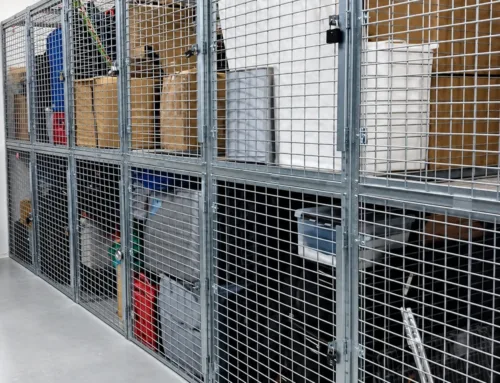
A catalogue tool crib assumes a rectangular room and a forklift arriving through the long side. Real spare parts stores have a column mid-bay, a rack depth set by the pallet that actually arrives and a two-and-a-half-metre wall beside a running machine. A custom wire mesh storage cage is specified from those numbers — bay height, widened and deepened bays, base plinths, shelves and mesh fill drawn per bay, one long-strip hinged mesh door per bay with its lock position scribed on the door bar, galvanised welded panels drawn back to back with straight bolts and through-nuts on 90-degree angle screws, expansion bolts after squaring. Two people, a hand drill and a wrench, no welder, no wet trades.
Top Mesh or Open Top: Sizing a Wire Mesh Storage Cage Around Sprinkler Deflectors and Air Paths
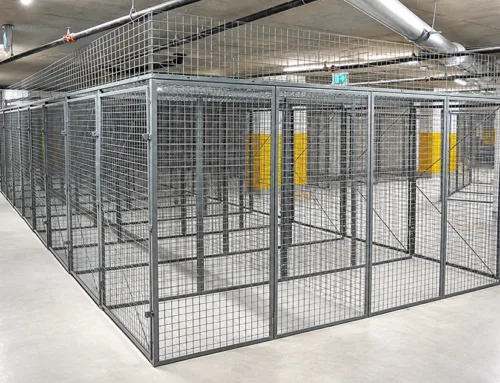
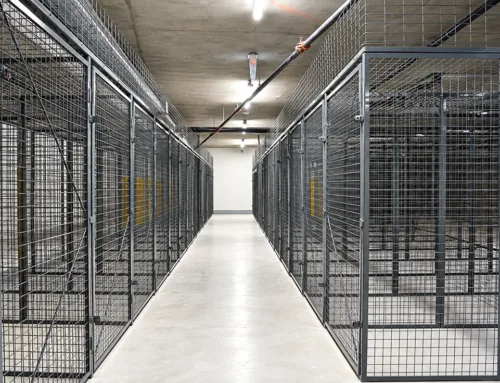
Solid partitions close two paths a storage room depends on: the air path that keeps a basement dry, and the spray path from the sprinkler deflector above the goods. A wire mesh storage cage keeps the lock and gives up the surface — galvanised welded mesh panels bolted to steel posts with 90-degree angle screws, one hinged mesh door per bay with its lock position scribed on the door bar, and a top mesh panel on a top rail only where the run stops below the sprinkler piping. Two people, a hand drill and a wrench, no welding under a live line.
A Tool Room That Dismantles: Bolt-Together Wire Mesh Storage Cages for Temporary Site Tool Lockup
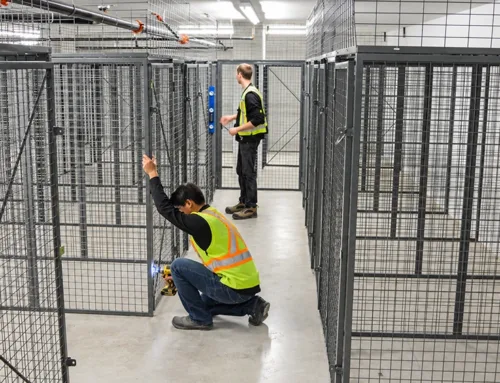
A temporary project needs a lockable tool room for the length of the programme and not a day longer. A bolt-together wire mesh storage cage goes up from parts — galvanised welded mesh panels bolted to steel posts with 90-degree angle screws, panels drawn back to back with straight bolts and through-nuts, one long-strip hinged mesh door per bay with its lock position scribed on the door bar, and expansion bolts driven after the run is squared. Two people, a hand drill and a wrench, no welding and no wet trades, and the same parts leave on the truck to the next site.