EN
 DE
 RU
 PT
 JA
 ES
 IT
The maximum extension length of the mobile retractable guardrail

Portable retractable fences are versatile security barriers commonly used in a variety of settings to protect individuals and demarcate boundaries. The flexibility and ease of use of these portable guardrails make them ideal for construction sites, events, warehouses, and more.
The maximum extension length of a portable retractable fence is the distance it can be extended or expanded to provide a barrier. This length can vary depending on the specific model and manufacturer. It is critical to consider this factor when selecting a guardrail as it directly affects the ability of the guardrail to cover a large area and create a secure perimeter.
The maximum extension length of a mobile retractable guardrail is an important aspect of ensuring optimum safety and security. Longer extension lengths allow for greater coverage, effective crowd control, hazard prevention, and restricted area demarcation. It ensures that the guardrail can span wide openings, such as entry points or construction zones, providing a strong barrier against unauthorized entry.
On construction sites, where safety is paramount, removable retractable guardrails with considerable extension lengths can be used to create a secure perimeter around hazardous areas, machinery, or excavations. Likewise, at events or festivals, guardrails with long extended lengths facilitate crowd management by effectively directing and controlling the flow of participants.
Warehouses and industrial facilities can also benefit from mobile retractable guardrails with longer extension lengths. They can be used to separate pedestrian access from forklift or vehicle traffic, ensuring the safety of employees and preventing accidents.
The maximum extension length of a mobile retractable guardrail plays a key role in its effectiveness as a safety barrier. By choosing guardrails with longer extension lengths, companies can create safe perimeters, effectively manage crowds, and improve overall safety in a variety of environments.
A Tool Crib Is Not a Standard Shape: Custom Wire Mesh Storage Cages Drawn to the Floor You Actually Have
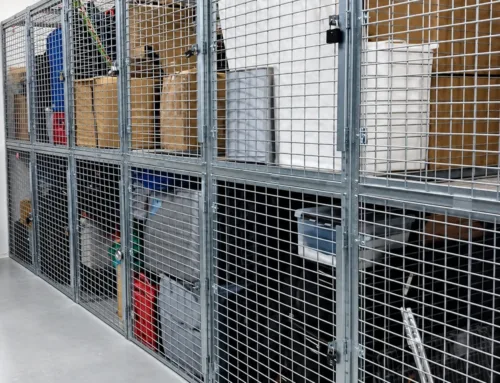
A catalogue tool crib assumes a rectangular room and a forklift arriving through the long side. Real spare parts stores have a column mid-bay, a rack depth set by the pallet that actually arrives and a two-and-a-half-metre wall beside a running machine. A custom wire mesh storage cage is specified from those numbers — bay height, widened and deepened bays, base plinths, shelves and mesh fill drawn per bay, one long-strip hinged mesh door per bay with its lock position scribed on the door bar, galvanised welded panels drawn back to back with straight bolts and through-nuts on 90-degree angle screws, expansion bolts after squaring. Two people, a hand drill and a wrench, no welder, no wet trades.
Top Mesh or Open Top: Sizing a Wire Mesh Storage Cage Around Sprinkler Deflectors and Air Paths
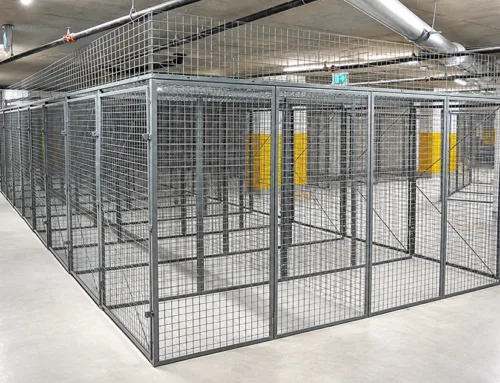
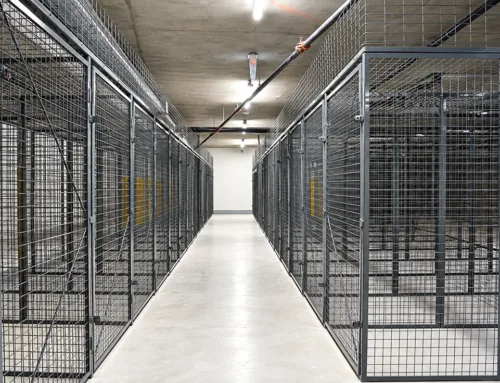
Solid partitions close two paths a storage room depends on: the air path that keeps a basement dry, and the spray path from the sprinkler deflector above the goods. A wire mesh storage cage keeps the lock and gives up the surface — galvanised welded mesh panels bolted to steel posts with 90-degree angle screws, one hinged mesh door per bay with its lock position scribed on the door bar, and a top mesh panel on a top rail only where the run stops below the sprinkler piping. Two people, a hand drill and a wrench, no welding under a live line.
A Tool Room That Dismantles: Bolt-Together Wire Mesh Storage Cages for Temporary Site Tool Lockup
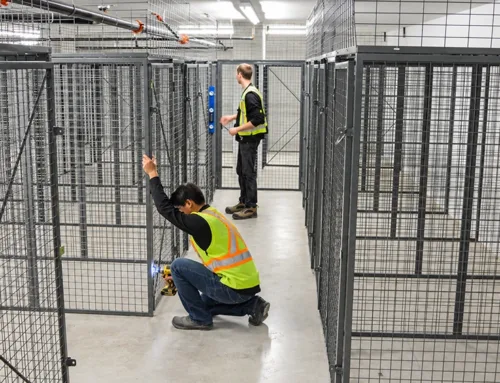
A temporary project needs a lockable tool room for the length of the programme and not a day longer. A bolt-together wire mesh storage cage goes up from parts — galvanised welded mesh panels bolted to steel posts with 90-degree angle screws, panels drawn back to back with straight bolts and through-nuts, one long-strip hinged mesh door per bay with its lock position scribed on the door bar, and expansion bolts driven after the run is squared. Two people, a hand drill and a wrench, no welding and no wet trades, and the same parts leave on the truck to the next site.