EN
EN  DE
DE  RU
RU  PT
PT  JA
JA  ES
ES  IT
IT Enhancing roof safety with Roof Guardrail: preventing falls from heights

Roof guards are important safety devices installed at the edge of a roof to prevent falls from heights. These barriers create a physical separation between workers and the unprotected roof edge, thereby significantly reducing the risk of accidents and injuries.
The role of roof parapets
Roof parapets are an important line of defense to ensure the safety of workers working at height. By providing a sturdy barrier, they can form a protective perimeter against accidental falls and protect workers from serious injury or even death. These safety devices play an important role in meeting regulatory requirements and industry standards for roof construction and maintenance work.
Materials and types of roof parapets
Roof parapets can be made from a variety of materials, including steel, aluminium and plastic. Each material offers unique advantages, such as durability, corrosion resistance and lightweight design. The choice of material depends on factors such as budget, desired service life and specific environmental conditions. There are several types of roof rails on the market. Freestanding parapets are portable and versatile, and can be easily relocated as required. Fixed parapets are permanently fixed to the roof or building structure, providing a permanent security solution. Folding parapets offer the convenience of folding and are suitable for areas where space is limited.
Considerations when choosing a roof parapet
Several factors should be considered when choosing a roof parapet. The type of roof, whether flat or pitched, will affect the method and design of the parapet installation. The height of the building determines the required height of the parapet and the regulations to be followed. In addition, it is important to ensure that the chosen parapet complies with local safety regulations and standards.
Roof parapets play a vital role in enhancing roof safety by providing a physical barrier against falls from heights. Whether during construction, maintenance or repair work, these safety devices are essential to protect workers from accidents and injuries. By choosing the right materials, types and adhering to safety standards, organisations can create a safe working environment and promote a culture of safety when working at height.
A Tool Crib Is Not a Standard Shape: Custom Wire Mesh Storage Cages Drawn to the Floor You Actually Have
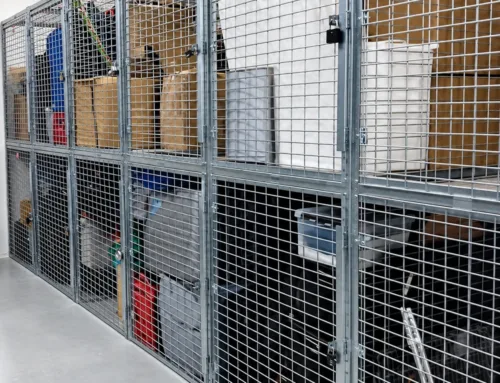
A catalogue tool crib assumes a rectangular room and a forklift arriving through the long side. Real spare parts stores have a column mid-bay, a rack depth set by the pallet that actually arrives and a two-and-a-half-metre wall beside a running machine. A custom wire mesh storage cage is specified from those numbers — bay height, widened and deepened bays, base plinths, shelves and mesh fill drawn per bay, one long-strip hinged mesh door per bay with its lock position scribed on the door bar, galvanised welded panels drawn back to back with straight bolts and through-nuts on 90-degree angle screws, expansion bolts after squaring. Two people, a hand drill and a wrench, no welder, no wet trades.
Top Mesh or Open Top: Sizing a Wire Mesh Storage Cage Around Sprinkler Deflectors and Air Paths
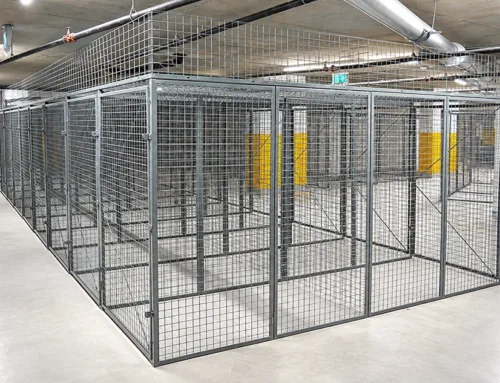
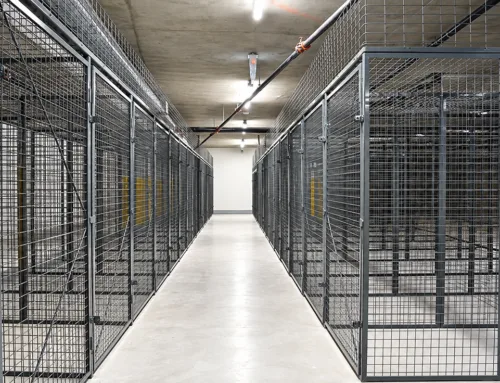
Solid partitions close two paths a storage room depends on: the air path that keeps a basement dry, and the spray path from the sprinkler deflector above the goods. A wire mesh storage cage keeps the lock and gives up the surface — galvanised welded mesh panels bolted to steel posts with 90-degree angle screws, one hinged mesh door per bay with its lock position scribed on the door bar, and a top mesh panel on a top rail only where the run stops below the sprinkler piping. Two people, a hand drill and a wrench, no welding under a live line.
A Tool Room That Dismantles: Bolt-Together Wire Mesh Storage Cages for Temporary Site Tool Lockup
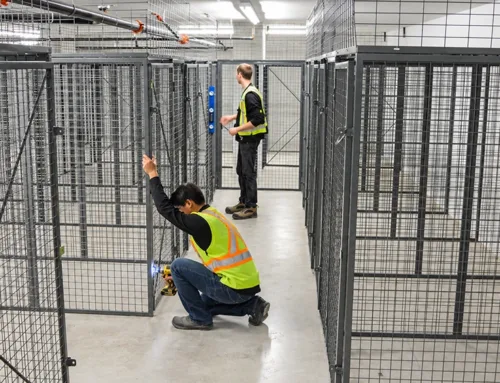
A temporary project needs a lockable tool room for the length of the programme and not a day longer. A bolt-together wire mesh storage cage goes up from parts — galvanised welded mesh panels bolted to steel posts with 90-degree angle screws, panels drawn back to back with straight bolts and through-nuts, one long-strip hinged mesh door per bay with its lock position scribed on the door bar, and expansion bolts driven after the run is squared. Two people, a hand drill and a wrench, no welding and no wet trades, and the same parts leave on the truck to the next site.