EN
 DE
 RU
 PT
 JA
 ES
 IT

The necessary operation to prevent falling guardrails

To prevent a guardrail from falling, it is essential to ensure that it is installed correctly and maintained regularly. Here are some steps you can take to prevent a falling guardrail:
Ensure Proper Installation: Guardrails must be installed according to the manufacturer’s instructions and industry standards. The installation process must be carried out by trained professionals who are familiar with the appropriate installation techniques and tools.
Regular Maintenance: Regular maintenance is crucial to ensure the guardrail remains secure and in good condition. The maintenance should include regular inspections, cleaning, and repair work as required. Any damage or defects should be repaired immediately.
Use High-Quality Materials: Guardrails should be made from high-quality materials that are durable and resistant to corrosion. Stainless steel and galvanized steel are commonly used for guardrails because they are strong and resistant to corrosion.
Consider the Environment: Guardrails must be designed to withstand the environmental conditions in which they are installed. If the area experiences high winds, heavy rain or snow, or extreme temperatures, then the guardrail must be designed to withstand these conditions.
Regular Testing: Guardrails must be tested regularly to ensure that they are functioning correctly. The testing should be carried out by trained professionals using specialized equipment to detect any defects or damage.
By following these steps, you can ensure that the guardrail remains secure and in good condition, thereby preventing it from falling and causing harm.
A Tool Crib Is Not a Standard Shape: Custom Wire Mesh Storage Cages Drawn to the Floor You Actually Have
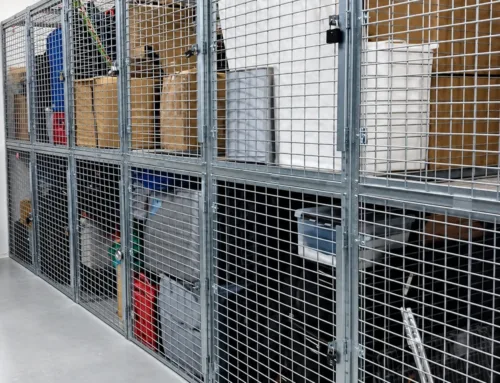
A catalogue tool crib assumes a rectangular room and a forklift arriving through the long side. Real spare parts stores have a column mid-bay, a rack depth set by the pallet that actually arrives and a two-and-a-half-metre wall beside a running machine. A custom wire mesh storage cage is specified from those numbers — bay height, widened and deepened bays, base plinths, shelves and mesh fill drawn per bay, one long-strip hinged mesh door per bay with its lock position scribed on the door bar, galvanised welded panels drawn back to back with straight bolts and through-nuts on 90-degree angle screws, expansion bolts after squaring. Two people, a hand drill and a wrench, no welder, no wet trades.
Top Mesh or Open Top: Sizing a Wire Mesh Storage Cage Around Sprinkler Deflectors and Air Paths
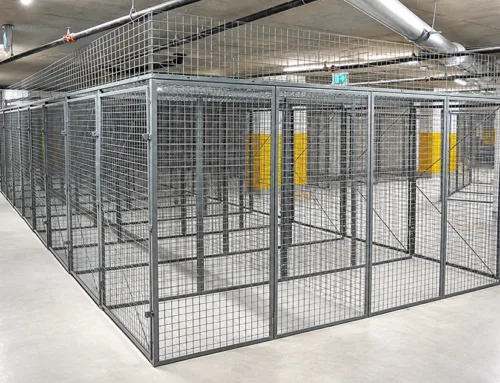
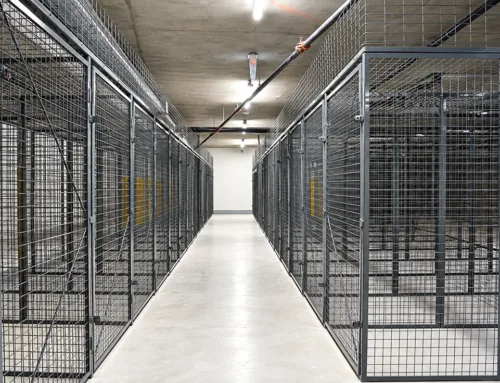
Solid partitions close two paths a storage room depends on: the air path that keeps a basement dry, and the spray path from the sprinkler deflector above the goods. A wire mesh storage cage keeps the lock and gives up the surface — galvanised welded mesh panels bolted to steel posts with 90-degree angle screws, one hinged mesh door per bay with its lock position scribed on the door bar, and a top mesh panel on a top rail only where the run stops below the sprinkler piping. Two people, a hand drill and a wrench, no welding under a live line.
A Tool Room That Dismantles: Bolt-Together Wire Mesh Storage Cages for Temporary Site Tool Lockup
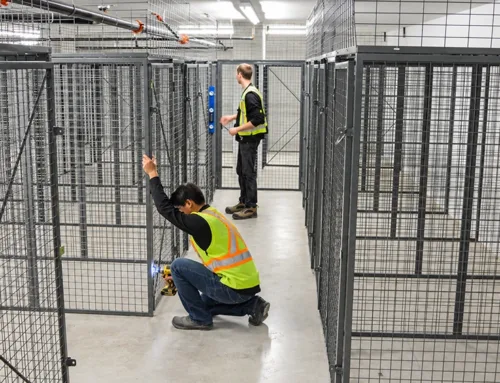
A temporary project needs a lockable tool room for the length of the programme and not a day longer. A bolt-together wire mesh storage cage goes up from parts — galvanised welded mesh panels bolted to steel posts with 90-degree angle screws, panels drawn back to back with straight bolts and through-nuts, one long-strip hinged mesh door per bay with its lock position scribed on the door bar, and expansion bolts driven after the run is squared. Two people, a hand drill and a wrench, no welding and no wet trades, and the same parts leave on the truck to the next site.