EN
 DE
 RU
 PT
 JA
 ES
 IT

Scenarios for low and high Profile Rack Guard

Here are some examples of application scenarios for low and high Profile Rack Guard:
A company has a small server room with limited space, and they need to protect their racks from accidental damage caused by equipment carts or people walking too close. Installing a low-profile rack guard will provide a barrier between the racks and the surrounding area, preventing any accidental bumps or collisions from causing damage.
A warehouse has a large number of racks with low clearances between them, making it difficult to install traditional rack guards. Installing a low-profile rack guard that is designed to fit in tight spaces will help protect the racks from forklifts or other equipment that may accidentally bump into them.
A retail store has racks that are close to the customer traffic flow. Installing a low-profile rack guard will protect the racks from shopping carts, strollers, or other items that may be pushed into them.
High Profile Rack Guard:
A manufacturing facility has a high volume of forklift traffic in the warehouse. Installing a high-profile rack guard will protect the racks from accidental collisions with forklifts and other heavy equipment.
A data center has tall racks with expensive equipment that needs to be protected from accidental damage caused by people or equipment. Installing a high-profile rack guard will provide an extra layer of protection for the racks and the equipment stored on them.
A distribution center has racks that are located in high-traffic areas, and there is a risk of accidental collisions with carts, forklifts, or other equipment. Installing a high-profile rack guard will provide a visible barrier that will help prevent accidents and protect the racks from damage.
A Tool Crib Is Not a Standard Shape: Custom Wire Mesh Storage Cages Drawn to the Floor You Actually Have
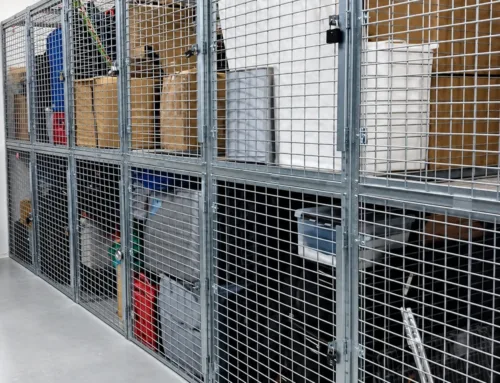
A catalogue tool crib assumes a rectangular room and a forklift arriving through the long side. Real spare parts stores have a column mid-bay, a rack depth set by the pallet that actually arrives and a two-and-a-half-metre wall beside a running machine. A custom wire mesh storage cage is specified from those numbers — bay height, widened and deepened bays, base plinths, shelves and mesh fill drawn per bay, one long-strip hinged mesh door per bay with its lock position scribed on the door bar, galvanised welded panels drawn back to back with straight bolts and through-nuts on 90-degree angle screws, expansion bolts after squaring. Two people, a hand drill and a wrench, no welder, no wet trades.
Top Mesh or Open Top: Sizing a Wire Mesh Storage Cage Around Sprinkler Deflectors and Air Paths
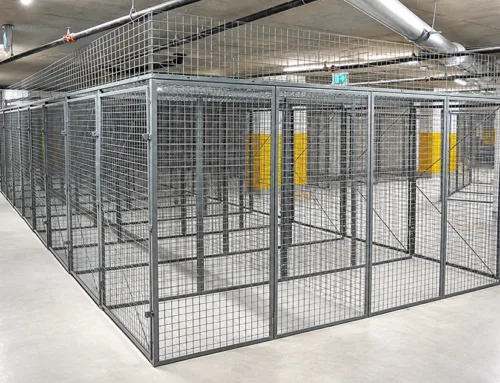
Solid partitions close two paths a storage room depends on: the air path that keeps a basement dry, and the spray path from the sprinkler deflector above the goods. A wire mesh storage cage keeps the lock and gives up the surface — galvanised welded mesh panels bolted to steel posts with 90-degree angle screws, one hinged mesh door per bay with its lock position scribed on the door bar, and a top mesh panel on a top rail only where the run stops below the sprinkler piping. Two people, a hand drill and a wrench, no welding under a live line.
A Tool Room That Dismantles: Bolt-Together Wire Mesh Storage Cages for Temporary Site Tool Lockup
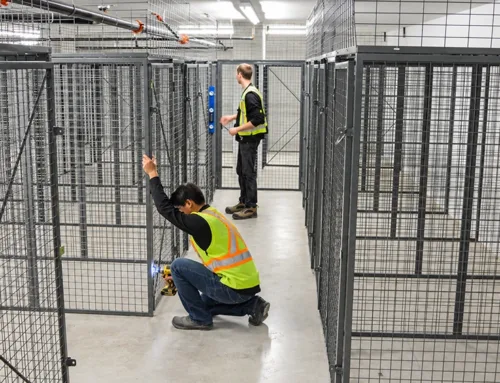
A temporary project needs a lockable tool room for the length of the programme and not a day longer. A bolt-together wire mesh storage cage goes up from parts — galvanised welded mesh panels bolted to steel posts with 90-degree angle screws, panels drawn back to back with straight bolts and through-nuts, one long-strip hinged mesh door per bay with its lock position scribed on the door bar, and expansion bolts driven after the run is squared. Two people, a hand drill and a wrench, no welding and no wet trades, and the same parts leave on the truck to the next site.