EN
EN  DE
DE  RU
RU  PT
PT  JA
JA  ES
ES  IT
IT Coastal dock / outdoor berth safety
Painted Guard Rails Rust Through at the Quay in Two Years — Coastal Docks Need Hot-Dip Galvanized Corrugated Steel
At berth edges, container yards and roll-on/roll-off aprons, salt spray, sea water splash, high humidity and day-night thermal cycling eat through powder-coated steel guard rails within 24 to 36 months. Hsafety hot-dip galvanized corrugated steel guard rails put the corrosion barrier at the steel substrate itself — not on top of the paint — so the same W-beam warehouse guard rail that protects inland aisles survives multi-year outdoor exposure at coastal terminals.
What the Coastal Spec Actually Buys You
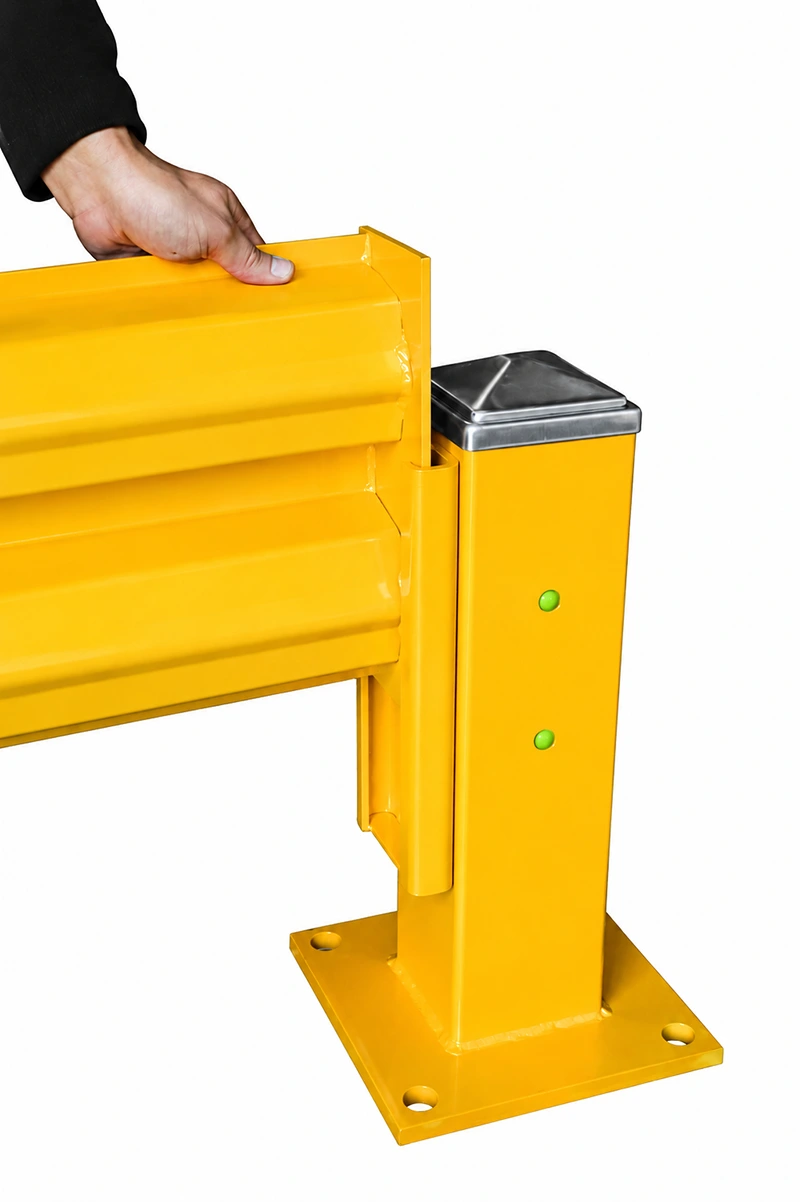
Hot-dip galvanizing is not a color change. The zinc coating metallurgically fuses with the Q235 substrate, so when a forklift tine or pallet corner scratches the surface, the surrounding zinc keeps sacrificing itself instead of letting rust spread under the paint film. The table below lists the standard Hsafety parameters relevant to outdoor salt-spray service. Rail thickness, post spacing, base plate footprint and surface finish should be locked to the project drawing before procurement.
| Parameter | Hsafety coastal-dock value |
|---|---|
| Substrate | Q235 carbon steel |
| Rail profile | 2-rib W-beam guardrail (W-beam guardrail) or 3-rib thrie beam guardrail |
| Rail thickness | 3 mm or 4 mm corrugated steel beam |
| Rib geometry | 194 mm peak spacing / 85 mm wave height / ~310 mm panel width / ~40 mm amplitude |
| Standard rail height | 1,000 mm (custom length guardrail on request) |
| Post section | 80×80×6 mm square tube (heavier section for outdoor) |
| Base plate | 160×160×16 mm with four anchor bolt holes |
| Anchor bolt | M16 mechanical expansion anchor into ≥150 mm concrete floor |
| Post spacing | ~1,500 mm standard; 1,040–1,500 mm for salt-spray heavy zones |
| Surface finish | Hot-dip galvanized finish (standard for outdoor) / yellow powder coated guardrail (indoor) |
| Low-light / fog option | Reflective tape guard rail on top rail, optional LED warning sign |
| Edge option | Bollard post + lift-out guardrail section for vehicle crossover |
| Connection | Bolted guard rail system — no site welding required |
Three Coastal-Dock Failure Modes the Hot-Dip Galvanized Spec Solves
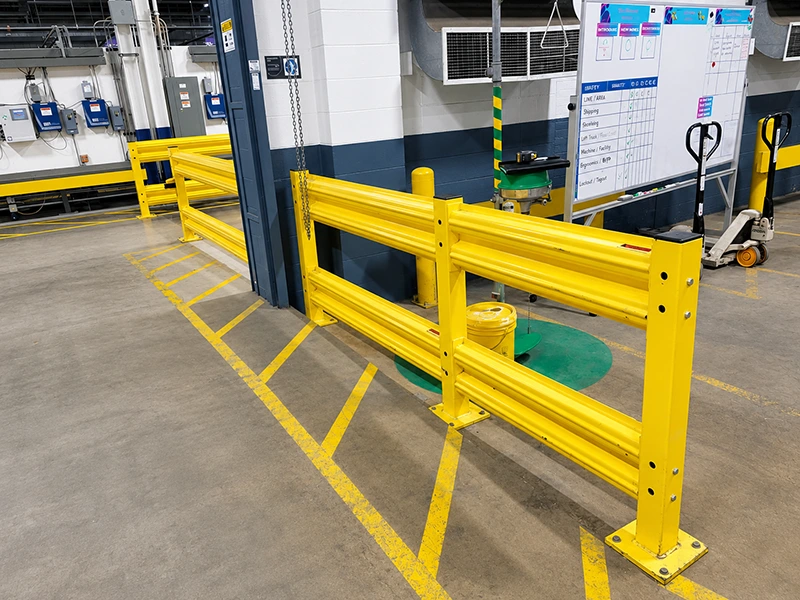
1. Hot-Dip Galvanizing vs Powder Coating in Salt Spray
Painted and powder coated guard rails fail at the dock through the same well-understood mechanism: a forklift tine or pallet corner breaks the paint film, salt water penetrates the break, oxygen and chloride ions undercut the coating from below, and a wide blister of rust lifts off within months. At a coastal terminal the salt-spray chloride load is roughly an order of magnitude above an inland warehouse, so the same painted barrier that would have lasted ten years indoors rusts through in two to three years outdoors.
Hot-dip galvanizing answers this with a metallurgical bond between the zinc layer and the Q235 substrate. Where a forklift scratches the surface, the exposed zinc behaves as a sacrificial anode and corrodes preferentially to the steel underneath — the scratch turns grey, not red. Hsafety specifies hot-dip galvanized finish as the standard surface for outdoor berth-edge service, with the yellow safety coating applied on top only where the EHS procedure explicitly asks for indoor visibility color. For multi-berth networks, the same hot-dip galvanized corrugated guard rail can then be deployed across inland warehouses and coastal terminals, with the surface selection the only line item that changes.
2. Bolted Base Plate and M16 Anchor for Outdoor Concrete Anchorage
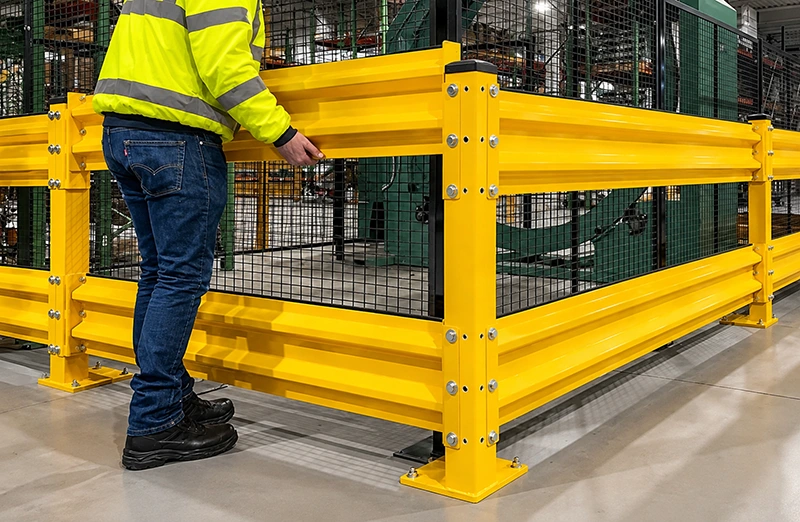
Salt-spray corrosion does not only attack the rail profile — it also creeps into the post-to-floor connection. A welded site-fabricated post sitting on bare concrete traps water at the base plate, and within two winters the anchor bolts rust and the post loosens. Hsafety uses a 160×160×16 mm base plate with four anchor bolt holes, bolted to the concrete floor through M16 mechanical expansion anchors in ≥150 mm slab. The base plate is hot-dip galvanized as a single fabricated assembly, so the same zinc metallurgical bond that protects the rail also protects the connection.
Floor mounted guardrail installation at the berth is done without site welding — the post sits on the cured concrete, the four M16 anchors are torqued to spec, and the corrugated steel beam panels are bolted to the post flanges with the standard bolted guard rail system connection. This matters at coastal docks because site welding breaks the zinc coating at the weld zone, and the heat-affected zone becomes the first place rust nucleates. A bolted assembly leaves the zinc layer continuous across the entire barrier, and a damaged section can later be unbolted and replaced without cutting or re-welding.
3. Bollards, Reflective Tape and the Edge Detail at the Berth
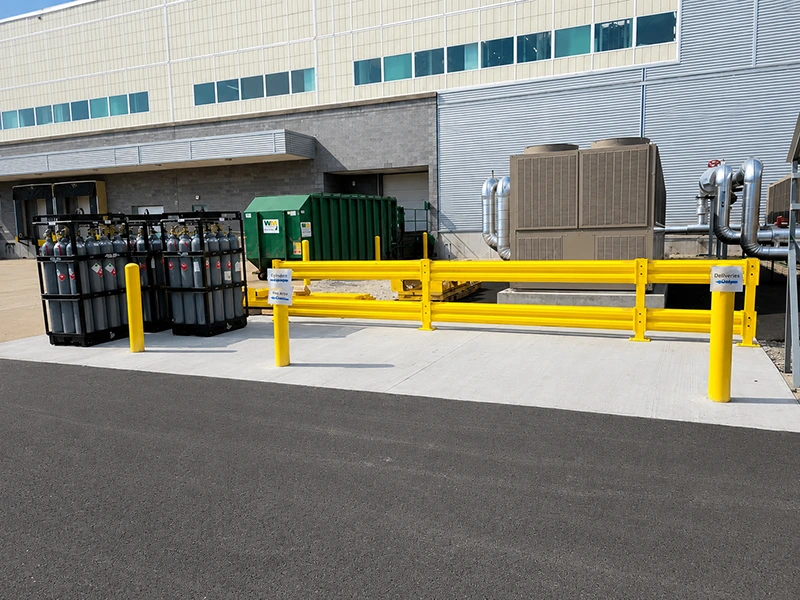
Most painted quber failures at coastal terminals start at the ends — the unprotected end of a barrier takes forklift corner strikes, salt-spray deposition is heaviest at the open edge, and the open end of the W-beam is the easiest for water to enter. Hsafety pairs the corrugated guard rail with a yellow end bollard at every exposed termination, so the bollard takes the direct strike and the rail profile stays intact. For terminals that handle round-the-clock night-shift or fog-window operations, optional reflective tape on the top rail of the guardrail bracket makes the barrier visible from the forklift cab before the cab reflects onto it.
The combined edge detail — bollard + reflective tape + bolted base plate + hot-dip galvanized finish — turns the berth-edge boundary into a four-layer system: sacrificial zinc layer for corrosion, base plate anchor for uplift, bollard for end-cap strike, and reflective tape for low-visibility shift. A berth-edge collision that would have ended a painted barrier in two years is distributed across all four layers and the barrier stays in service. Where berth layouts change with vessel rotation, lift-out guardrail sections can be specified at fixed crossover points so traffic can be re-routed without unbolting the entire run.
Where Coastal-Dock Operators Deploy Hot-Dip Galvanized Warehouse Guard Rails
- Container terminal berth-edge guardrail along the quay-side crane approach lane
- Roll-on/roll-off (RoRo) ramp side barrier protecting the link-span from side-impact
- Quay-side equipment protection around shore-power cabinets, navigation aids and fender panels
- Salt warehouse and bulk-cargo shed perimeter against reach-stacker and front-loader approach
- Marine logistics yard behind the berth for trailer staging, reefer plug points and genset parking
- Inter-island ferry dock and passenger walkway separation from service-vehicle route
- Dry dock and shipyard laydown area around welding stations, painting sheds and tool cribs
- Coastal free-zone container freight station (CFS) yard with high humidity and chlorides
For each application, the spec is the same modular warehouse guard rail — only the surface finish (hot-dip galvanized finish vs yellow safety coating), the post spacing (tighter 1,040 mm in heavy strike zones, standard 1,500 mm elsewhere) and the optional add-ons (reflective tape, end bollard, lift-out section) change with site risk. This lets a multi-berth operator run one approved barrier drawing across inland and coastal sites instead of maintaining two separate vendor lists, two separate installation crews and two separate inspection cycles. Steel road barriers on adjacent public carriageways are out of scope for warehouse guard rail selection and must be specified to a different impact and code regime.
Engineering Checklist Before You Sign the Coastal-Dock PO
Lock these six items to the project drawing before procurement so the hot-dip galvanized corrugated guard rail does not become a problem on the quay:
1. Surface finish. Specify hot-dip galvanized finish for every post, base plate, rail panel and bolted connector. Yellow powder coated guardrail may be applied on top of the zinc only where the EHS procedure explicitly asks for indoor visibility color; outdoor coating shall be zinc-only or zinc + reflective tape.
2. Rail profile and post spacing. W-beam guardrail (2-rib) for general berth-edge use; thrie beam guardrail (3-rib) for areas with heavier reach-stacker traffic. Lock post spacing at 1,500 mm standard, tighten to 1,040–1,140 mm at corners and where the dock apron has a vehicle crossover.
3. Base plate and anchor. 160×160×16 mm base plate, four M16 mechanical expansion anchors into ≥150 mm concrete slab. Reject welded site-fabricated posts at the dock — the heat-affected zone breaks the zinc and rusts first.
4. Rail thickness. 3 mm for general warehouse forklift traffic, 4 mm corrugated steel beam where reach-stacker or heavy front-loader impact is expected. Lock thickness to the impact risk register, not to a generic catalog number.
5. Edge detail. End bollard at every exposed termination, optional reflective tape on the top rail, optional lift-out guardrail section at fixed vehicle crossover. Confirm guardrail end cap and guardrail bracket are hot-dip galvanized as part of the same assembly.
6. Site condition. Concrete slab thickness verified at every anchor location; chloride exposure category of the dock confirmed against the surface finish selected; impact rating selected per forklift class (3 t at 10 km/h is a documented target, not an independent certification).
This list is engineering judgment for coastal-dock procurement and is not a substitute for a project-specific risk assessment, an independent impact calculation, or a third-party coating certification. Surface, anchor and impact parameters must be locked to the actual site drawing and the SiT/operator fleet before order.
Spec Your Berth Layout
Send your berth-edge drawing, the forklift / reach-stacker class in service and the chloride exposure category of the dock. We will return a hot-dip galvanized corrugated steel guard rail bill of materials — rail length, post spacing, base plate footprint, anchor bolt quantity and optional add-ons (reflective tape, end bollard, lift-out section) — sized to your berth and your vessel rotation.