EN
EN  DE
DE  RU
RU  PT
PT  JA
JA  ES
ES  IT
IT Compliance as the new floor
PAS 13, OSHA NEP and UNI TS 11886: The compliance threshold that forces a Q235 warehouse guard rail into an honest third-party impact test workstream
A 2026 safety auditor no longer accepts a yellow barrier as evidence. PAS 13 in the UK, the OSHA Notice of Enforcement Procedure on powered industrial trucks, and Italy’s UNI TS 11886 all push the passive isolation layer up the hierarchy of controls. This guide maps where a bolted, modular Q235 corrugated steel guard rail actually fits in that audit pack, what an Amazon-class procurement board still has to see, and the honest workstream that an independent PAS 13 strike test still demands.
Where Q235 corrugated guard rails already read in the hierarchy of controls
The table below compares what each code expects at the passive isolation layer against the bolted, modular Q235 corrugated steel system we ship from stock. Use it as a quick audit-gap check before any HQ procurement board opens a Q&A on multi-site rollout.
| Compliance floor | What an auditor looks for at the passive isolation layer | What the Q235 corrugated steel guard rail already brings |
|---|---|---|
| PAS 13 (BSI):2017, safety barriers in and around working areas | Visible barrier in the travel path; rated impact performance; documented re-inspection cycle | 2-rib or 3-rib corrugated steel rail across the travel path; bolted base plate accepts repeatable re-inspection; 1,000 mm height, 1,500 mm post spacing and project-cut special panels align with site geometry rather than against it |
| OSHA NEP on powered industrial trucks (29 CFR 1910.178) | Engineering and administrative controls; traffic separation that survives a real struck-by event | Floor-mounted Q235 post and rail system anchored into the concrete slab; yellow surface and optional reflector tape deliver the visibility that struck-by compliance relies on |
| UNI TS 11886 (Italy), forklift impact protection in logistics environments | Documented impact-class hardware under a maintenance discipline | Modular 1,500 mm panels and 680-1,140 mm special panels that can be single-bolt replaced after a strike, keeping spares on shelf ready for the next re-audit |
| ANSI / MH 31.2 (US heavy duty guard rail, supplier-stated) | Tested energy envelope and stated impact class | Engineering-stated 2-Rib and 3-Rib rating envelope; independent PAS 13 or EN 1317 third-party strike test is the open workstream we list in every audit pack |
| Hierarchy of controls applied to traffic separation | A passive barrier ahead of administrative controls and PPE; visibly there on every shift, every site | Yellow coating plus optional reflector strip on the same hardware line; bolted, long-line, turn and lift-out configurations so the same spec covers every plant |
Three honest answers to the audit packet HQ procurement is now sending
What our Q235 corrugated guard rail already puts in the audit pack — and what it deliberately does not
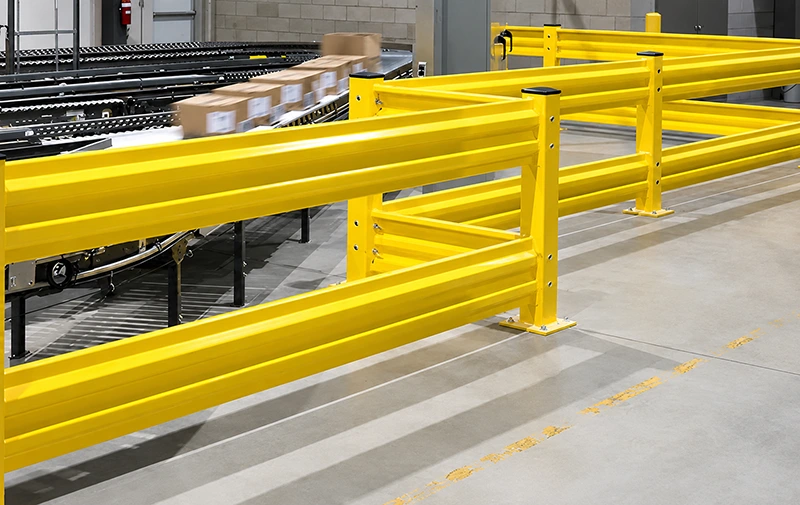
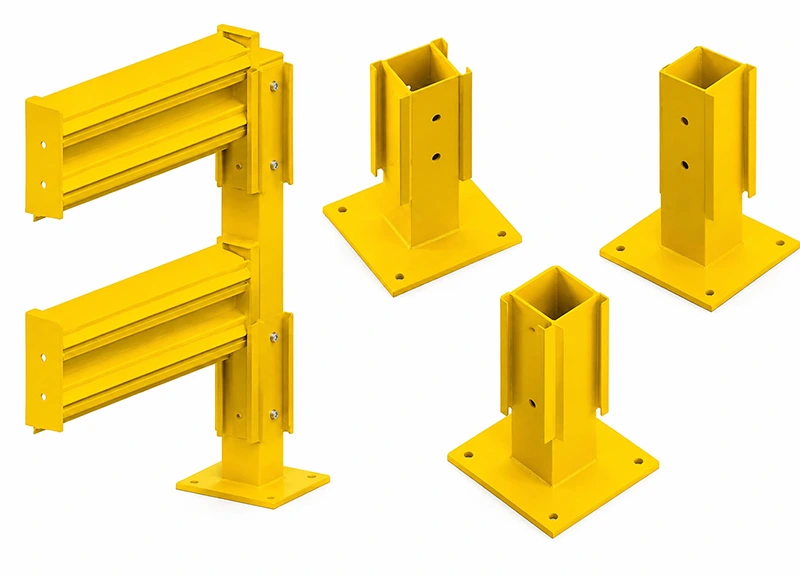
Where the hardware line earns its keep today: a double corrugated steel rail (2-Rib or 3-Rib) that physically separates the forklift envelope from your racks, conveyors and asset corners; 80 x 80 x 6 mm posts on 160 x 160 x 16 mm base plates, bolted into a minimum 150 mm concrete slab; 1,500 mm post spacing and 680-1,140 mm special panels that close the awkward lengths in any four-zone re-balance.
What the same hardware does not yet do: publish an independent third-party impact-class number comparable to an A-SAFE polymer barrier on an Amazon BWU6 spec sheet. The bolted Q235 system arrives engineered to a stated energy envelope — the test house that confirms that envelope against PAS 13 or EN 1317 is the open workstream listed below.
The honest workstream: PAS 13, EN 1317 and a third-party impact test report
Our internally stated engineering numbers (2-Rib about 4.5 t and 3-Rib about 5.4 t at 6.5 km/h in the technical video) are starting points for project discussion, not independent third-party certificates. PAS 13:2017 is the BSI code of practice that auditors point to when they want to know whether a barrier system has been impact-rated under a controlled test, and EN 1317 is the European road-restraint-system family of standards that some HQ procurement boards use as a proxy for severity class.
Until that test report ships, every Hsafety audit pack carries two lines side by side: the engineering-stated energy envelope the Q235 panel and post geometry is sized to, and an explicit gap statement that no PAS 13 third-party certificate is currently published. That gap statement is also why every assembly, base-plate size, bolt grade and concrete-slab reading in this guide still resolves to a site-by-site engineering review before purchase order.
Multi-site color and identification: the cheapest line item in HQ’s compliance manual
Most warehouse guard rail audit failures are not structural — they are color and identification failures. A 100-site rollout with one yellow color quickly turns into one auditable failure across the whole network when a site uses the wrong shade, omits the reflector strip on the night shift, or paints a black corner cap on top of yellow.
The Hsafety line ships in yellow as the default high-visibility color, with red, hot-dip galvanized and custom powder-coated finishes ordered per project. The bolted base plate takes reflector tape, LED warning boards, end caps and post-top accessories on the same footprint, so a network-level EHS manual can publish one drawing and let every site order the same item numbers. Sites that need a region-specific identification stripe can specify the color at RFQ and reuse the geometry spec their HQ already approved.
Where the compliance threshold is being enforced today
- Warehouse racking end protection, where OSHA 1910.176 traffic separation is the auditor’s first stop
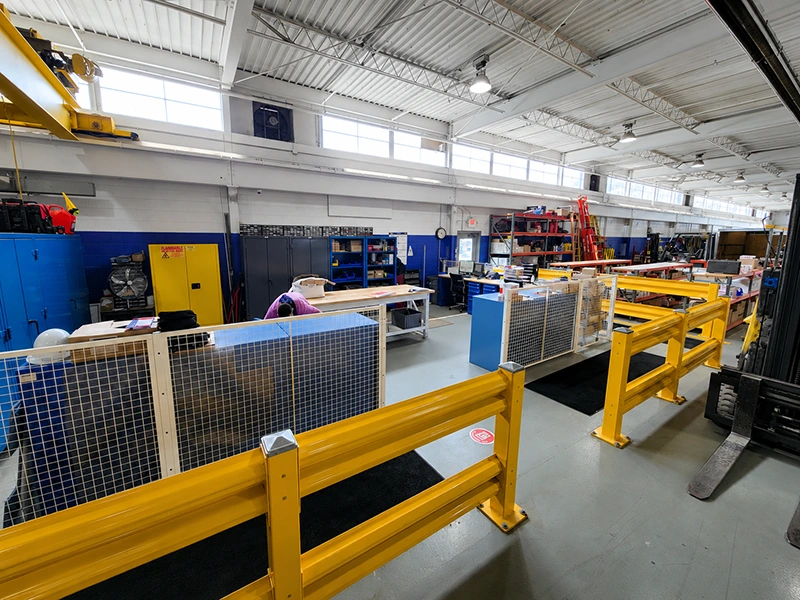
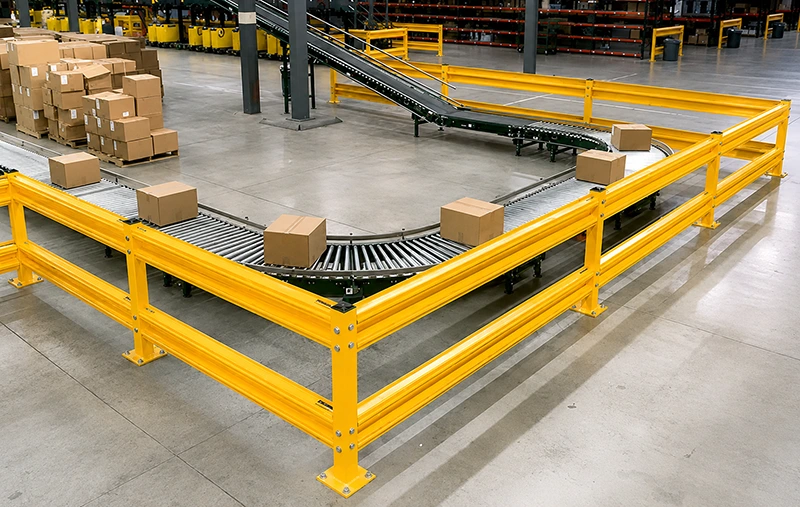
- Conveyor impact zones, where the double corrugated rail plus reflector strip covers both the strikepoint and the low-light visibility claim
- Electrical equipment room and concrete-block corner guards, where a single bolted run absorbs both forklift traffic and routine rack-shift strikes
- Loading dock doors with pedestrian and truck-trailer separation, where the post-and-base-plate geometry lets the same line handle dock-edge, traffic-lane and lift-out access
- Mixed-traffic forklift and AMR routes, where the bolted base plate lets the safety team re-cut the layout without disposing of the panels
- Multi-site HQ layouts that publish one drawing and color per zone for every site to follow
Across all six patterns, the audit asset is the same line of bolted Q235 corrugated steel hardware — the difference is which color, which post spacing and which special-panel length closes the geometry of the site.
Audit pack download
Spec sheet, drawing set and audit pack (with engineering-stated impact data and the explicit gap statement on PAS 13 third-party testing) ready on request via the contact page. Please flag any site-specific impact or anchoring requirement that the standard spec does not cover.
Get the multi-site guard rail spec into your next audit pack
Send the site lengths, forklift class, target standard (PAS 13 / OSHA NEP / UNI TS 11886 / ANSI MH 31.2) and any color or identification requirement. We will scope an audit-ready bolted Q235 corrugated steel guard rail set in 1,500 mm and special-length panels — and we will return the engineering-stated impact envelope alongside the open third-party impact test workstream so procurement can record both facts.