EN
 DE
 RU
 PT
 JA
 ES
 IT
End-of-line automation · robotic palletizing cells and AGV aisles
Robot Cell Barriers: Open-Mesh Frameless Safety Fencing Instead of a Solid Panel Wall
A robotic palletizing cell at the end of a packaging line needs a boundary that keeps people out of the reach envelope without turning the cell into a blind box. Mefence is the frameless 3D welded mesh industrial safety fencing that does that job: Q235 carbon steel panels, powder coated, clipped and screwed to base plate posts, cut on site to the bay that actually exists. Built for robotic workstation enclosure, AGV lane separation, automated equipment guarding and warehouse zoning. Where a palletizing robot can throw product at a strike point, that point belongs to the impact-rated Machine Fence line — not to this one.
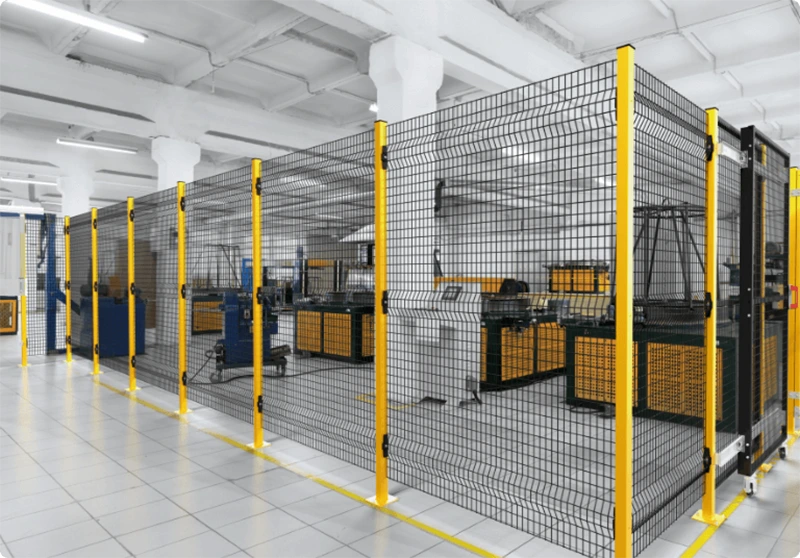
Why the Solid Wall Around the Palletizer Keeps Getting Removed
End-of-line automation is now the default, not the exception: robot palletizers, stretch wrappers, labelers and an AGV or AMR fleet moving finished pallets to the dock. The reflex answer is a solid panel wall bolted around the cell. It satisfies the “keep people out” half of the requirement and fails the other half. The operator can no longer see whether the robot is mid-cycle, in fault or waiting for a pallet. A fixed camera sees a grey rectangle where the tool path used to be. An AMR lane that was surveyed before the wall went in now has a new hard surface and an occlusion shadow behind it. And when the layout moves — new SKU, new pallet pattern, a second cell — the wall is a demolition job, not a re-arrangement.
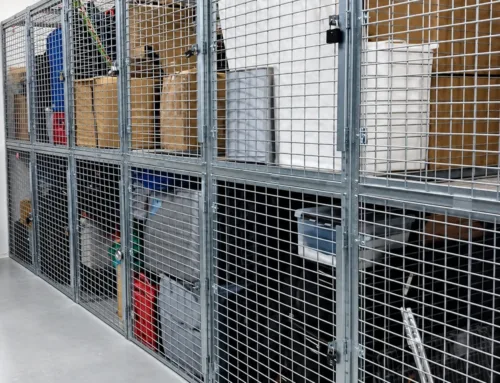
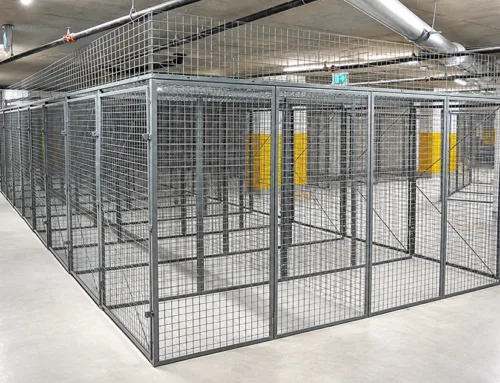
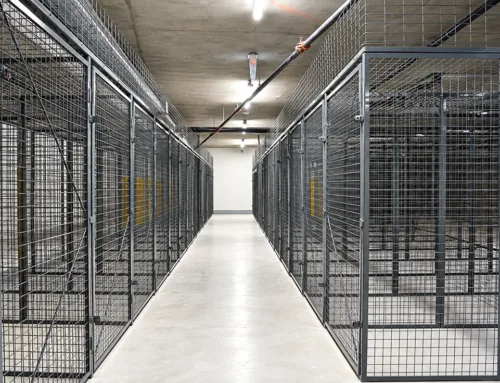
A frameless 3D safety fence solves the same problem from the other direction. The panel is an open welded mesh: 3 mm or 4 mm Q235 carbon steel wire, powder coated, with mesh openings of 20 × 100 mm or 50 × 50 mm. It is a physical boundary you can see through, shoot through with a camera and read past from the aisle.
| Specification | Mefence frameless 3D safety fence |
|---|---|
| Panel construction | Frameless welded wire mesh, no frame border, multiple horizontal T-shaped ridges pressed into each panel |
| Material and finish | Q235 carbon steel, powder coated (electrostatic spray), standard yellow + black, custom colours on request |
| Wire diameter | 3 mm / 4 mm |
| Mesh opening | 20 × 100 mm / 50 × 50 mm |
| Panel size range | Width 200–1400 mm, height 200–3000 mm, cut on site to the bay that exists |
| Ground clearance | 140 mm |
| Posts | 40 × 60 mm / 60 × 60 mm, slotted mounting holes for vertical adjustment |
| Fixing method | Plastic clips and self-tapping screws — no welding on a live floor |
| Floor anchoring | Base plate posts with expansion bolts, slotted holes allow fine alignment on a finished slab |
| Integrated functions | T-shaped ridge doubles as a cable channel and a wood slat insert slot |
| Installation | One person, three steps; documented install time reduction of more than 50% versus conventional framed fence |
| Scope limit | Non-impact area demarcation and access control. Certified impact protection is a Machine Fence scope. |
Three Details That Decide Whether the Cell Stays Visible
The post is the cable route, so nothing hangs in the aisle
Door interlocks, muting sensors, stack lights and camera drops all need a path back to the panel. On a solid wall they get surface-mounted conduit or a trailing loom. On Mefence the horizontal T-shaped ridge pressed into every panel is a formed channel, and the posts carry the run down to the floor with slotted holes for adjustment. Cable management becomes part of the fence rather than an addition to it — and the same ridge takes a carbonised or oiled wood slat when a section genuinely needs to be screened.
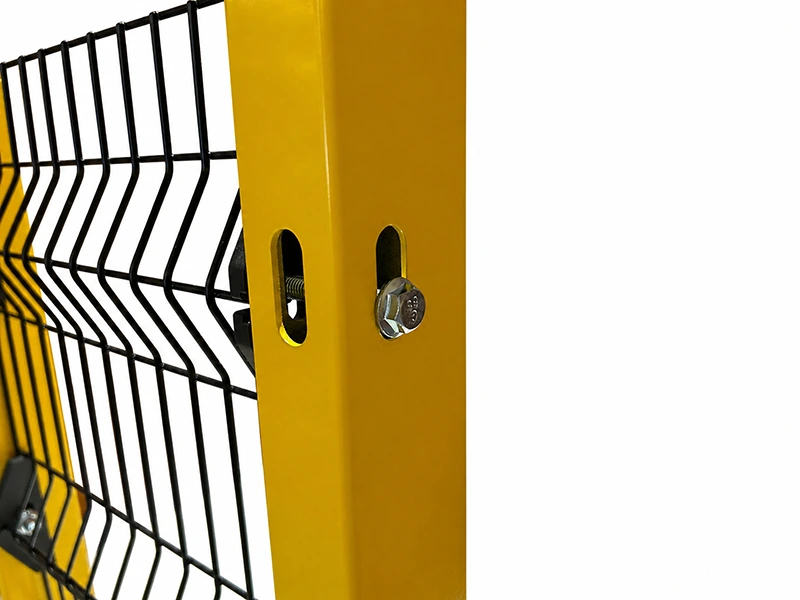
One planned gate instead of a wall people walk around
Personnel separation only holds if there is a legal way in. The modular system accepts a lockable maintenance door at the position the maintenance team actually uses, so the boundary is closed to production traffic and open to a scheduled service window. Panels run 200–1400 mm wide, so the last bay in front of a column or a conveyor leg gets trimmed on site rather than left with a gap somebody eventually squeezes through.
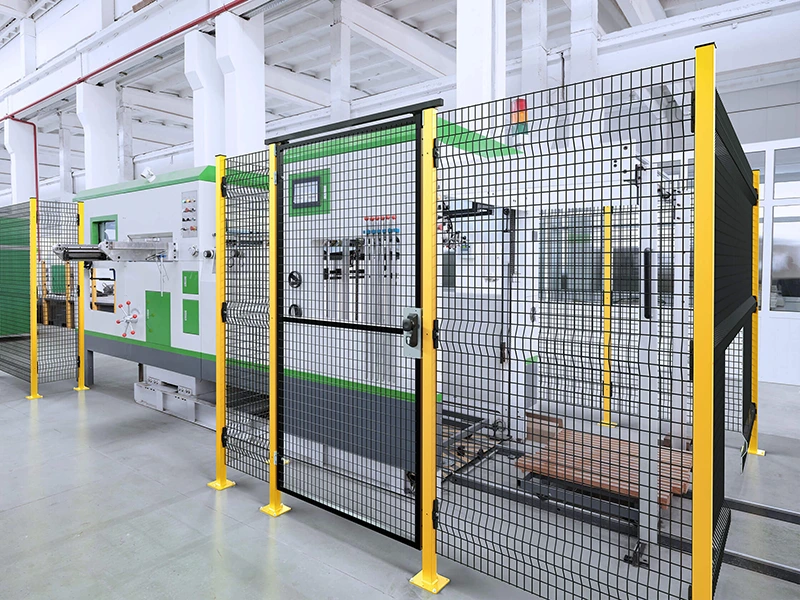
Reconfigurable, because the cell will move again
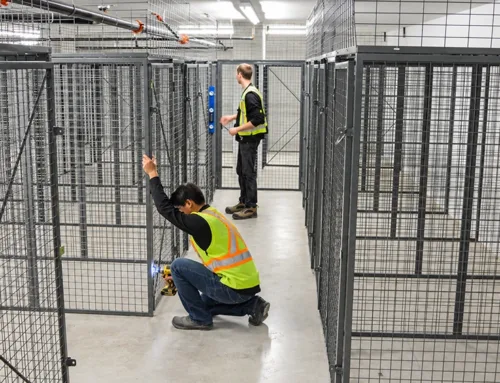
Plastic clip and self-tapping screw assembly means the perimeter comes apart as easily as it went together: unbolt the base plate posts, lift the panels out, re-cut and re-erect around the next layout. Nothing is welded, nothing is scrapped. For a plant that re-zones around new pallet patterns, a second cell or a relocated AMR lane, the fence behaves like re-deployable equipment instead of a sunk construction cost.
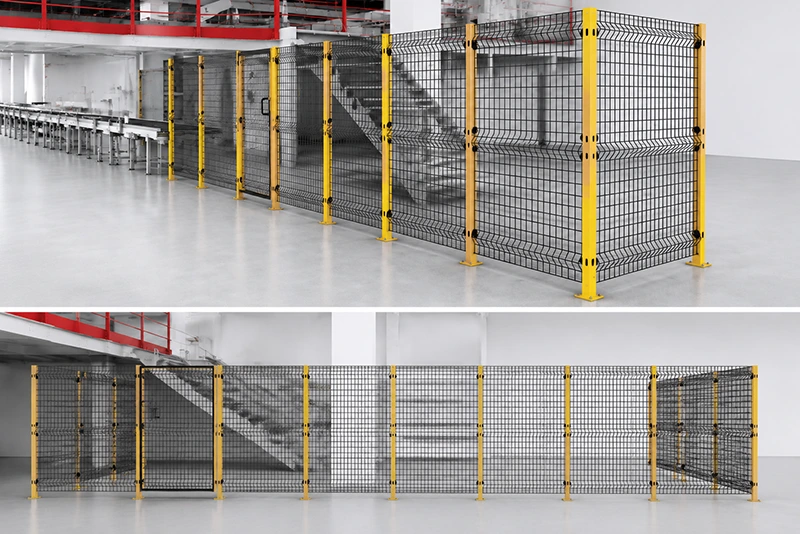
Where Mefence Fits — and Where It Does Not
- Robotic workstation enclosure and robotic cell safety at end-of-line palletizing, case packing and stretch wrapping
- AGV lane separation and AMR lane control, converting random crossings into fixed access points
- Automated equipment guarding around conveyors, transfer units and pick stations
- Pedestrian vehicle separation and forklift path barriers on mixed-traffic floors
- Warehouse zoning, storage area separation, material segregation and tool crib enclosure
- Construction site barrier and temporary partition during changeovers and line moves
What it is not: an impact-rated guard. Mefence is a non-impact area demarcation product for personnel separation and traffic planning. If the risk assessment identifies a strike point — a high-speed palletizer that can eject a case, a robot that can throw a tool, a truck that can reach the cell — that point is quoted on the Machine Fence line, which is built for certified impact containment. Most plants end up with both: Mefence for the running metres of zoning, Machine Fence for the handful of strike points. That split is also the cheapest way to pass the barrier layer of a risk-reduction file written against ISO 14120, ANSI B11.19 or OSHA 29 CFR 1910.212.
What to Send With the Enquiry
A marked-up cell plan with the posts and columns you have to work around, the panel heights you want, the gate position, and a note on which sections need cable routing or a wood slat screen. We return a panel schedule with cut widths, post positions and the anchor layout for the base plates — so the installation window is a hardware job, not a fabrication project.
Keep the Boundary, Keep the Sightline
Tell us the cell footprint and the bay widths that do not exist on any drawing. We will size the frameless 3D safety fence around it and flag the points that should go to Machine Fence instead.