EN
 DE
 RU
 PT
 JA
 ES
 IT
Compressed gas & chemical storage · two requirements that fight each other
Locked against tampering, open to air: a lockable wire mesh storage cage for cylinders and chemicals
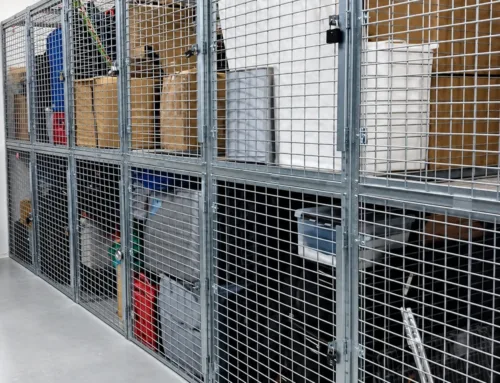
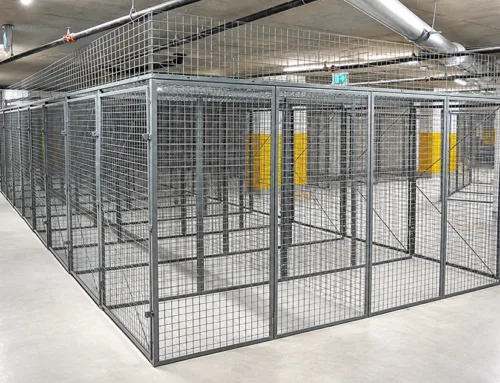
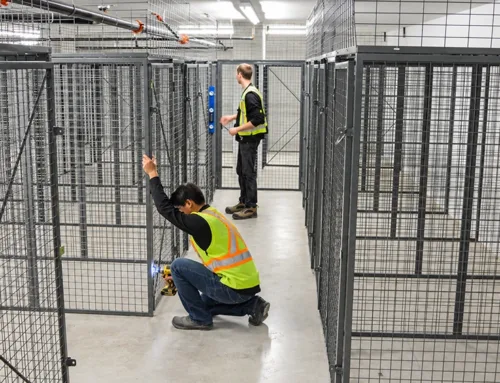
OSHA’s oxygen–fuel gas rules and NFPA 55 pull in opposite directions: cylinders and chemical containers stored so nobody reaches the valves uninvited, and a storage area with enough air movement that a leak never collects. A solid steel cabinet answers the first and blocks the second. A lockable wire mesh storage cage gives both — galvanised welded mesh panels bolted to steel posts, one hinged mesh door per bay with the lock position scribed on the door bar, and a top mesh panel where the run stops below the slab. Two people, a hand drill and a wrench, no welding in a room where nobody should be striking an arc.
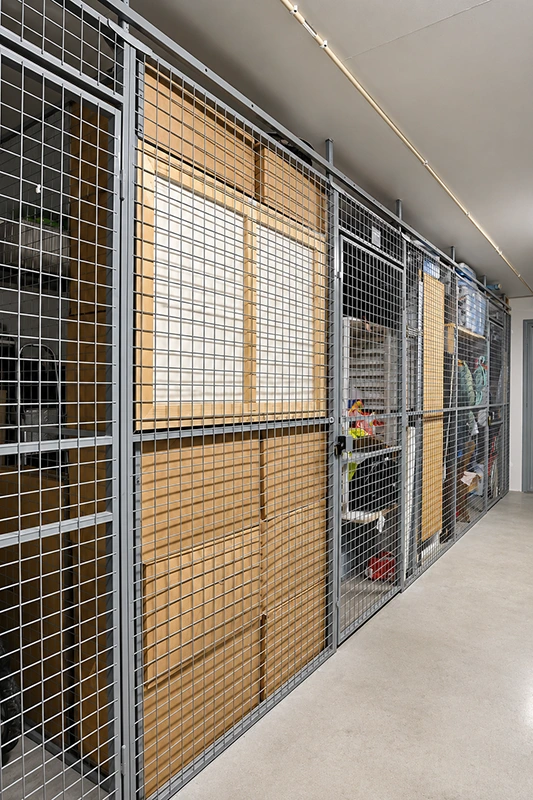
What a cylinder or chemical store has to satisfy, and what the cage actually does about it
The old answer was a solid metal locker: it locks, and it stops the air. The other old answer was open shelving: it ventilates, and it does not lock. Both leave the same gap. The table below pairs each requirement with the part of the wire mesh storage cage that carries it, using only what is confirmed about the product — panel construction, door hardware, top closure, anchoring and custom sizing.
| Requirement | How the wire mesh storage cage meets it |
|---|---|
| Valves and containers out of unauthorised reach | Each bay has its own hinged mesh door. The lock position is scribed on the door bar so the padlock bolt falls on the bar, not beside it; a padlock, a keyed lock or a reader can be specified per run. |
| Ventilation of the storage area | The panel face is aperture, not sheet. Air moves through the entire wall of the cage instead of through a louvre slot punched in a solid door. |
| No trapped gas, no trapped heat or moisture | Open welded mesh keeps the bay cross-ventilated front to back; galvanised steel welded mesh panels and posts are the material stated on the product page. |
| Sprinkler spray and lighting still reach the bay | Mesh does not intercept spray or light the way a solid steel panel does. Where the run stops below the structure, a top mesh panel closes the cage without capping the room. |
| No hot work in a gas storage area | Bolt-together assembly: mesh panels fixed to posts with 90-degree angle screws, adjacent panels drawn back to back with straight bolts and nuts, then expansion bolts driven into the slab after the run is squared. Two people, hand drill, wrench, hammer, ladder, tape — no welding, no cutting, no shutdown of the store. |
| Bays that fit the cylinders you actually hold | Heights, widened and deepened bays, base plinths, shelves and different fill and mesh options are specified per project; a single unit occupies roughly one square metre or a little more, which is what makes a run along a wall work. |
| Nothing reachable over the top | Where the cage runs to the ceiling, no top panel and no top rail are needed. Where it stops short of the slab above, a mesh ceiling panel on a top rail completes the boundary. |
Three details that decide whether a locked cage is really locked
One hinge line, one marked lock position
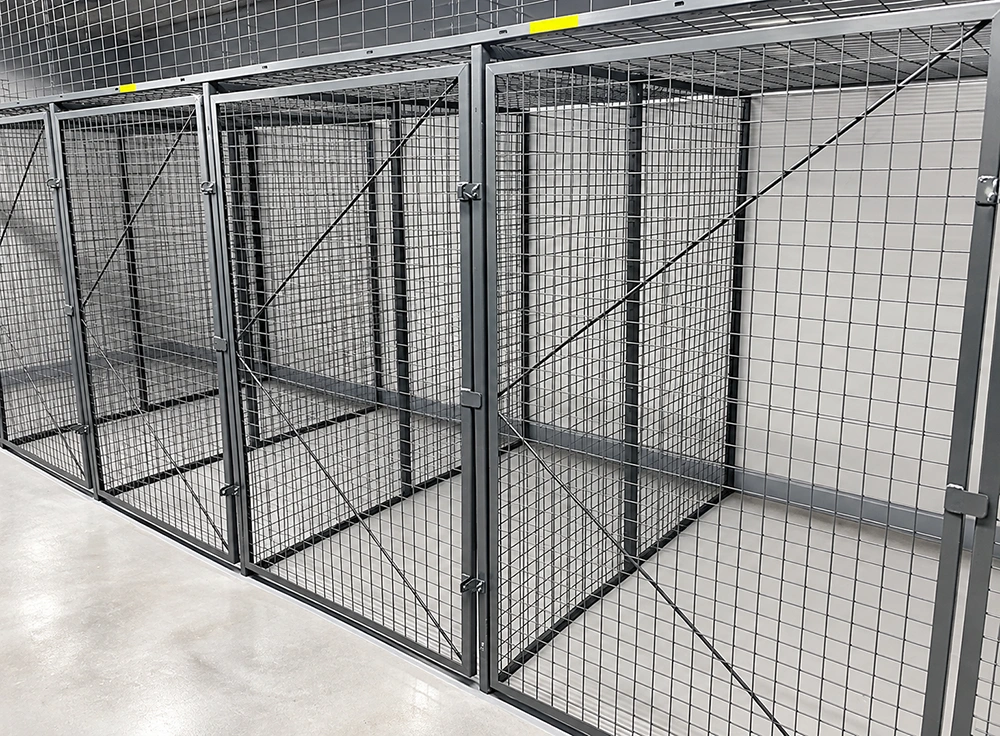
On a grey welded mesh bay, the door hangs on a long-strip hinge welded to the panel, and the hasp sits on a door frame that carries an X-shaped diagonal brace on the side panels. The bracing is not decoration: a run of bays loaded one at a time will rack, and a racked run is a door that no longer meets its bar. The lock position is marked before the handle and hasp are fixed, so the bolt lands where the door bar is — the difference between a locked store and a store that looks locked. Padlock today, keyed lock or access reader later, same door.
The top is part of the boundary, not an afterthought
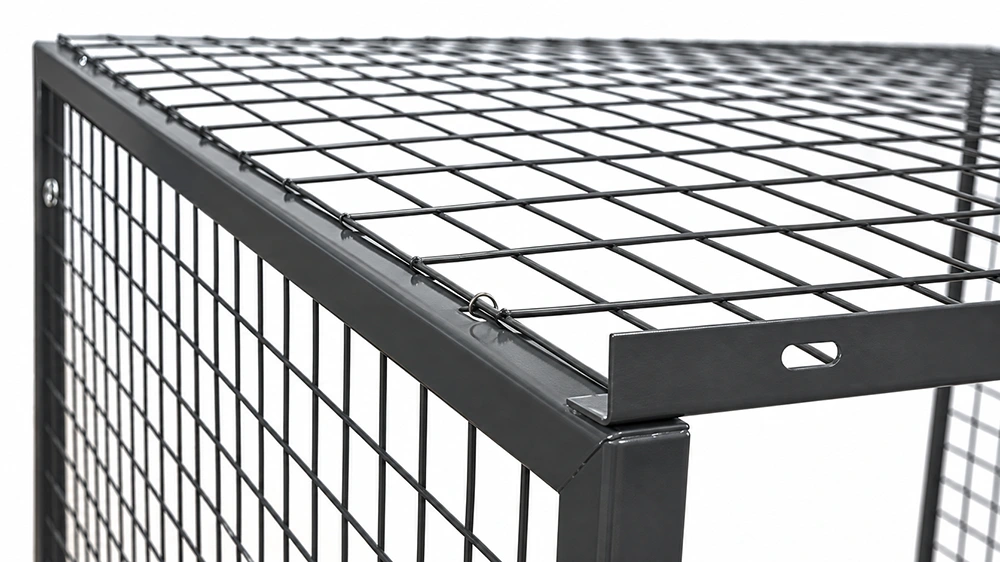
A cage that is open at the top is a lock with a hole above it, and cylinders are tall. In the top corner detail you can see the mesh panel dropped onto the formed steel frame and held with spiral fasteners through slotted holes, with visible weld points where the frame was made. The slots are what let the whole run be squared and pulled tight before the fasteners are finally seated — useful when a cylinder store has to sit parallel to a wall and still leave a walkway. The same top rail is the mounting point for the ceiling panel where the run stops below the slab.
Locked bays you can still read from the aisle
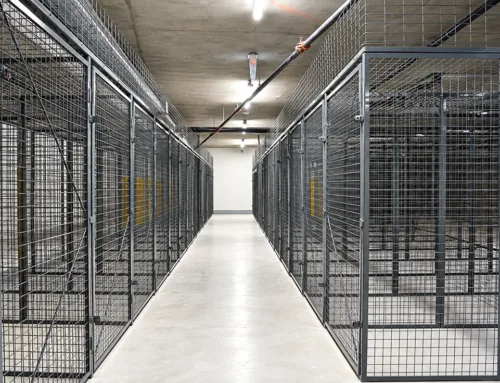
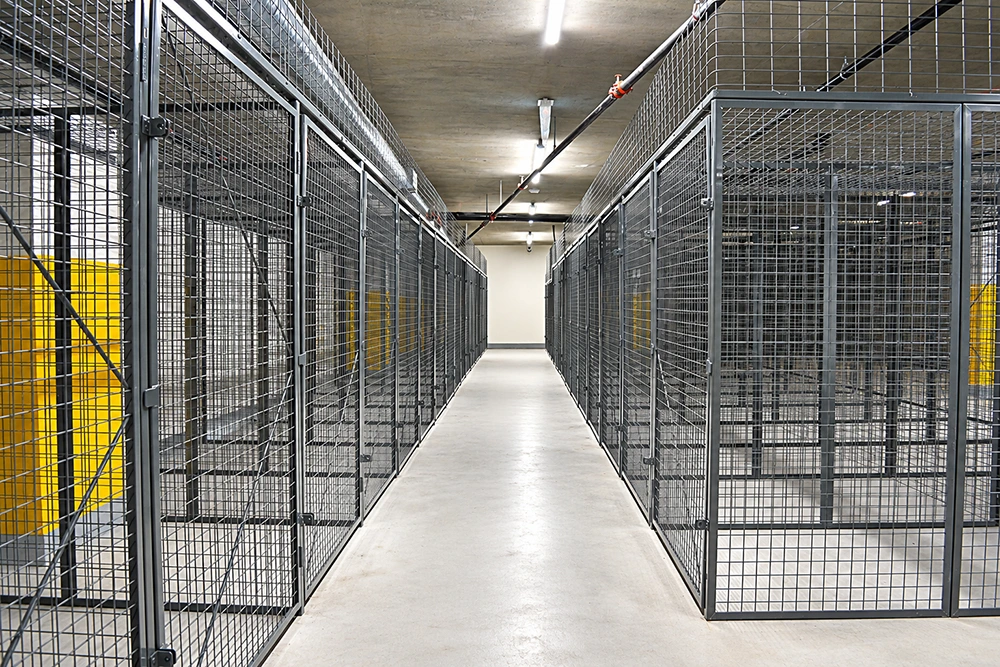
An aisle formed by lockable grid doors does something a closed cabinet cannot: it lets the daily walk-past do the work. A weeping valve, a corroded regulator, a drum that has been moved to the wrong bay, a cylinder that is no longer upright — all visible without a key and without opening a door, which matters because opening doors in a gas store is exactly the disturbance the lock is there to limit. For chemical stores the same open face means a spill or a damaged container shows up in the corridor rather than at the next audit, and the camera over the aisle records contents, not just closed panels.
Where a ventilated, lockable mesh cage earns its floor space
- Compressed gas cylinder storage rooms — oxygen, acetylene, CO₂ and shielding-gas cylinders held in bays that lock while the room keeps its air movement.
- Chemical and solvent stores — containers behind a lockable mesh door, with vapours and heat not sealed in behind a solid panel.
- Industrial tool storage cage and tool crib cage — gas equipment, regulators and torches under one issue point with one lock position per bay.
- Warehouse storage cage — hazardous goods and customer-owned stock segregated from general inventory.
- Data center security cage and server cage — a lockable boundary that does not cut the airflow the hall was designed around.
- Employee storage locker and equipment storage cage — personal and site equipment isolated bay by bay.
None of these rooms are the same shape, and none of them will stop being used the way they are drawn today. That is why the cage is specified as a run of parts rather than a fixed-size box: heights, bay widths, plinths and shelves are set per project, and a layout can be unbolted and re-laid when the cylinder count or the chemical inventory changes.
Fix these six points before the order — the cage already answers each one
State the run length and height and we set the post spacing and panel count; say whether the run reaches the slab above, and we either drop the top rail entirely or add the mesh ceiling panel; name the lock you intend to use, and the door bar is scribed for a padlock, a keyed lock or a reader before the hasp is fixed; confirm the base, and we add the plinth so cylinders and drums are not standing in wash-down water; list the bays that need shelving, and the shelf positions are set with the panels; and tell us what is stored where, because a gas bay and a solvent bay have different ventilation paths even in the same mesh wall. Send the room dimensions and we will come back with the panel schedule and the anchoring plan — no welding, no wet trades, no store closure.
Bring the layout, the cylinders and the lock — we will size the cage around them
Tell us the room, what is stored in it and who is allowed to open it. You get a bolt-together wire mesh storage cage specified bay by bay, with the lock positions marked and the ceiling handled, delivered as parts and assembled by two people.