EN
 DE
 RU
 PT
 JA
 ES
 IT
Area demarcation budgeting · corrugated & packaging plants
Cost Per Running Metre: Frameless 3D Industrial Safety Fence Budgets in a Sub-1% Margin Corrugated Plant
In a corrugated or packaging plant, paper price, energy and labour inflation hit the front of the cost line while the box price is negotiated backwards by the fast-moving-consumer-goods and e-commerce customer at the other end. Facility spend is the first line asked to give something back — including the metres of floor that have to be separated. Mefence frameless 3D industrial safety fencing is supplied factory-direct at roughly $10–32 per running metre against $105–213 for European certified-brand framing, so a fixed isolation budget encloses 3–5× the metres. Clip-fixed Q235 welded mesh panels on base plate posts, cut on site to the bay that actually exists — area demarcation, warehouse zoning and pedestrian vehicle separation, not a crash-rated barrier.
What You Actually Pay For in One Running Metre
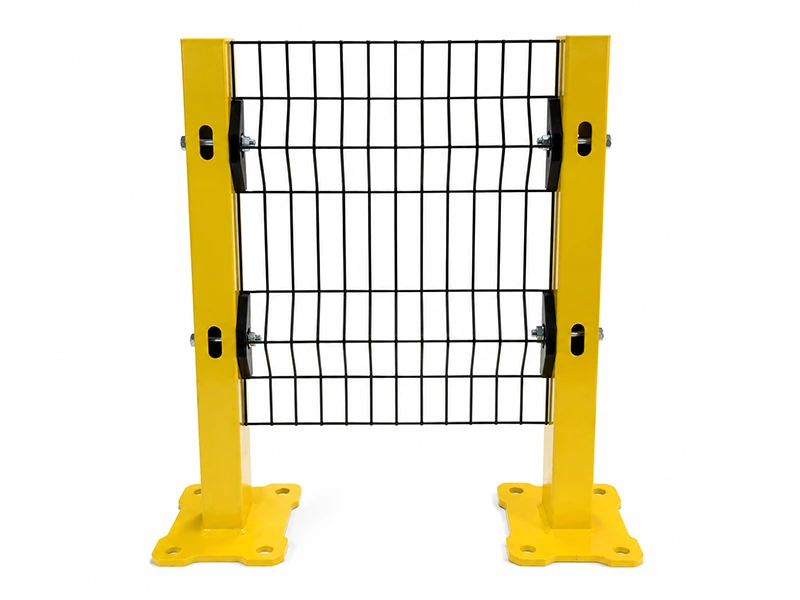
A panel price is not a running metre. What lands on the maintenance budget is panel + post + clips + fixings + the labour to close the last bay, and every one of those is a line a supplier can move. Mefence is a frameless 3D welded mesh panel: there is no separate square-tube border carrying cost without carrying load, and the T-shaped ridge pressed into the mesh is structure and cable route at once. The parameters below are the ones that decide whether a metre closes cleanly or turns into a fabricated infill.
| Parameter | Mefence frameless 3D safety fence |
|---|---|
| Material and finish | Q235 carbon steel, electrostatic powder coating (powder coated steel) |
| Wire diameter | 3 mm / 4 mm |
| Mesh opening | 20 × 100 mm / 50 × 50 mm |
| Panel width | 200 – 1400 mm, trimmed on site |
| Panel height | 200 – 3000 mm |
| Post size | 40 × 60 mm / 60 × 60 mm |
| Post-to-floor fixing | Base plate post + expansion bolt, slotted mounting holes for alignment |
| Panel-to-post connection | Plastic clip + self-tapping screw, no site welding |
| Ground clearance | 140 mm |
| Standard colour | Yellow + black; custom colours available, including orange |
Three Places the Money Leaves the Budget — and How the Structure Answers
No frame border, no welder callout
Framed fencing is welded square tube, so the shop weld, the site weld and the hot-work permit all sit inside the price — and on a live packaging floor the callout costs more than the panel does. Mefence assembles with plastic clips and self-tapping screws: one person, three steps, no welding in production or on site. Panels run 200–1400 mm wide and 200–3000 mm high, so a bay that measures something awkward gets trimmed rather than fabricated, and the offcut is not billed as a custom panel.
Base plate posts that do not ask for a slab re-pour
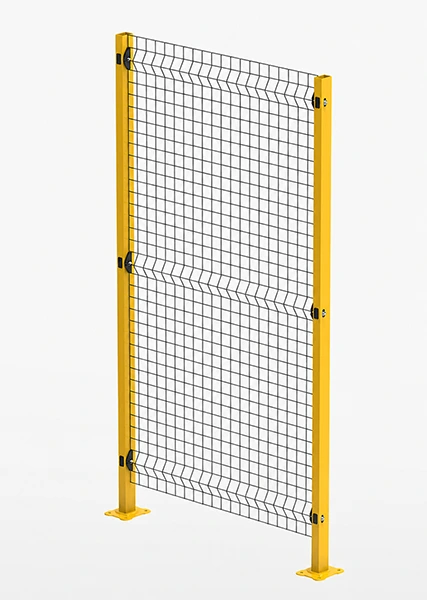
A perimeter that needs a new foundation is a construction project, not a fencing purchase. Base plate posts fix with expansion bolts through slotted mounting holes, so the 40 × 60 mm or 60 × 60 mm post finds the anchor point that exists and still lines up square. The 140 mm ground clearance keeps the mesh out of washdown water and pallet-truck traffic, and when the next order book re-draws the floor the panels unbolt from their base plates and re-deploy instead of going to scrap — a modular reconfigurable fence rather than a one-time pour.
Access points, cable and sightlines costed into the perimeter
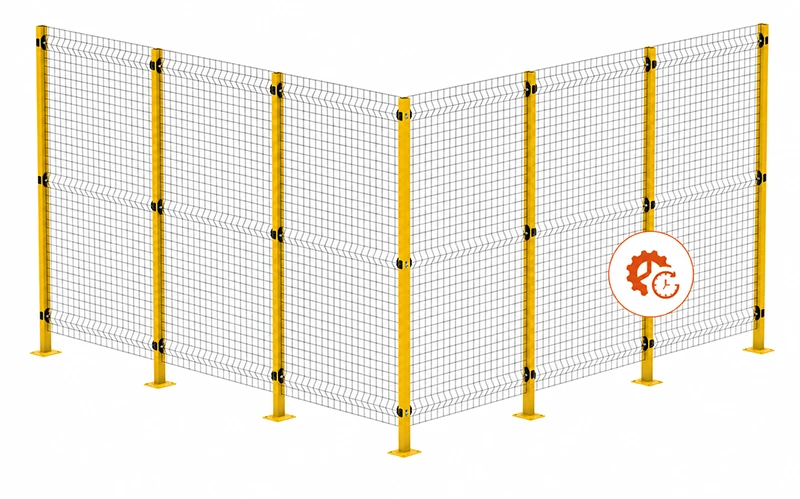
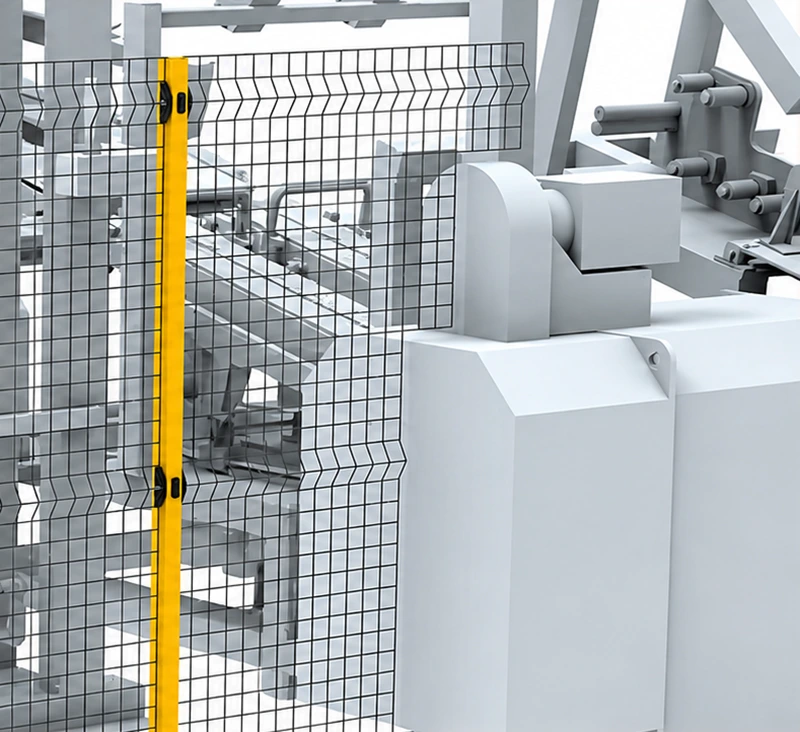
Two items always get added after the fence is quoted: a controlled access point, and a way to run camera, interlock or network cable along the line. Mefence panels take gate hardware at the panel line, and the T-shaped ridge pressed into every panel works as a cable management fence trough, so no separate conduit run is bolted to the outside. Open 3D welded mesh keeps the supervisor sightline, light and airflow that a solid warehouse partition would delete. One honest boundary: this is area demarcation and traffic control. Strike points that need certified impact containment route to the SGF Machine Fence line.
What to Check Before You Sign — and How Mefence Already Answers It
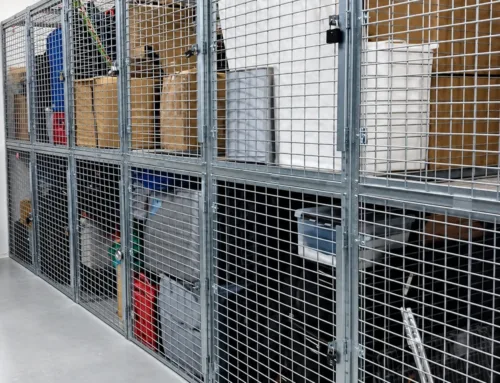
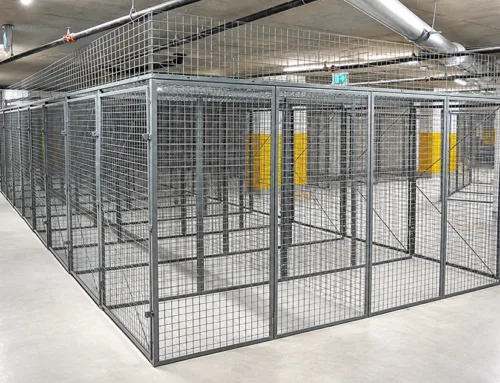
- Check the price per running metre, not per panel. Mefence runs roughly $10–32 per running metre factory-direct against $105–213 for European certified-brand framing, so the same budget encloses 3–5× the metres of warehouse zoning, storage area separation or tool crib enclosure.
- Check whether the last bay needs a custom fabricated panel. Frameless 3D welded mesh at 200–1400 mm panel width means the last bay is cut on site with the on-site cutting fence, not ordered as a special.
- Check what the fixing does to the slab. Base plate post plus expansion bolt through slotted mounting holes — no new foundation, no floor pocket to cast, no drying time in the shutdown window.
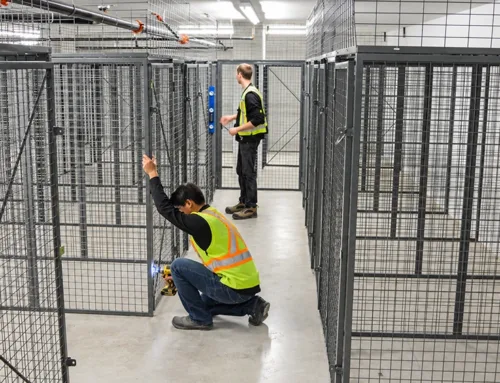
- Check whether the installer needs a welder and a hot-work permit. Plastic clip and self-tapping screw assembly lets the plant’s own maintenance crew raise a quick install safety fence inside one normal shift.
- Check how camera, interlock and data cable reach the fence line. The T-shaped ridge in every panel is the route, so the perimeter does not grow a second cable tray.
- Check whether the perimeter survives the next layout change. Clip-fixed modular panels unbolt from their base plates and go back up along the new aisle line — a forklift path barrier and AGV lane separation that moves with the flow.
Run those six checks against the two quotes in front of you, and the difference stops being a price and starts being a number of metres you can actually enclose.
Get a Per-Metre Running Schedule for Your Floor
Send the aisle widths, the bay dimensions between columns and the layout you need to separate. We return a running-metre schedule with the panel width that closes each bay, the post and base-plate list, and the clip and screw count — priced per metre, so the comparison against a framed quote becomes arithmetic rather than a feeling.
Separate the floor without spending the margin
Tell us how many metres need a boundary, and whether the need is warehouse zoning, pedestrian vehicle separation, machine guarding perimeter or a robot safety fence around automated equipment. You get the per-metre figure and the panel schedule back, sized to the bays you actually have.